Numbers 8 - Lighting Lamps/Firstborn/Cleansing Levites
Timeline: 1451 BC
(Numbers 8 :1-4,16--22, 3:11-13, 3:40-51)
|
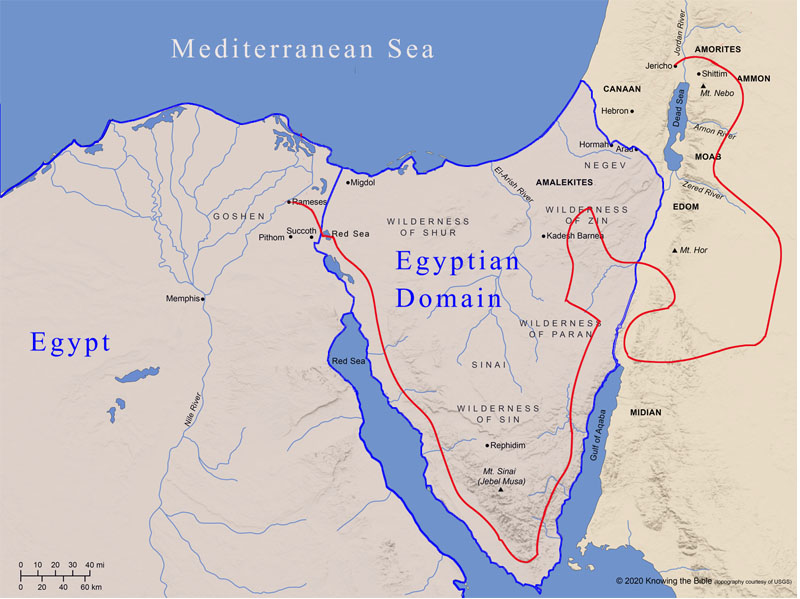
Israelite Journeys Rameses
|
After years of extensive research, a life-sized, 5-foot, 265-pound, gold-coated menorah replica was crafted by the Temple Institute which stands today in Jerusalem's old city Jewish Quarter, overlooking the Temple Mount. It was created exclusively to be used in the new Holy Temple. The menorah weighs one-half ton. It contains forty five kilograms of twenty four karat gold. Its estimated value is approximately three million dollars.More information can be found at https://templeinstitute.org/history-holy-temple-menorah/. For a comprehensive review of these subjects, refer to the links to the source material which were introduced in prior chapters. The Lampstand Numbers 8:1 Then the LORD said to Moses, "Speak to Aaron and tell him: 'When you set up the seven lamps, they are to light the area in front of the lampstand.'" Numbers 8:3 And Aaron did so; he set up the lamps facing toward the front of the lampstand, just as the LORD had commanded Moses. Numbers 8:4 This is how the lampstand was constructed: it was made of hammered gold from its base to its blossoms, fashioned according to the pattern the LORD had shown Moses. (Exodus 25:31-40 details of the golden lampstand (menorah) for the Tabernacle) Cleansing the Levites Numbers 8:5 Again the LORD spoke to Moses, saying, "Take the Levites from among the Israelites and make them ceremonially clean. This is what you must do to cleanse them: Sprinkle them with the water of purification. Have them shave their whole bodies and wash their clothes, and so purify themselves. Numbers 8:8 Then have them take a young bull with its grain offering of fine flour mixed with oil, and you are to take a second young bull for a sin offering. Bring the Levites before the Tent of Meeting and assemble the whole congregation of Israel. You are to present the Levites before the LORD and have the Israelites lay their hands upon them. Aaron is to present the Levites before the LORD as a wave offering from the sons of Israel, so that they may perform the service of the LORD. And the Levites are to lay their hands on the heads of the bulls, and offer to the LORD one as a sin offering and the other as a burnt offering, to make atonement for the Levites. Numbers 8:13 You are to have the Levites stand before Aaron and his sons and then present them before the LORD as a wave offering. In this way you shall separate the Levites from the rest of the Israelites, and the Levites will belong to Me. After you have cleansed them and presented them as a wave offering, they may come to serve at the Tent of Meeting. Numbers 8:20 So Moses, Aaron, and the whole congregation of Israel did with the Levites everything that the LORD had commanded Moses they should do. The Levites purified themselves and washed their clothes, and Aaron presented them as a wave offering before the LORD. Aaron also made atonement for them to cleanse them. After that, the Levites came to perform their service at the Tent of Meeting in the presence of Aaron and his sons. Thus they did with the Levites just as the LORD had commanded Moses. Firstborn Children and Animals Numbers 8:16 For the Levites have been wholly given to Me from among the sons of Israel. I have taken them for Myself in place of all who come first from the womb, the firstborn of all the sons of Israel. For every firstborn male in Israel is Mine, both man and beast. I set them apart for Myself on the day I struck down all the firstborn in the land of Egypt. But I have taken the Levites in place of all the firstborn among the sons of Israel. And I have given the Levites as a gift to Aaron and his sons from among the Israelites, to perform the service for the Israelites at the Tent of Meeting and to make atonement on their behalf, so that no plague will come against the Israelites when they approach the sanctuary." In ancient Israel, the firstborn child in every family was to be dedicated to God. God set apart all firstborn children of Israel as His to be used in His service. He substituted the Levite for all the firstborn of Israel to serve at the sanctuary in place of the firstborn from all the other tribes.
The firstborn children and animals, as well as the first fruits, were seen as the best and most significant possession of a man purely because of their birth order. The concept of a special status for the firstborn male child was widespread in ancient Near East cultures long before the events of Genesis. In these societies, the firstborn male was regarded as a symbol of the family's future and prosperity. The act of consecrating the "best" and "firstfruits" of the land and family serve as a constant reminder that God is the owner of all things and all blessings ultimately come from Him. He was held in high regard and often given a double portion of the family inheritance and leadership responsibilities. Tragically, however, in some cultures, this special standing made the eldest son a coveted and powerful sacrifice to the gods. The process of dedicating the firstborn involved specific rituals. For animals, the firstborn of clean animals were to be sacrificed, while unclean animals, such as donkeys, were to be redeemed with a lamb which was sacrificed in its place. Human firstborn sons were consecrated to serve in the tabernacle and perform sacred duties unless they were otherwise redeemed. This dedication was in memory of God's great deliverance and a sign to their children that God had brought them out of Egypt. God selected all the males from the tribe of Levi to work in the tabernacle, instead of the firstborn males from other tribes, as an act of redemption, giving the Levites the responsibility for maintaining His place of worship. This declaration signifies ownership and a special relationship between God and the Levites.
On the first Passover night in Egypt God set apart all the first-born of the Israelites, man and beast, to Himself. He did this when He chose the nation of Israel as His firstborn son. The Israelites were to dedicate their firstborn sons for sanctuary service and their firstborn cattle as sacrifices as a permanent reminder of their rescue from Egypt. God selected the Levites and their cattle to take the place of the firstborn of the Israelites. God bestowed this privilege on the Levites because they stood with God when the rest of the nation apostatized by worshiping the golden calf. In modern times, this custom has continued. A firstborn son who is born to a non-kohen and non-Levite mother is invited to the ceremony which is performed for a firstborn male after he turns 31 days old. In this ceremony, the father gives five silver coins or their equivalent to a kohen (a man descended from the priestly line) to redeem his son. It is a symbolic act that reminds the family that all they have ultimately belongs to God. It redeems the son from the biblical requirement that all firstborn males serve as priests in the Temple.
The count Moses performed showed a shortage of Levites, as there were 22,273 firstborn males from the other tribes compared to just 22,000 Levite men. There weren't enough Levites for a one-to-one substitution, 273 firstborn still had not been replaced. Therefore they had to be bought back, or redeemed from sanctuary service, by a payment of money to God's representatives, the priests. The general price for the redemption was established by the Mosaic law in Leviticus 27:6 for the redemption of the first-born males. Although the firstborn were replaced by Levites on a one-for-one basis, the redemption only freed them from God's claim on them for sanctuary service. All the Israelites still belonged to God.
In ancient Israel, people used pieces of silver for money, but the pieces of silver were not all the same weight. To ensure consistency and fairness, the people brought their redemption money to the priest in order to be measured against a standard piece of silver that was stored in the sanctuary. The standard was placed in one pan of the balances and the silver was placed in the other. Five shekels, or about 2.1 ounces of silver, amounted to about six months' wages for a day laborer. The redemption money was used to provide for the needs of the tabernacle and its leaders. |
| Cassie, Matt, Joe |