Numbers 5 - Cleansing the Camp
Timeline: 1451 BC
|
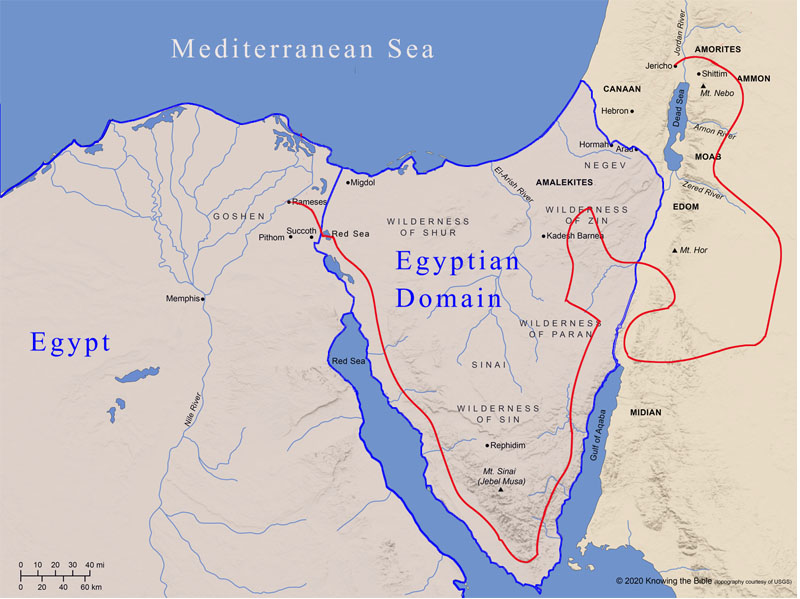
Israelite Journeys Rameses
|
Isolation of the Unclean The Hebrew title for the book of Numbers is "Bamidbar," which translates to "In the Wilderness." It describes the period where the Israelites were wandering in the desert after leaving Egypt, waiting to enter the Promised Land. It also details the establishment of laws and statutes given to Moses by God, which served as a framework for their social, religious, and national life during this time of transition. God's tabernacle was now fixed in the midst of their camp, a place for God's holy presence. Since nothing impure was allowed near Him, God gave the following laws to His people. These rules were meant to maintain holiness in the community so God could continue to live among them and bestow His blessings. The laws clearly defined what was clean and unclean, emphasizing the need to avoid defilement to remain holy in God's eyes. God taught His people the value of cleanness. Numbers 5:1 Then the LORD said to Moses, "Command the Israelites to send away from the camp anyone with a skin disease, anyone who has a bodily discharge, and anyone who is defiled by a dead body. You must send away male and female alike; send them outside the camp so they will not defile their camp, where I dwell among them." The physical separation served to protect the community's health. Where anyone has a condition that was considered contagious, there had to be an effort to separate the individuals in order to purify and protect the rest of the camp. A priest was required to perform a visual inspection to determined a person's ceremonial status, declaring them "clean" or "unclean." All those who are afflicted with contagious disorders were isolated outside the camp, under medical treatment. Exclusion was not always permanent. Once they were cleared by the priest, a ritual was performed for cleansing and atonement, after which an individual could be readmitted to the camp and community. The regulations covered both the physical well-being and spiritual condition of the community members. Touching a corpse was regarded as a form of uncleanness, likely because it could lead to infection. Death was associated with the consequences of sin, necessitating a purification process after such contact. This state of uncleanness was temporary and not a sin in itself, but it required the person to be isolated outside the camp for seven days and to undergo a cleansing ritual. Beyond their symbolic spiritual meaning, these rules also had practical advantages; dead bodies posed health risks, and the prescribed rituals of isolation, washing clothes, and bathing effectively reduced the transmission of disease within the community. Numbers 5:4 So the Israelites did this, sending such people outside the camp. They did just as the LORD had instructed Moses. Sending people outside the camp did not mean that they were left behind to perish. These individuals were still considered part of the nation. The secluded people moved with the larger Israelite community when the camp relocated, maintaining a secluded but connected status. Confession and Restitution Numbers 5:5 And the LORD said to Moses, "Tell the Israelites that when a man or woman acts unfaithfully against the LORD by committing any sin against another, that person is guilty and must confess the sin he has committed. He must make full restitution, add a fifth to its value, and give all this to the one he has wronged. The laws were harsh, and the punishments were severe. To maintain peace and order, the nation's purity had to be carefully guarded. Deceiving someone, especially by lying or denying the truth, was also considered a sin against God, who strictly commanded them to act justly. Restitution for a wrong committed against someone else involved five steps: one must acknowledge the wrongdoing and accept responsibility, confess the sin to the victim and to God; make amends by adding a fifth to the value of that which was lost; and a bring a sacrifice to the tabernacle for a trespass offering to remove sin and restore a right relationship with God. In Judaism, a person who lies while swearing a false oath and invoking God's name is serious. It is considered an abomination and a violation of the Ten Commandments. By associating a lie with God's name, the individual treats the divine name as less than holy, effectively denying God's truthfulness. Numbers 5:8 But if the man has no relative to whom restitution can be made for the wrong, the restitution belongs to the LORD and must be given to the priest along with the ram of atonement, by which the atonement is made for him. If someone wrongs another person and the wronged person is deceased with no living heir, the restitution goes to the priest to be given to the Lord. A ram is sacrificed as a trespass offering in addition to the restitution to make atonement for the sin. Numbers 5:9 Every sacred contribution the Israelites bring to the priest shall belong to him. Each man's sacred gifts are his own, but whatever he gives to the priest will belong to the priest." A contribution that a person sets aside for atonement purposes is considered holy. An Israelite's offerings (sacred gifts) remained their personal property until the moment they were officially given to the priest, underscoring personal responsibility in worship. Once the offering is consecrated, the blood is presented to God in the holy sanctuary, while the animal's flesh is designated as food for the officiating priest. It is about the legal transfer of property for priestly support. The Adultery Test The Adultery was intended as a safeguard, preventing a husband from acting rashly on suspicion alone and calling on God's direct involvement to verify the charge, while also protecting the wife from arbitrary accusation and punishment. Numbers 5:11 Then the LORD said to Moses, "Speak to the Israelites and tell them that if any man's wife goes astray and is unfaithful to him by sleeping with another man, and it is concealed from her husband and her impurity is undetected (since there is no witness against her and she was not caught in the act), and if a feeling of jealousy comes over her husband and he suspects his wife who has defiled herself—or if a feeling of jealousy comes over him and he suspects her even though she has not defiled herself— then he is to bring his wife to the priest. Adultery was regarded as a grave transgression, violating the seventh commandment. When a man and a woman were caught in the act and substantiated by the testimony of two or three witnesses, both individuals faced capital punishment, usually by stoning. If a husband is jealous and accuses his wife, who may be innocent or guilty, and has no witnesses to prove his accusation, he would take her to the priests. He must also bring for her an offering of a tenth of an ephah of barley flour. He is not to pour oil over it or put frankincense on it, because it is a grain offering for jealousy, an offering of memorial as a reminder of iniquity. No one was to approach the sanctuary empty handed so he brought a grain offering on her behalf. A regular grain offering symbolized joy and worship, serving as a reminder to the Israelites of God's actions on their behalf. It was composed of fine flour, olive oil, frankincense, and salt representing the enduring commitment of the covenant between God and Israel. A regular grain offering symbolized joy and worship, serving as a reminder to the Israelites of God's actions on their behalf. It was composed of fine flour, olive oil, frankincense, and salt representing the enduring commitment of the covenant between God and Israel. In contrast, an offering brought in a case of suspected jealousy involving a wife was made of barley, a coarser grain. This choice of grain symbolized the seriousness and humiliation associated with the alleged act. Oil and frankincense were omitted because the occasion was somber and unpleasant. God would be the judge, not the husband or the community since only he would know if she were guilty or innocent. Numbers 5:16 The priest is to bring the wife forward and have her stand before the LORD. Then he is to take some holy water in a clay jar and put some of the dust from the tabernacle floor into the water. The priest acted as a mediator between the two parties and the Lord. The holy water, presumably from the basin before the sanctuary, was poured into a clay jar which was worthless in comparison with the copper one. The dust was an allusion to that which was eaten by the serpent in Genesis as the curse of sin. Numbers 5:18 After the priest has the woman stand before the LORD, he is to let down her hair and place in her hands the grain offering of memorial, which is the grain offering for jealousy. The priest is to hold the bitter water that brings a curse. And he is to put the woman under oath and say to her, 'If no other man has slept with you and you have not gone astray and become defiled while under your husband's authority, may you be immune to this bitter water that brings a curse. But if you have gone astray while under your husband's authority and have defiled yourself and lain carnally with a man other than your husband'— and the priest shall have the woman swear under the oath of the curse—'then may the LORD make you an attested curse among your people by making your thigh shrivel and your belly swell. May this water that brings a curse enter your stomach and cause your belly to swell and your thigh to shrivel.' Then the woman is to say, 'Amen, Amen.' The woman herself stood with head uncovered, in token of her shame and potential infidelity. The priest placed the jealousy-offering in her hands while holding the water in his own hand. He then declared a solemn oath of purification before her. If the woman was innocent, she would readily agree to the terms by saying "Amen, Amen". If she were guilty, the curse would prove the accusations were valid and the result would be a physical manifestation of her guilt. Josephus believes the curse brought about dropsy, characterized by an abnormal accumulation of fluid in the body's tissues, causing swelling. Some translations interpret the punish to mean "your womb will miscarry" as a punishment for infidelity, but this interpretation is debated. Still other scholars believe it was a Thrombophlebitis, a condition in which a blood clot (thrombus) forms in a vein, causing inflammation and pain. The symptoms described in the biblical text do not align with those of Thrombophlebitis. Whatever the result, the woman would never be able to become pregnant. Numbers 5:23 And the priest shall write these curses on a scroll and wash them off into the bitter water. He is to have the woman drink the bitter water that brings a curse, and it will enter her and may cause her bitter suffering. The priest shall take from her hand the grain offering for jealousy, wave it before the LORD, and bring it to the altar. Then the priest is to take a handful of the grain offering as a memorial portion and burn it on the altar; after that he is to have the woman drink the water. The curse was written on a scroll of parchment, which the Hebrews commonly call a book. Once the ink was dry, it was scraped into the water. Similarly, the phrase "blotting out" is also used in connection with the "book of life," referring to a person who is rejected from salvation and cut off from God's people. The woman handed the grain offering to the priest, who in turn presented it to the Lord as a wave offering. The portion that was burnt on the altar was for the Lord and the rest went to the priest who performed the service. Then the woman drank the bitter water and waited for the result. Numbers 5:27 When he has made her drink the water, if she has defiled herself and been unfaithful to her husband, then the water that brings a curse will enter her and cause bitter suffering; her belly will swell, her thigh will shrivel, and she will become accursed among her people. But if the woman has not defiled herself and is clean, she will be unaffected and able to conceive children. If the woman was guilty, she would not be able to become pregnant, expressing a public awareness of her adultery. If found innocent, she would be publicly cleared of guilt restoring her honor and status within the community, unharmed by the water, and would be able to conceive children. This was considered a sign of God's favor. Numbers 5:29 This is the law of jealousy when a wife goes astray and defiles herself while under her husband's authority, or when a feeling of jealousy comes over a husband and he suspects his wife. He is to have the woman stand before the LORD, and the priest is to apply to her this entire law. The husband will be free from guilt, but the woman shall bear her iniquity." The Bible considers a man cheating on his wife a grave sin, viewing it as a violation of the marriage covenant and the seventh commandment "You shall not commit adultery". Testament law prescribed the death penalty for adultery, even for a man, and New Testament teachings emphasize the seriousness of both physical and lustful intent, stating that the marriage bed must be undefiled and that God will judge the sexually immoral. Although the man is free from guilt of jealousy, it does not give him the right to be unfaithful to his wife. The Bible indicates that God views cheating as an "abomination" and that all those who are unfaithful will face God's judgment. |