Resources
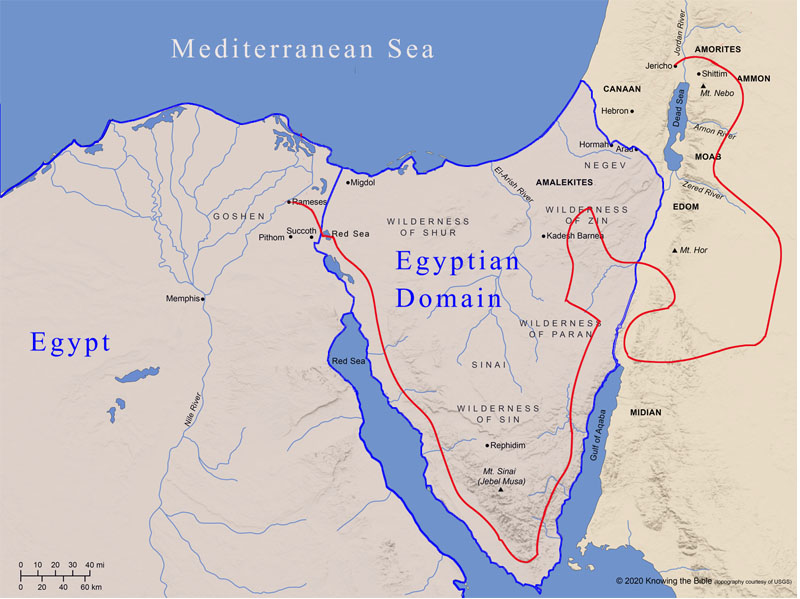
Israelite Journeys
Rameses
Succoth
Etham
Pi-hahiroth
By the Red Sea
Wilderness of Etham
Marah
Elim
By the Red Sea
Wilderness of Sin
Dophkah
Alush
Rephidim
Wilderness of Sinai
Kibroth-hattaavah
Hazeroth
Rithmah
Rimmon-perez
Libnah
Rissah
Kehelathah
Mount Shepher
Haradah
Makheloth
Tahath
Terah
Mithkah
Hashmonah
Moseroth
Bene-jaakan
Hor-haggidgad
Jotbathah
Abronah
Ezion-geber
Kadesh
Mount Hor
Zalmonah
Punon
Oboth
Iye-abarim
Dibon-gad
Almon-diblathaim
Abarim
Moab
Beth-jeshimoth
Abel-shittim
Numbering the Levites
(Numbers 3:1-4, 14-20)
The first major census was crucial for organizing the tribes for military purposes and for the distribution of land. The census documented the growth of the Israelite community, demonstrating God's faithfulness in fulfilling His promises to Abraham, Isaac, and Jacob. The Levites were not counted in the general census of Israel's fighting men because they did not serve in the army or own land. In this chapter, however, they are numbered to determine those available for service in the tabernacle. Census also served to preserve genealogical records.
The first census in the United States was taken in 1790 to determine the population of the country. The results were used to determine each state's number of seats in the House of Representatives. The final tally was 3,929,625 people. A new census is taken every 10 years, the most recent was 2020.
Numbers 3:1 This is the account of Aaron and Moses at the time the LORD spoke with Moses on Mount Sinai.
Although Moses was the leader of the Israelites and was given the instruction to build the tabernacle and served priestly functions before Aaron was instituted, he did not continue as a priest. This chapter details the families that served in the priesthood and therefore Moses' lineage was included in the general Levitical service and not in the priesthood. Only Aaron and his descendants were designated as priests to perform the sacred rituals in the Tabernacle and later the Temple. The rest of the tribe of Levi served as religious caretakers of the tabernacle. They had designated groups responsible for carrying the various components of the tabernacle, such as the sacred objects and furnishings, as the Israelites traveled.
Today, Levites and Kohanim comprise about 8% of the worldwide Jewish population. Modern genetic studies, such as the Y-chromosome testing conducted by Dr. Karl Skorecki, have indicated that the majority of modern-day Kohanim descend from a single common male ancestor, supporting the biblical tradition of a hereditary priesthood descended from Aaron. Although they no longer serve as temple officiants in the same way they did in ancient times, they still retain certain traditional honors and restrictions within the Jewish community.
Numbers 3:2 These are the names of the sons of Aaron: Nadab the firstborn, then Abihu, Eleazar, and Ithamar. These were Aaron's sons, the anointed priests, who were ordained to serve as priests.
Levi was the third born son of Jacob who had three sons, Gershon, Kohath and Merari in order of their birth. Aaron was the oldest son of Kohath. Aaron was designated as the High Priest. His four sons, Nadab, Abihu, Eleazar and Ithamar, were ordained as priests to serve alongside their father. They were set apart – or made holy – in order bring the sacrifices to God.
Numbers 3:4 Nadab and Abihu, however, died in the presence of the LORD when they offered unauthorized fire before the LORD in the Wilderness of Sinai. And since they had no sons, only Eleazar and Ithamar served as priests during the lifetime of their father Aaron.
During the incident described in Leviticus 10:1–7, Nadab and Abihu died without having children, leading to Eleazar and Ithamar taking on all the priestly responsibilities and serving during their father Aaron's lifetime. Both Eleazar and Ithamar are considered the direct male ancestors of the Kohenim (priests) who continued to serve God today.
Numbers 3:14 Then the LORD spoke to Moses in the Wilderness of Sinai, saying, "Number the Levites by their families and clans. You are to count every male a month old or more."
Unlike other tribes, who were counted from age 20 for military service, the Levites were counted from one month old, a significant milestone given high infant mortality rates. This was to emphasize their predetermined role in the religious service of the tabernacle and later in the Temple.
Numbers 3:16 So Moses numbered them according to the word of the LORD, as he had been commanded.
Numbers 3:17 These were the sons of Levi by name: Gershon, Kohath, and Merari. These were the names of the sons of Gershon by their clans: Libni and Shimei. The sons of Kohath by their clans were Amram, Izhar, Hebron, and Uzziel. And the sons of Merari by their clans were Mahli and Mushi. These were the clans of the Levites, according to their families.
Levi, the third son of Jacob and Leah, was the patriarch of the Levi tribe. His sons became the chiefs, or ancestral heads, of three groups. Gershon, father of Libni and Shimei, was Levi's oldest son and is often confused with Gershom, the firstborn of Moses and Zipporah. Kohath had four sons: Amram, Izhar, Hebron, and Uzziel. Amram married Jochebed, and they had children named Moses, Aaron, and Miriam. Merari, Levi's youngest son, had two sons, Mahli and Mushi.
The Levites set up camp around the tabernacle, creating a protective zone between it and the twelve tribes who camped beyond them. Each Levitical clan had distinct duties in the Tabernacle's service, including helping to transport the tabernacle during journeys and safeguarding it when it was stationary.
Numbers 4 provides a more specific census of Levites which lists those between 30 and 50 years of age who were actually in service. Although chapter 3 lists the clans by household and family, chapter 4 lists them according to the importance or sacredness of their service.
The Gershonites
(Numbers 3:21 - 26, 4:21-28, 38-41)
Numbers 3:21 From Gershon came the Libnite clan and the Shimeite clan; these were the Gershonite clans. The number of all the males a month old or more was 7,500.
Gershon, was the oldest son of Levi and therefore listed here first, however, the Gershonites were assigned the second position in the wilderness camp, after the Kohathites.
Numbers 4:21 And the LORD said to Moses, "Take a census of the Gershonites as well, by their families and clans, from thirty to fifty years old, counting everyone who comes to serve in the work at the Tent of Meeting.
The Gershonites listed in chapter 4 include only those men who were qualified to work at the tabernacle. The prime years of a man's life, combining physical strength with maturity and experience was often seen as the beginning of full maturity and responsibility. The qualification to serve was not merely about age but also about being ritually clean and spiritually prepared. After age fifty, Levites would transition to roles that used their experience, such as guiding and assisting younger workers.
Numbers 4:38 Then the Gershonites were numbered by their clans and families, everyone from thirty to fifty years old who came to serve in the work at the Tent of Meeting. And those numbered by their clans and families totaled 2,630. These were counted from the Gershonite clans who served at the Tent of Meeting, whom Moses and Aaron counted at the LORD's command.
Two thirds of the Gershonite men were excluded from the official count because of their age or other duties. Nevertheless, they were still integral members of their clan and contributed to the wider community. All three of the Levite clans had a variety of duties beyond the physical transport of the Tabernacle, which included serving as guards, judges, and teachers of the law.
Numbers 3:23 The Gershonite clans were to camp on the west, behind the tabernacle, and the leader of the families of the Gershonites was Eliasaph son of Lael.
In the Israelite encampment, the Gershonite families were stationed on the west side of the tabernacle, which was the rear of the sacred structure. This placed them between the tabernacle and the larger tribal camp of Ephraim. The westward direction in that region is toward the Mediterranean Sea.
Numbers 3:25 The duties of the Gershonites at the Tent of Meeting were the tabernacle and tent, its covering, the curtain for the entrance to the Tent of Meeting, the curtains of the courtyard, the curtain for the entrance to the courtyard that surrounds the tabernacle and altar, and the cords—all the service for these items.
Taking down and putting up the coverings of tapestry, goats' hair, rams' skins and sea-cow skin respectively were the responsibility of the Gershonites. In addition to these, they carried all the hangings belonging to the tabernacle and to the outer court, with the single exception of the "veil" which was between the Holy Place and the Holy of Holies. Moses gave the sons of Gershon 2 carts and 4 oxen for the transport of those materials.
Numbers 4:24 This is the service of the Gershonite clans regarding work and transport: They are to carry the curtains of the tabernacle, the Tent of Meeting with the covering of fine leather over it, the curtains for the entrance to the Tent of Meeting, the curtains of the courtyard, and the curtains for the entrance at the gate of the courtyard that surrounds the tabernacle and altar, along with their ropes and all the equipment for their service. The Gershonites will do all that needs to be done with these items.
The Tabernacle was taken down by the Levite clans in a specific order when it was time to move camp. The first task was performed by the priests (Aaron and his sons) who covered the sacred items before the Kohathites could transport these ceremonial objects. Next the Gershonites dismantled and packed the outer coverings, curtains and screens. After that, the structural components like the poles, beams and frame were packed by the Merarites.
Gershonite clans were tasked with transporting the lighter but bulky components of the tabernacle. Their significant numbers, as well as their skills in weaving and tent-making were well-suited for caring for the tabernacle's curtains, coverings, and ropes.
Numbers 4:27 All the service of the Gershonites—all their transport duties and other work—is to be done at the direction of Aaron and his sons; you are to assign to them all that they are responsible to carry. This is the service of the Gershonite clans at the Tent of Meeting, and their duties shall be under the direction of Ithamar son of Aaron the priest.
God directed Ithamar, son of Aaron to be in charge of the duties performed by both the Gershonites and the Merarites. Ithamar's oversight was critical for the orderly transportation and care of the Tabernacle's components during the Israelites' journey. This assignment highlights Ithamar's administrative and organizational skills, ensuring that the transport of the sacred structure and its furnishings was carried out correctly and efficiently.
The Kohathites
(Numbers 3:27- 32, 4:1--20, 34-37)
Numbers 3:27 From Kohath came the clans of the Amramites, the Izharites, the Hebronites, and the Uzzielites; these were the clans of the Kohathites. The number of all the males a month old or more was 8,600. They were responsible for the duties of the sanctuary.
Moses and Aaron were the children of Amram, and therefore their families were part the clan of the Kohathites, since Amram was the son of Kohath. The Kohathite clan were more numerous then the other Levite tribes. They were divided into four families from Kohath's four sons and camped near the tabernacle.
Numbers 4:34 So Moses, Aaron, and the leaders of the congregation numbered the Kohathites by their clans and families, everyone from thirty to fifty years old who came to serve in the work at the Tent of Meeting. And those numbered by their clans totaled 2,750. These were counted from the Kohathite clans, everyone who could serve at the Tent of Meeting. Moses and Aaron numbered them according to the command of the LORD through Moses.
The Aaronic priests, who were also descendants of Kohath, had distinct and higher-level responsibilities related to the sacred items. The detailed instructions for their duties were given by God to Moses and Aaron, highlighting the significance of their service in the worship of God.
Numbers 3:29 The clans of the Kohathites were to camp on the south side of the tabernacle, and the leader of the families of the Kohathites was Elizaphan son of Uzziel.
Elizaphan later assisted Moses in dividing the land into future inheritance portions for each tribe. The Kohath group camped on the south side of the tabernacle, followed by the larger military camp of the tribes of Reuben, Simeon, and Gad, with Reuben's standard leading the division.
Numbers 3:31 Their duties were the ark, the table, the lampstand, the altars, the articles of the sanctuary used with them, and the curtain—all the service for these items.
The Kohathites were in charge of the holy things required for the service performed in connection to worship and sacrifice. Every piece of furniture, from the most important to the smallest utensil, had a holy purpose and is was significant.
Numbers 4:1 Then the LORD said to Moses and Aaron, "Take a census of the Kohathites among the Levites by their clans and families, men from thirty to fifty years old—everyone who is qualified to serve in the work at the Tent of Meeting. This service of the Kohathites at the Tent of Meeting regards the most holy things. Whenever the camp sets out, Aaron and his sons are to go in, take down the veil of the curtain, and cover the ark of the Testimony with it. They are to place over this a covering of fine leather, spread a solid blue cloth over it, and insert its poles.
After the tabernacle was set up, Moses anointed the ark of the Testimony and only Aaron, the high priest, was authorized to touch the Ark of the Testimony, and then only once a year for the Day of Atonement. Aaron and his sons alone were permitted inside the sanctuary to handle and cover the holy articles before the Kohathites transported them.
When the Israelite camp prepared to move, the veil separating the Holy Place from the Holy of Holies was spread around the Ark of the Covenant. Over this, a waterproof covering of fine leather (sometimes translated as badger skins or sea cow skins) protected the sacred ark from the elements as the Israelites traveled. A vivid, sapphire-like blue cloth, produced from a rare dye, was placed on top symbolizing God's presence and authority during the journey, as well as a warning to prevent unauthorized people from touching or even looking at the sacred object. While most sacred objects in the tabernacle were wrapped in a similar fashion, the Ark was the only one that had a visible layer of blue cloth on top.
The poles were never to be taken out of the ark according to Exodus 25:15. The word "insert" used in verse 6 can also mean to "place" or "secure," implying they were adjusting the poles for transport rather than taking them out completely.
Numbers 4:7 Over the table of the Presence they are to spread a blue cloth and place the plates and cups on it, along with the bowls and pitchers for the drink offering. The regular bread offering is to remain on it. And they shall spread a scarlet cloth over them, cover them with fine leather, and insert the poles.
The loaves of showbread that represented the twelve tribes symbolized God's continuous provision for the twelve tribes of Israel. They were to remain on the table until it was replaced every Sabbath.
The Bible does not give any explicit details as to where they got the flour for the showbread in the tabernacle. Based on historical context and a cultural understanding of food at that time, two possibilities have been suggested.
One option is that the Israelites brought grain with them from Egypt, and as they traveled through the wilderness, their grain stores began to run low. That would explain why God needed to provide the people with manna, and would also make the showbread, made from the limited supply of grain, a costly and rare item, just like the rest of the tabernacle.
The other option is that the showbread was made with ingredients from the manna. Numbers 11 says that the Israelites were already using manna to make cakes that tasted like, "cakes baked with oil". If this were the case, the showbread would be a continued reminder of the nation's complete dependency on God to provide both their physical needs and their spiritual needs.
The showbread table has three layers of covering like the ark. A blue cloth was placed over the bread and then the plates, dishes, and bowls which were used for the meat and drink offerings were set on top. The next covering was scarlet cloth that represented royalty, human glory, and atonement. The fine leather cover provided protection from the wind, rain and sun.
It seems a different style pole was used for the showbread table than the ones used for transporting the ark. It was a flexible bar carried by two men with the implements tied to the bar.
Numbers 4:9 They are to take a blue cloth and cover the lampstand used for light, together with its lamps, wick trimmers, and trays, as well as the jars of oil with which to supply it. Then they shall wrap it and all its utensils inside a covering of fine leather and put it on the carrying frame.
The golden lampstand, along with its accessories, was crafted from approximately 75 pounds of pure gold and was unique in how it was carried. Unlike other furnishings that used rings and poles, it was carried on a single bar after being covered with a blue cloth and leather. This was possible because its design, hammered from a single talent of gold, did not include rings and poles.
Numbers 4:11 Over the gold altar they are to spread a blue cloth, cover it with fine leather, and insert the poles. They are to take all the utensils for serving in the sanctuary, place them in a blue cloth, cover them with fine leather, and put them on the carrying frame.
When the Tabernacle was moved, the priests (specifically Aaron and his sons) were the ones who covered the altar of incense before the Kohathites carried it. All the holy things must be covered, the ark and table with three coverings, all the rest with two.
Numbers 4:13 Then they shall remove the ashes from the bronze altar, spread a purple cloth over it, and place on it all the vessels used to serve there: the firepans, meat forks, shovels, and sprinkling bowls—all the equipment of the altar. They are to spread over it a covering of fine leather and insert the poles.
The brazen altar had a purple cloth draped over it, as a symbolic gesture of reverence. Even though the altar was in public view in the sanctuary's court, it was still covered with a purple cloth and fine leather during transport. While the ashes were cleared from the bronze altar, the sacred fire, which come from heaven, was never extinguished. Therefore, it must have been moved to a pan or brazier hidden beneath the covering.
The preparation of the laver for transportation in the Tabernacle is not explicitly detailed in the biblical text. However, the Septuagint, the Greek translation of the Hebrew Bible, adds the following:
Numbers 4:14a (Septuagint version) And they shall take a purple cloth and cover the laver and its foot, and they shall put it into a blue cover of skin, and put it on bars.
The bronze laver itself was a large, heavy fixture that sat on a base. The Bible does not specify who carried the laver specifically, but it was still under the responsibility of the Levites.
Numbers 4:15 When Aaron and his sons have finished covering the holy objects and all their equipment, as soon as the camp is ready to move, the Kohathites shall come and do the carrying. But they must not touch the holy objects, or they will die. These are the transportation duties of the Kohathites regarding the Tent of Meeting.
A pillar of cloud and fire directed the Israelites in the wilderness. They were to remain in camp as long as the cloud stayed, even when it lingered over the tabernacle for many days. Whenever the cloud lifted, the Israelites had to break camp and move to a new location. It took only a few hours for Aaron and his sons to pack up the tabernacle, following the reverse order of its assembly. Once all the components were secured, the sons of Kohath would come in, take the staves and begin to carry them. The entire process was done at the Lord's command.
Numbers 3:32 The chief of the leaders of the Levites was Eleazar son of Aaron the priest; he oversaw those responsible for the duties of the sanctuary.
Eleazar, now the eldest son of Aaron and the heir to the high priest's office, was assigned the responsibility as overseer of the Kohathites.
Numbers 4:16 Eleazar son of Aaron the priest shall oversee the oil for the light, the fragrant incense, the daily grain offering, and the anointing oil. He has oversight of the entire tabernacle and everything in it, including the holy objects and their utensils."
Eleazar must take care that nothing was forgotten, left behind, or displaced. Some commentaries indicate that he himself was to carry the instruments used in worship and sacrifices, and not to commit them to the sons of Kohath. Others state that they were carried by the Kohathites.
Numbers 4:17 Then the LORD said to Moses and Aaron, "Do not allow the Kohathite tribal clans to be cut off from among the Levites. In order that they may live and not die when they come near the most holy things, do this for them: Aaron and his sons are to go in and assign each man his task and what he is to carry. But the Kohathites are not to go in and look at the holy objects, even for a moment, or they will die."
Unlike the Gershonites and the Merarites who were allowed to transport the items under their care on carts, with oxen, etc; the Kohathites had the responsibility to carry by shoulders the most precious objects, all of them with proper staves. King David carried the Ark of the Covenant on a cart which was against the rules listed here which resulted in the death of a man named Uzzah. They could not touch the actual articles which is why God made poles for them to be carried with so the article would not be touched by human hands. The small loose metal objects were carried on common stretchers. Every article was prepared by the priests before the Kohathites were allowed into the sanctuary.
The probable number of persons needed for this task was:
The ark—4 persons
The table of offerings—2 persons
The incense table—2 persons
The candlestick, plates, silverware—2 persons
The altar—8 persons
The utensils for the altar—2 persons
The basin and other utensils—4 persons
for a total of 24 people.
The Merarites
(Numbers 3:33-38, 4:29-33, 46-49)
Numbers 3:33 From Merari came the clans of the Mahlites and Mushites; these were the Merarite clans. The number of all the males a month old or more was 6,200.
Merari was the youngest son of Levi. The Merarite's work, though often behind the scenes, was essential to the worship and religious life of Israel, ensuring that the sacred spaces were maintained according to divine instructions.
Numbers 3:35 The leader of the families of the Merarites was Zuriel son of Abihail; they were to camp on the north side of the tabernacle.
The Merarites clan were positioned in the north side between the tabernacle and the tribes of Dan, Asher, and Naphtali.
Numbers 4:29 As for the sons of Merari, you are to number them by their clans and families, from thirty to fifty years old, counting everyone who comes to serve in the work of the Tent of Meeting.
The Levites served as both guardians and carriers, responsible for protecting the holy objects of the Tabernacle during transport. In a notable instance, their military zeal was directed toward defending God's honor, solidifying their status as "warrior priests" and setting them apart for this special purpose.
Numbers 4:42 And the Merarites were numbered by their clans and families, everyone from thirty to fifty years old who came to serve in the work at the Tent of Meeting. The men registered by their clans numbered 3,200. These were counted from the Merarite clans, whom Moses and Aaron numbered at the LORD's command through Moses.
More than half of the Merarites were eligible men for service. Though they were the smallest clan among the Levites, they had the most eligible men among them set apart for religious duties and service to the tabernacle.
Numbers 4:31 This is the duty for all their service at the Tent of Meeting: to carry the frames of the tabernacle with its crossbars, posts, and bases, and the posts of the surrounding courtyard with their bases, tent pegs, and ropes, including all their equipment and everything related to their use. You shall assign by name the items that they are responsible to carry.
Each Levite was assigned specific items to carry, clearly defining each person's responsibility to prevent confusion or errors during the moving of the tabernacle. It was important and necessary, that an inventory was kept of every single structural element of the tabernacle — not only on account of their number and variety, but of their comparative commonness and smallness, which might have led to their being lost or missing through carelessness, mishandling, or neglect. The tasks assigned to the Merarites were physically demanding because of all the precious metals used. The weight of the tabernacle was some 19,000 pounds because of all the precious metals used in its construction. They were responsible for transporting the parts that formed the Tabernacle's framework.
Numbers 3:36 The duties assigned to the sons of Merari were the tabernacle's frames, crossbars, posts, bases, and all its equipment—all the service for these items, as well as the posts of the surrounding courtyard with their bases, tent pegs, and ropes.
The Merarites were divinely appointed to handle the demanding and meticulous tasks associated with the Tabernacle. Their responsibilities included taking down, transporting, and setting up the sacred structure, in addition to supporting various religious ceremonies and offerings.
Their service encompassed not only the logistics of moving the Tabernacle and courtyard frames but also ongoing maintenance to ensure all components remained in optimal condition. To facilitate the movement of the heaviest and bulkiest materials—specifically the boards, pillars, and sockets—the Merarites were provided with a practical transport solution: four carts and eight oxen.
Numbers 4:33 This is the service of the Merarite clans according to all their work at the Tent of Meeting, under the direction of Ithamar son of Aaron the priest."
The Gershonites and Merarites were superintended by Ithamar, Aaron's younger son, who had already had the oversight of the tabernacle in its construction. He had been responsible for all the timber and metal parts belonging to the tabernacle framework and the fence that surrounded the court.
Numbers 4:46 So Moses, Aaron, and the leaders of Israel numbered by their clans and families all the Levites from thirty to fifty years old who came to do the work of serving and carrying the Tent of Meeting. And the number of men was 8,580. At the LORD's command through Moses they were numbered, and each one was assigned his work and burden, as the LORD had commanded Moses.
The Bible records 29 separate journeys that the Israelites made during their 40 years in the wilderness. They moved the tabernacle every time the pillar of cloud moved. This suggests that it was dismantled, moved, and re-erected at least that many times. The process was highly organized in an orderly fashion so that when it was performed, it took only a few hours.
Moses and Aaron
(Numbers 3:38-43)
Numbers 3:38 Moses, Aaron, and Aaron's sons were to camp to the east of the tabernacle, toward the sunrise, before the Tent of Meeting. They were to perform the duties of the sanctuary as a service on behalf of the Israelites; but any outsider who approached the sanctuary was to be put to death.
Moses and Aaron's camp was the entrance side. It was the post of honor, and consequently reserved to Moses and the priestly family. However, the sons of Moses were not mentioned. While Gershom and Eliezer were part of the Levitical line they did not become priests. They were counted with the Kohathites. Both sons died sometime during the 40 years the Israelites' wandering. Gershom and Eliezer's lineage are mentioned in other scriptures where his descendants are noted for significant roles such as treasurers of the storehouses of the house of God and temple administration.
The tabernacle was the sacred space where God's presence was with the Israelites, and access was strictly limited. Only Moses, Aaron, and his sons were allowed to approach and serve there, while anyone else from the tribes of Israel, or any non-Levite, would face death if they came near the sanctuary.
Numbers 3:39 The total number of Levites that Moses and Aaron counted by their clans at the LORD's command, including all the males a month old or more, was 22,000.
Moses then numbered all the first-born male Levites from one month old by their clans. The Meraris totaled 6200 (Numbers 3:22), Gershonites totaled 7500 (Numbers 3:34), and the Kohathites totaled 8600 (Numbers 3:28). When adding the numbers, they total 223,000. This census records 22,000, a difference of 300.
Commentators offer different explanations for the discrepancy:
A minority view is that a copying error occurred in the original manuscript, and numbers for the Kohathites should have been different, 8300 rather than 8600. Some copies of the ancient Greek version have "8300." The Hebrew copies have "8600."
Some theories suggest that the 22,000 is a rounded number and that the text is not intended to be mathematically exact.
The argument is weakened by the fact that the number of firstborn sons was an exact 22,273, not an approximation. In addition, Numbers 3:46 records a specific excess of 273 firstborn males over the Levites, confirming that the figures were not rounded.
In some Jewish traditions, a father's firstborn son, whose mother had given birth to sisters before him, does not need to be redeemed.
This interpretation comes from the verses that state the at the firstborn of every womb, human or animal, belongs to the Lord and must be redeemed through a redemption price. For the animal, it means that if you wanted to save an animal from sacrifice, one must substitute another in it place. For a human, it means that the first born son must serve in the sanctuary or be ransomed by a payment to the priesthood.
Exodus 13:1-2 states, "Then the LORD said to Moses, "Consecrate to Me every firstborn male. The firstborn from every womb among the Israelites belongs to Me, both of man and beast."
Some scholars suggest that the 300 firstborn Levites were counted separately because they were already sanctified to God after the Exodus from Egypt on Passover night. He claimed all firstborn males of Israel as His own because He had "spared" them during the Passover when the firstborn of Egypt were killed.
In Exodus 13:1, God told Moses to consecrate the first offspring of every womb among the Israelites male to Himself. And in verse 13, God says they must redeem every firstborn among their sons when He brought them out of Egypt. Of those firstborn males who were still alive during the census could very well have numbered 300.
Numbers 3:40 Then the LORD said to Moses, "Number every firstborn male of the Israelites a month old or more, and list their names. You are to take the Levites for Me—I am the LORD—in place of all the firstborn of Israel, and the livestock of the Levites in place of all the firstborn of the livestock of the Israelites."
On the first Passover night in Egypt God set apart all the first-born of the Israelites, man and beast, to Himself. He did this when He chose the nation of Israel as His firstborn son. The Israelites were to dedicate their firstborn sons for sanctuary service and their firstborn cattle as sacrifices as a permanent reminder of their rescue from Egypt. God selected the Levites and their cattle to take the place of the firstborn of the Israelites. God bestowed this privilege on the Levites because they stood with God when the rest of the nation apostatized by worshiping the golden calf.
In modern times, this custom has continued. A firstborn son who is born to a non-kohen and non-Levite mother is invited to the ceremony which is performed for a firstborn male after he turns 31 days old. In this ceremony, the father gives five silver coins or their equivalent to a kohen (a man descended from the priestly line) to redeem his son. It is a symbolic act that reminds the family that all they have ultimately belongs to God. It redeems the son from the biblical requirement that all firstborn males serve as priests in the Temple.
Numbers 3:42 So Moses numbered all the firstborn of the Israelites, as the LORD had commanded him. The total number of the firstborn males a month old or more, listed by name, was 22,273.
The 22,273 firstborn sons were probably those who were born in the thirteen months since their departure from Egypt, excluding the Levites. This census shows that the tribe of Levi is smaller in number than all the firstborn children of Israel.