Numbers 2 - Instructions for Setting Up Israel's Camp
Timeline: 1451 BC
|
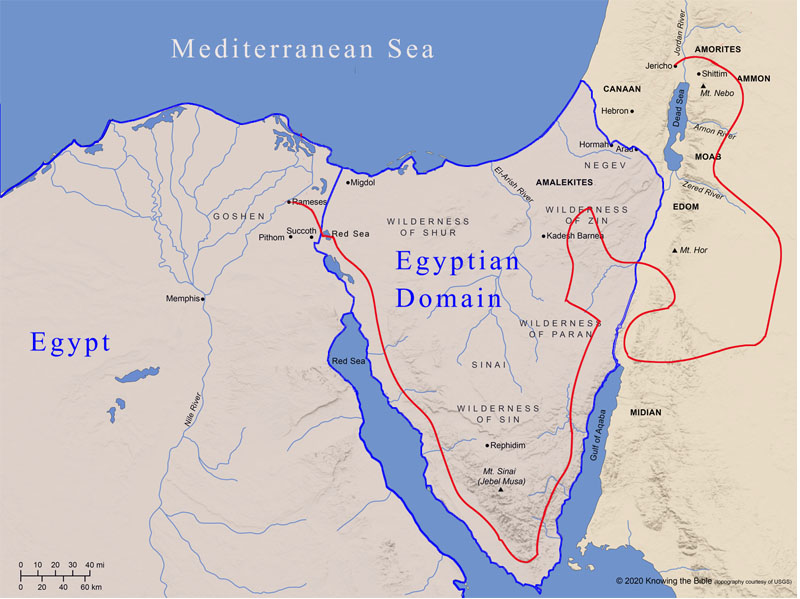
Israelite Journeys Rameses
|
Once the census was taken, God assigned the Israelites positions around the tabernacle. The people camp by "regiments," each group facing the tabernacle in the center of the encampment. The Levites were situated in the space immediately surrounding the tabernacle, also called the "Tent of Meeting", forming an inner, defensive perimeter around God's dwelling place in the center of the Israelite camp. Moses, Aaron, and his sons were camped on the east near the entrance. The three families of the Levites were also stationed around the Tabernacle: the Kohathites on the south, the Gershonites on the west, and the Merarites on the north. The rest of the tribes were to camp at a safe distance to remind the people of God's holiness. Numbers 2:1 Then the LORD said to Moses and Aaron: "The Israelites are to camp around the Tent of Meeting at a distance from it, each man under his standard, with the banners of his family. For us, north is the prime direction because the compass points that way. On the other hand, the Egyptians based their directions facing the source of the Nile, and west was "the right." Ancient maps were universally oriented to the east, the location of the rising sun. North was called "left," and west was sometimes called "back" or "seaward." The twelve tribes were grouped into four camps consisting of three tribes each. Beginning with Judah the description goes clockwise with the Tabernacle in the center. The tribes of Judah, Issachar and Zebulun were stationed to the east, the tribes of Reuben, Gad and Simeon to the south, the tribes of Ephraim, Benjamin and Manasseh it to the west, and the tribes of Dan, Asher and Naphtali to the north. A standard, which denotes a flag or a banner identified the various tribes of Israel. The flag of the lead tribe was carried at the head of each division. 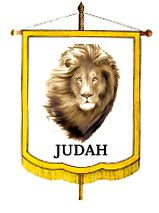 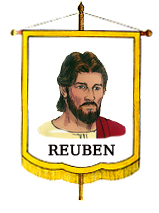 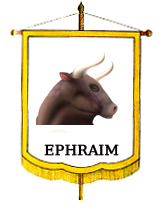  While the Old Testament doesn't specify the imagery on the four banners, it's generally understood that these "four standards" symbolized the main forms of life within God's creation. The images on the cherubim, as described in Isaiah, Ezekiel and Revelation, are believed to reveal the imagery of these four primary banners. Since ancient times, these symbols were associated with the four authors of the gospels. A winged man, or angel, came to represent Matthew, because his book opens with the human ancestors of Jesus. A winged lion stands for Mark because he emphasizes the royal dignity of Christ, and opens his book with John the Baptist roaring like a lion in the wilderness. Luke is suggested by the ox, a sacrificial animal, begins with the priest Zechariah and emphasizes Jesus's sacrificial work and priestly role, as oxen were common sacrificial animals. And a winged eagle, the creature that dwells closest to heaven, symbolizes John, because of his visions and the heavenly opening of his Gospel. Numbers 2:3 On the east side, toward the sunrise, the divisions of Judah are to camp under their standard: The tribes of Judah, Issachar, and Zebulun are to Camp towards the east, symbolizing the dawn of a new day and a fresh beginning. When the camp of Israel moved, these tribes were the first to set out. When Jacob blessed his sons, he compared Judah to a lion. His position foreshadows its future importance in the lineage of King David and ultimately Jesus Christ. The Southern Kingdom was known as the Kingdom of Judah. The leader of the Judahites is Nahshon son of Amminadab, and his division numbers 74,600. Amminadab was the father of Nahshon and Elisheba who was married to Aaron, the brother of Moses. Nahshon was the father of Salmon, who was an ancestor of King David, and is mentioned in the lineage of Jesus thus fulfilling the promise of God to bring forth the Messiah from the tribe of Judah. Judah was the fourth son of Jacob and Leah. Numbers 2:5 The tribe of Issachar will camp next to it. The leader of the Issacharites is Nethanel son of Zuar, and his division numbers 54,400. Issachar was the fifth of the six sons of Jacob and Leah. His name is associated with a jawboned donkey. The men of that tribe were strong and industrious. The territory of Issachar in the land of Israel became known as a place of Torah because of their ability "to interpret the signs of the times." They were instrumental in calculating the Jewish calendar. Numbers 2:7 Next will be the tribe of Zebulun. The leader of the Zebulunites is Eliab son of Helon, and his division numbers 57,400. In the Song of Deborah (Judges 5:18), Zebulun is praised for risking their lives in battle. In addition to being the leader of the Zebulun tribe, Eliab was noted for participating in the dedication of the altar (Numbers 7:24-29). Eliab's role in presenting the offerings on behalf of his tribe, symbolized their collective worship and dedication to God. Zebulun was the fourth son of Jacob and Leah. Numbers 2:9 The total number of men in the divisions of the camp of Judah is 186,400; they shall set out first. When the Israelites began to travel from one location to another, Judah lead the nation. The total number of the tribes of Judah, Issachar and Zebulun were given the responsibility to lead the march, symbolizing leadership and initiative. Numbers 2:10 On the south side, the divisions of Reuben are to camp under their standard: The tribe's lineage began with Reuben, the firstborn son of Jacob and Leah. To the south after them, were the camps of Simeon and Gad,, in the direction of warmth and abundance, signifying prosperity and growth. When the camp of Israel moved, these tribes were to set out second. The leader of the Reubenites is Elizur son of Shedeur, and his division numbers 46,500. The name Elizur translates to "God is my rock," symbolizing a solid basis in belief. He is listed among the leaders selected to aid Moses in counting and organizing the tribes of Israel. Elizur's duties involved assisting Moses and Aaron with management and leadership functions, especially during the counting of Israelite men qualified for military duty. Numbers 2:12 The tribe of Simeon will camp next to it. The leader of the Simeonites is Shelumiel son of Zurishaddai, and his division numbers 59,300. Simeon was the second son born to Jacob and Leah. The Tribe of Simeon, known for their warrior spirit and strength, was one of the strongest tribes during the desert wanderings, with a fearsome reputation. People were referred to as "sons" of their father in the Bible, primarily to show a connection to a prominent lineage or inheritance. It was also a practical way to identify people and differentiate them from others with the same first name. Numbers 2:14 Next will be the tribe of Gad. The leader of the Gadites is Eliasaph son of Deuel, and his division numbers 45,650. Jacob's seventh son was born to Zilpah, Leah's maidservant. The Gadites were famous for their military skills and valor, capable with shields, spears, and bows. The men of Gad were also described as wise, diligent, and possessing a strong ability to care for and protect others. Jacob prophesied that Gad would be a "troop" but would triumph in the end. Numbers 2:16 The total number of men in the divisions of the camp of Reuben is 151,450; they shall set out second. The specific number indicates the precision and care with which the Israelites were organized. The order of march is significant, whether in camp or on the march, that each tribe could be instantly located. This structured order ensured discipline and unity under God's command. Numbers 2:17 In the middle of the camps, the Tent of Meeting is to travel with the camp of the Levites. They are to set out in the order they encamped, each in his own place under his standard. There was a time when towns and cities were built with the church building on a hill in the center of town with a high steeple. The Tabernacle's placement in the heart of the Israelite camp underscored the importance of God's holiness. Even when traveling, the tabernacle was the middle part of the procession. The Levites, were chosen to take care of the tabernacle. Each Levite tribe's position held profound significance, resonating with their unique roles and responsibilities. When the camp of Israel moved, the tribes to the east set out first, then the south. After that, the Levites followed behind them with the Tabernacle. The tribes on the west were next and finally the tribes on the north. Numbers 2:18 On the west side, the divisions of Ephraim are to camp under their standard: Ephraim, born to Joseph in Egypt, was formally adopted by his grandfather Jacob, elevating him to the status of full tribal patriarchs within the Twelve Tribes of Israel. The leader of the Ephraimites is Elishama son of Ammihud, and his division numbers 40,500. Although the tribe of Ephraim became one of the largest and most prominent tribes of Israel, their division was the smallest of all the camps. They were situated closest to the tabernacle. Placing Ephraim to the west where the sun sets was associated with God's protection and blessings. Prophets and other biblical texts often used the name "Ephraim" to refer to the entire Northern Kingdom of Israel. Numbers 22:20 The tribe of Manasseh will be next to it. The leader of the Manassites is Gamaliel son of Pedahzur, and his division numbers 32,200. Jacob gave Ephraim a greater blessing than his older brother, Manasseh. Therefore, his division was chosen to camp under the "standard" of Ephraim. Gamaliel, a name meaning "God is my reward," was the leader of the tribe. Numbers 2:22 Next will be the tribe of Benjamin. The leader of the Benjamites is Abidan son of Gideoni, and his division numbers 35,400. Benjamin was the twelfth and youngest son of Jacob. The tribe of Benjamin played a crucial role in the history of ancient Israel. The first king of Israel, Saul, the prophet Jeremiah, and the apostle Paul all descended from this tribe. Benjamin's territory included Jerusalem, capital of Israel located between the northern and southern kingdoms. Numbers 2:24 The total number of men in the divisions of the camp of Ephraim is 108,100; they shall set out third. Ephraim, Manasseh and Benjamin were all descendants of Jacob and Rachel. It was from the tribe of Ephraim that Joshua, the leader who succeeded Moses, led the Israelites into the Promised Land. Numbers 2:25 On the north side, the divisions of Dan are to camp under their standard: The Tribe of Dan refers to the descendants of Dan, the fifth son of Jacob and his concubine Bilhah. The tribes of Dan, Asher and Naphtali in the North, are often associated with cold and hardship symbolizing the trials and tribulations of life. These tribes were are reminded of the challenges they must overcome to grow. When the camp of Israel moved, these tribes were to bring up the rear of the procession. The leader of the Danites is Ahiezer son of Ammishaddai, and his division numbers 62,700. The tribes of Dan, Asher and Naphtali, one of the larger tribes, would be the last to break camp and move during a march, acting as the rear guard. In ancient Jewish tradition, the north was considered a direction of challenge and difficulty. Numbers 2:27 The tribe of Asher will camp next to it. The leader of the Asherites is Pagiel son of Ocran, and his division numbers 41,500. Asher is the eighth son of Jacob and Zilpah, the handmaid of Leah. Jacob blessed Asher, foretelling that his land would be prosperous and his foot would be "dipped in oil". His tribe settled in the western and coastal area of Galilee, particularly known for it's olive oil. Anna the Prophetess, the woman who prophesied about Jesus at the Temple of Jerusalem, was a descendant of the tribe of Asher. Numbers 2:29 Next will be the tribe of Naphtali. The leader of the Naphtalites is Ahira son of Enan, and his division numbers 53,400. Naphtali was the sixth son of Jacob, the second of his two sons with Bilhah. The tribe's warriors were known for their swiftness in battle and won many victories against the enemies of Israel before the Assyrian invasion. The tribe's territory was in the northern part of the Holy Land, bordering the Sea of Galilee. The land of Naphtali was a significant setting for Jesus' miracles and parables, fulfilling prophecies of "light" to the people living in darkness in that region. Numbers 2:31 The total number of men in the camp of Dan is 157,600; they shall set out last, under their standards." The Tribe of Dan is best known for being the tribe that produced Samson, the judge who was a Nazirite and drew power from never cutting his hair. The tribe was associated with law and order as well as seafaring and cunning. Numbers 2:32 These are the Israelites, numbered according to their families. The total of those counted in the camps, by their divisions, was 603,550. But the Levites were not counted among the other Israelites, as the LORD had commanded Moses. As the Israelites journeyed from Egypt to the Promised Land, God had given Moses specific instructions for how the camp should be arranged. The square formation offered a powerful defense against enemy forces. The repeated listing of each tribe's leader and position serves to highlight the unity and collective strength of the Israelites. In summary, the tabernacle was set center of the camp with it's entrance facing toward the east. Moses and Aaron camped by the opening.  Numbers 2:34 So the Israelites did everything the LORD commanded Moses; they camped under their standards in this way and set out in the same way, each man with his clan and his family. The use of "LORD" in all capital letters signifies the translation of the Tetragrammaton, YHWH, the covenant name of God, emphasizing His eternal and unchanging nature. Prior to the Exodus, the Israelites were a loose confederation of tribes, each descended from the biblical patriarch Jacob. God brought them out of slavery in Egypt and organized them into a functioning nation, establishing tribal banners, and creating a structure for governing the people and managing their journey. Perhaps when the Israelites were directed to set up their camps they could not see the big picture. However if they were able to look at the camp from a bird's-eye view, they would get a glimpse into the future. 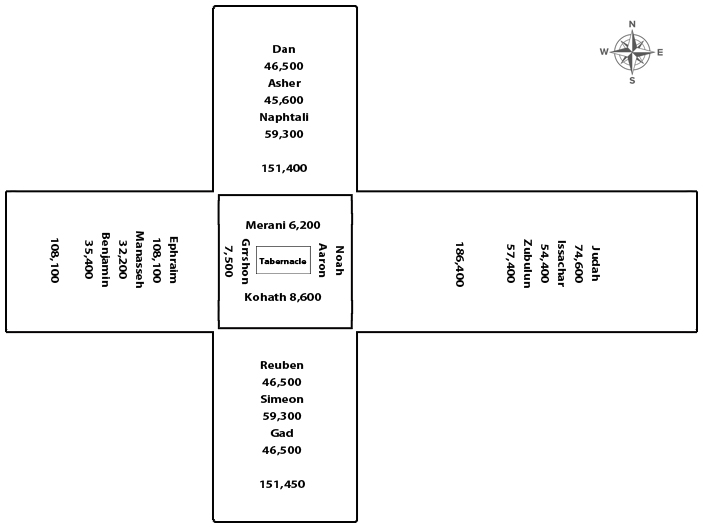 |
| Cassie, Matt |