Numbers 19 - The Red Heifer/Purification of the Unclean
Timeline: 1426 BC
(Numbers 19:1-22)
|
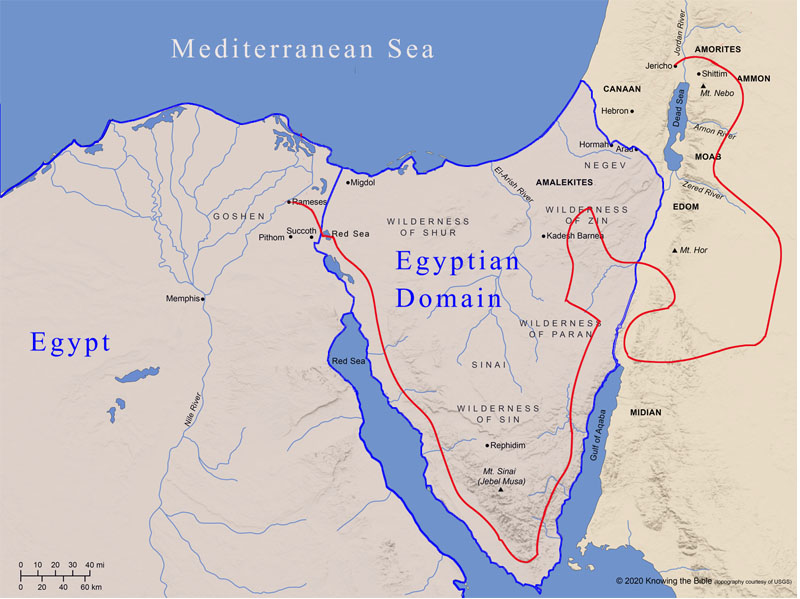
Israelite Journeys Rameses
|
The Red Heifer The entire adult population will die in the wilderness due to their lack of faith and complaining. To deal with such, God gave a law to purify the ones who had to bury their dead. This purification procedure is for someone who has touched a dead body. Numbers 19:1 Then the LORD said to Moses and Aaron, "This is the statute of the law that the LORD has commanded: Instruct the Israelites to bring you an unblemished red heifer that has no defect and has never been placed under a yoke. Give it to Eleazar the priest, and he will have it brought outside the camp and slaughtered in his presence. God gave specific instructions for ceremonial purification in ancient Israel. The Mosaic Law specified that the red heifer, a female cow between 2-3 years old, had to maintain a uniform reddish hue without defect or blemish. This is the only case in which the color of the victim is specified. Even two hairs of a different color, such as black or white, would disqualify the animal. Judaism later added many other standards and extra criteria. The actual slaying of animals and the burning of fat usually took place on the bronze altar located inside the camp. However, the red heifer ceremony was uniquely designed to purify those who had become defiled by contact with death. Just as the red heifer and sin offerings were sacrificed "outside the camp," Jesus was crucified outside the gates of Jerusalem to take on the sins of the world. The Israelites were given specific methods and moral guidelines for slaughtering animals, which focus on reverence for life, draining the blood and minimizing animal suffering. According to ancient Jewish rabbinic text, the red heifer was slain by Eleazar the day after the tabernacle was erected, on the second day of the first month after Israel's coming out of Egypt. Eleazar was properly trained and for this procedure. The slaughter is performed using a surgically sharp, perfectly smooth blade made of precious material so they could maintain a hyper-clean edge during repeated use. It was inspected before and after use to ensure it had no nicks, which could cause pain. The animal's throat is severed with a single, uninterrupted stroke, cutting the trachea, esophagus, carotid arteries, and jugular veins. As the animal quickly loses consciousness from the swift loss of blood, it endures very little pain. If the process was not done properly, it was not acceptable to God. According to Jewish tradition, only nine red heifers were sacrificed in history, and the ashes of the tenth will be used in the messianic era. Because of this, certain Orthodox Jewish groups view the discovery and preparation of a flawless red heifer as a vital, missing prerequisite for rebuilding the Third Temple in Jerusalem. Indeed, the Temple Institute, an organization in Israel focusing on establishing the Third Temple, has been working with ranchers and breeders in Texas, importing and raising potential candidates. In 1997 and then again in 2002 they identified two possible red heifer candidates. Although both were initially thought to be kosher, they were later found to be unsuitable. Numbers 19:4 Eleazar the priest is to take some of its blood on his finger and sprinkle it seven times toward the front of the Tent of Meeting. Then the heifer must be burned in his sight. Its hide, its flesh, and its blood are to be burned, along with its dung. The priest is to take cedar wood, hyssop, and scarlet wool and throw them onto the burning heifer. Sin and death had no proper place within the city of God. Therefore the bodies of those animals which were offered for the sin of the congregation were always burnt outside the camp. Eleazar could not come near the tabernacle, because it was reputed an unclean and accursed thing, so it was sufficient for him to face the front of the tabernacle. He took the blood in his left hand, and sprinkled it with the finger of his right hand. The carcass was wholly consumed without being either flayed, or cleaned, or divided, or laid out in order. Cedar is physically prized for its durability, resistance to decay, and pleasant aroma. In Jewish tradition, it symbolizes spiritual vitality, endurance, and the triumph of life over death. The hyssop in the fire emphasized the restoration of life and holiness over decay and uncleanness. The scarlet wool symbolized the shedding of blood and the ultimate cost of sacrificial atonement. In biblical tradition, the number seven denotes spiritual perfection, completeness, and finality, signifying that the purification from ritual defilement is absolute and thorough. These were rolled or bound up together and made one bundle that might the more easily be cast into the fire. Because the ashes of the red heifer were extraordinarily potent—only a tiny pinch was put into a vessel of pure spring water to create the water of purification. The ashes of the first heifer was carefully preserved and lasted more than a thousand years. Then when the second heifer was burned in the time of Ezra, the ashes were added to the ashes from the first one. Seven more red heifers were prepared by high priests and sages during the era of the Second Temple and the ashes from the original heifer were mixed into the succeeding eight. In this way, there were always elements of the very first red heifer integrated into the subsequent batches used for ritual purification. It is believed that those ashes have been preserved and are in a cistern on the Mount of Olives. Numbers 19:7 Then the priest must wash his clothes and bathe his body in water; after that he may enter the camp, but he will be ceremonially unclean until evening. The one who burned the heifer must also wash his clothes and bathe his body in water, and he too will be ceremonially unclean until evening. This verse indicates that Eleazar officiated and performed the ritual but was not the one who burnt the heifer although he and every one who took part in the sacrificial act was rendered unclean. They were to bathe in forty sheaths of water so that they were completely immersed. The garments that bore the dust and odor of the red heifer sacrifice had to be thoroughly cleansed in order to return to a state of holiness. Once their clothes and flesh were washed, they were allowed to reenter the camp but were barred from entering the tabernacle, participating in religious festivals, or eating fellowship offerings. The individual was restored to a clean status the next day which began at sundown. Numbers 19:9 Then a man who is ceremonially clean is to gather up the ashes of the heifer and store them in a ceremonially clean place outside the camp. They must be kept by the congregation of Israel for preparing the water of purification; this is for purification from sin. The man who has gathered up the ashes of the heifer must also wash his clothes, and he will be ceremonially unclean until evening. This is a permanent statute for the Israelites and for the foreigner residing among them. While the ashes were regarded in relation to their appointment as the means of purification, they were to be treated as clean. Not only were they to be collected together by a clean man; but they were to be kept for use in a clean place, just as the ashes of the sacrifices that were taken away from the altar were to be carried to a clean place outside the camp. In the Hebrew Bible, the phrase "permanent statute" (or "lasting ordinance") emphasizes the enduring nature of specific commandments. While the translation varies, the original Hebrew words chukkath 'olam denote a law designed to be observed continuously across all generations. Foreigners who chose to live with the Israelites were obligated to follow their laws and practices. Purification of the Unclean The red heifer was burned to create a purifying agent rather than being offered on the altar to atone for sin. The ashes were uniquely required to perform a purification ritual needed for anyone who had become "ritually unclean" after coming into contact with a dead body. Numbers 19:11 Whoever touches any dead body will be unclean for seven days. He must purify himself with the water on the third day and on the seventh day; then he will be clean. But if he does not purify himself on the third and seventh days, he will not be clean. Anyone who touches a human corpse and fails to purify himself defiles the tabernacle of the LORD. That person must be cut off from Israel. He remains unclean, because the water of purification has not been sprinkled on him, and his uncleanness is still on him. While the ancient Hebrews observed this ritual for spiritual purification and ceremonial cleanliness, these ingredients provided notable practical health benefits against the biological risks of handling the deceased. The burning of the heifer, cedar wood, and hyssop produces an alkaline, potassium-rich ash. When combined with water, this forms a crude potassium carbonate (lye). This lye contains natural antibacterial, antifungal, and antiseptic properties, offering ancient populations an effective way to sanitize skin and reduce the spread of disease following exposure to biological hazards. Theologically, the third day is frequently associated with rising above hardship, new beginnings, and resurrection. The seventh day signifies the transition from death and uncleanness to renewed life and holiness. Practically, the required days were designed to allow for an observation period to ensure the threat of contamination, sickness, or decomposition had passed. Waiting for the seventh day ensures an incubation cycle or time for contagion to resolve. The penalty for failing to undergo this ritual cleansing was severe because it brought an unclean state into the community where the Tabernacle—the dwelling place of God—resided. Being "cut off from Israel" meant excommunication from the religious and social life of the community. Numbers 19:14 This is the law when a person dies in a tent: Everyone who enters the tent and everyone already in the tent will be unclean for seven days, and any open container without a lid fastened on it is unclean. Special instructions concerning the defilement were given. If a man died in a tent, every one who entered it, or who was there at the time, became unclean for seven days. So also did every vessel that was not covered with a linen or a woolen cloth, wrapped and fastened by a string, to prevent the smell of the corpse from penetrating it. Numbers 19:16 Anyone in the open field who touches someone who has been killed by the sword or has died of natural causes, or anyone who touches a human bone or a grave, will be unclean for seven days. This would apply especially, it would seem, to the field of battle. Anyone who touched one that was slain, either by the sword or other means; and even one touched the sword with which he was slain, was unclean for seven days. Numbers 19:17 For the purification of the unclean person, take some of the ashes of the burnt sin offering, put them in a jar, and pour fresh water over them. Then a man who is ceremonially clean is to take some hyssop, dip it in the water, and sprinkle the tent, all the furnishings, and the people who were there. He is also to sprinkle the one who touched a bone, a grave, or a person who has died or been slain. An ordained priest was not required for a standard personal purification ritual bath. Individuals generally immersed themselves independently to cleanse ritual impurities. Then a ceremonially clean person was responsible for taking the hyssop and sprinkling the water of purification over anyone (or anything) that had touched a dead body. By this act the uncleanness was removed. Numbers 19:19 The man who is ceremonially clean is to sprinkle the unclean person on the third day and on the seventh day. After he purifies the unclean person on the seventh day, the one being cleansed must wash his clothes and bathe in water, and that evening he will be clean. But if a person who is unclean does not purify himself, he will be cut off from the assembly, because he has defiled the sanctuary of the LORD. The water of purification has not been sprinkled on him; he is unclean. Numbers 19:21 This is a permanent statute for the people: The one who sprinkles the water of purification must wash his clothes, and whoever touches the water of purification will be unclean until evening. Anything the unclean person touches will become unclean, and anyone who touches it will be unclean until evening." Portions of Scripture aren't repeated by accident. Repetition and iteration reinforces learning. The Old Testament was an oral record long before it was ever written down. Repetition is a memory aid for oral recitation. Repetition can also be a literary device that is meant to emphasize things that were critically important to the Israelites' understanding of God's law. |