Numbers 18 - Offerings/Priestly Duties/Retirement
Timeline: 1426 BC
(Numbers 18:1-32, 3:5-13, 40-51, 8:16-19, 23-26)
|
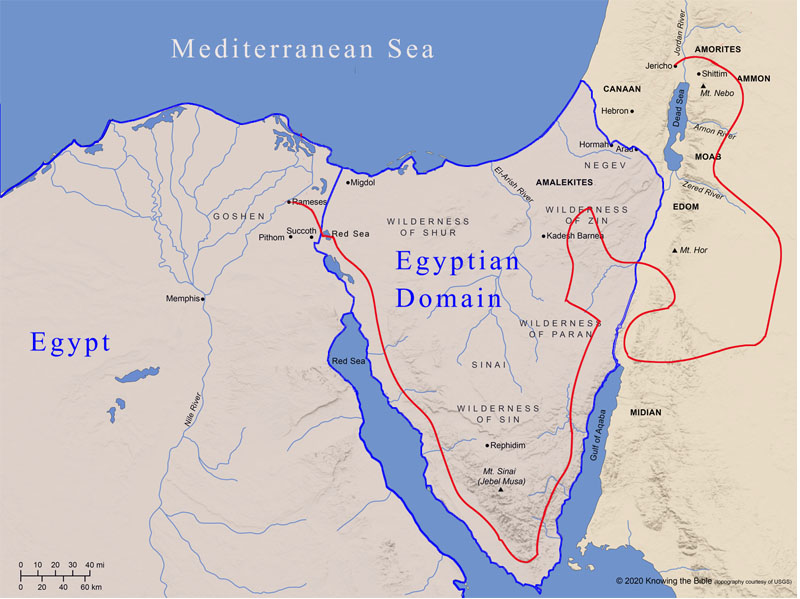
Israelite Journeys Rameses
|
Duties of the Levites/Offerings Numbers 18:1 So the LORD said to Aaron, "You and your sons and your father's house must bear the iniquity involving the sanctuary. And you and your sons alone must bear the iniquity involving your priesthood. But bring with you also your brothers from the tribe of Levi, the tribe of your father, that they may join you and assist you and your sons before the Tent of the Testimony. And they shall attend to your duties and to all the duties of the Tent; but they must not come near to the furnishings of the sanctuary or the altar, or both they and you will die. They are to join you and attend to the duties of the Tent of Meeting, doing all the work at the Tent; but no outsider may come near you. Moses has now been commanded by God to give some of his duties over to his brother Aaron and his sons. Chapters 3-4 detail the families that served in the priesthood and therefore Moses' lineage was included in the general Levitical service and not in the priesthood. Although Moses was the leader of the Israelites and was given the instruction to build the tabernacle and served priestly functions before Aaron was instituted, he did not continue as a priest. From this point forward, Moses will not be allowed to offer sacrifice or enter into the holy place or the "Holy of Holies". Only Aaron and his descendants were designated as priests to perform the sacred rituals in the Tabernacle and later the Temple. The rest of the tribe of Levi served as religious caretakers of the tabernacle. They had designated groups responsible for carrying the various components of the tabernacle, such as the sacred objects and furnishings, as the Israelites traveled. Aaron and his sons were chosen by God to serve as Israel's initial priests, a role that brought significant power, authority, and, consequently, considerable responsibility and accountability. God designated the entire tribe of Levi to perform priestly duties and support the needs of Aaron and his lineage of priests. The Levites were set apart for service to God, a concept rooted in the aftermath of the golden calf incident, where the tribe of Levi stood with Moses. The duties of the priests were great, so to assist them, the rest of the tribe of Levites were called to support the work of Aaron and his sons. Moses played an important part in building the tabernacle, relaying the laws to the people and following God's instructions.
Since Aaron and his sons performed the ceremonial exercises of the worship itself, God designated the other Levites to minister to the priests. They were tasked with performing various duties within the Tabernacle, including tending to the sacred objects and assisting with sacrifices to make atonement for the Israelites, manage the tabernacle's upkeep, transport its holy articles. They served as mediators to ensure that no plague strikes the Israelites when they approach the sanctuary, standing guard to prevent anyone from improperly approaching the sacred space.
The tabernacle was a sacred, consecrated space representing God's divine presence among the Israelite people. Any common Israelite could enter the outer court to bring sacrifices. Access to the inner sanctuary was forbidden to all but the priests. Even they could enter the innermost chamber only once per year. While the strict regulations for approaching the sanctuary protected God's holiness, they also protected the Israelites from the destructive consequences of their own sin in the presence of God's perfect holiness. Guards from the Levite tribe were posted around the perimeter and were authorized to put to death anyone who came too close. Numbers 18:5 And you shall attend to the duties of the sanctuary and the duties of the altar, that there may be no more wrath on the children of Israel. Behold, I Myself have taken your brethren the Levites from among the children of Israel; they are a gift to you, given by the Lord, to do the work of the tabernacle of meeting. Therefore you and your sons with you shall attend to your priesthood for everything at the altar and behind the veil; and you shall serve. I give your priesthood to you as a gift for service, but the outsider who comes near shall be put to death." In addition to serving the needs of the tabernacle, the tribe of Levi were tasked with guarding the tabernacle, which involved guarding its furnishings, camp, and the area around it. Their role was to protect the sacred space from unauthorized approach and to ensure the tabernacle was properly maintained and transported. Their duty also served to shield the rest of the Israelite community from the tabernacle's holiness and facing a penalty of death.When the male Levites reached the age of 25, they began training as an apprentice which included lighter tasks like opening doors, singing sanctuary songs, and familiarizing themselves with sacred rituals. This allowed them to learn the laws and proper procedures before beginning active, specialized work. When they turned 30, they began full service duties, particularly carrying the sacred items of the tabernacle. Then at age 50, they were to stop their regular, physically demanding duties to serve in other capacities, such as assisting with guard duties in the tent of meeting. Offerings for Priests and Levites Numbers 18:8 Then the LORD said to Aaron, "Behold, I have put you in charge of My offerings. As for all the sacred offerings of the Israelites, I have given them to you and your sons as a portion and a permanent statute. A portion of the most holy offerings reserved from the fire will be yours. From all the offerings they render to Me as most holy offerings, whether grain offerings or sin offerings or guilt offerings, that part belongs to you and your sons. You are to eat it as a most holy offering, and every male may eat it. You shall regard it as holy. As the appointed high priest, Aaron held divine authority, yet he was also directly accountable to God. While the priesthood was restricted to Aaron and his descendants, the entire tribe of Levi was called to assist them, supported by the community. Together, the Levite priests were charged with maintaining the tabernacle and conducting sacrifices. The types of sacrifices included grain offerings, sin offerings, and guilt offerings brought by the people. While burnt offerings were wholly consumed, grain offerings were part-burned as a memorial, and sin/guilt offerings involved burning the fat. The portion that remained was consecrated or set apart for the priests. This special provision ensured their sustenance, allowing them to focus on their sacred duties without concern for material needs. There is a distinction between the "most holy gifts" that were given only for the priests themselves. These were to be consumed in the court of the tabernacle, emphasizing the sanctity and reverence required in handling what is dedicated to God. The "holy gifts," which were offerings that were more accessible, were often allowed to be consumed or used by the Levites or sometimes the worshipers themselves. The holy gifts included sacrifices that were made to God for sacred use and was not to be used for common or profane tasks. Numbers 18:11 And this is yours as well: the offering of their gifts, along with all the wave offerings of the Israelites. I have given this to you and your sons and daughters as a permanent statute. Every ceremonially clean person in your household may eat it. I give you all the freshest olive oil and all the finest new wine and grain that the Israelites give to the LORD as their firstfruits. The firstfruits of everything in their land that they bring to the LORD will belong to you. Every ceremonially clean person in your household may eat them. The wave offerings were brought to God as part of the peace offering, for a Nazirite consecration offering and for thanksgiving. In the wave offering, the breast (and often the right thigh) of the peace offering animal was presented to God. Other offerings included the first and best portion of grain before the full harvest, the best of the oil, and the new wine, was a required offering, which were presented as part of their worship and devotion. The ceremony involved moving the choice portions toward the altar and back to symbolize presenting them to God and receiving them back. The fat portion was burnt on the altar to make atonement for unintentional transgressions, leading to forgiveness. The food that was not put to fire was then given over the priests and their families as well as those who brought the offering, as long as they were 'clean', spiritual or ceremonial (i.e. not suffering from skin diseases, bodily discharges or contact with the dead). Numbers 18:14 Every devoted thing in Israel belongs to you. The firstborn of every womb, whether man or beast, that is offered to the LORD belongs to you. But you must surely redeem every firstborn son and every firstborn male of unclean animals. You are to pay the redemption price for a month-old male according to your valuation: five shekels of silver, according to the sanctuary shekel, which is twenty gerahs. When man, animal, or property is set apart or committed to God, it is given to the Levitical priests. This command applies specifically to the nation of Israel, demonstrating their total dedication to God. As a remembrance of God sparing the Israelite firstborn in Egypt, the firstborn of every womb is consecrated to God. While firstborn males of clean animals, cattle, sheep and goats, were offered as sacrifices, firstborn sons and unclean animals were redeemed (transferred ownership from one to another through payment of a price or an equivalent substitute). Initially, firstborn sons served a priestly role, but God later replaced them with the tribe of Levi for service in the tent of meeting. When the firstborn was a month old, the Israelite was required to bring their son to the tabernacle and pay a redemption price, to symbolically buy back the child, typically five shekels of silver. The redemption money then belongs to the priest. The shekel was the common unit of weight, not a coin, which was used throughout Canaan and Mesopotamia. It apparently varied somewhat in weight according to the place and time. It has been suggested there were three kinds of shekels in use in Israel. The sanctuary shekel equaled approximately 11.4 grams of an ounce of gold used for temple taxes, vows, and sacred offerings. The royal shekel weighed about 11.33–11.5 grams, a standard set by the monarchy and the standard shekel weighed about 10–11 grams which often varied by merchant for buying or selling. Even firstborn of unclean male animals, such as donkeys, were considered sacred and set apart for the Lord. Because the priests could not use the animal as a sacrifice, it must be redeemed. The owner was allowed to buy it back by paying the price set by the priest plus one-fifth (20%) of its value. Alternatively, they could substitute a lamb or a young goat which was sacrificed in its place. If the owner did not sufficiently value him to give a lamb instead, then the neck was broken and the animal destroyed. According to Leo of Modena, a prominent Italian rabbi, scholar, poet, and teacher in Venice, redemption of the firstborn is one of the rites which are still practiced among the Jews. Modena explains the ritual as follows:
Numbers 18:17 But you must not redeem the firstborn of an ox, a sheep, or a goat; they are holy. You are to splatter their blood on the altar and burn their fat as a food offering, a pleasing aroma to the LORD. And their meat belongs to you, just as the breast and right thigh of the wave offering belong to you. The firstborn male of cattle, sheep, and goats that were unblemished were given to the priests to be sacrificed as a peace offering. The priest could eat all the meat from the sacrifice of the firstborn animals except for the fat. If they had a blemish, such as lameness, blindness, or a defect, they were not to be sacrificed. Instead, they could be eaten by the owner within their own towns, without the ceremonial restrictions of the altar, and could be eaten by both the ritually clean and unclean. Numbers 18:19 All the holy offerings that the Israelites present to the LORD I give to you and to your sons and daughters as a permanent statute. It is a permanent covenant of salt before the LORD for you and your offspring." The promise and provision are not only for Aaron and his immediate family but also for his descendants. The covenant of salt signifies an enduring and binding agreement and was included in all of the offerings. It emphasizes that God's commitments are unbreakable, guaranteeing that His promises will stand forever. In the ancient world, salt was a valuable, high-priced commodity. If two parties entered into an agreement, they would eat salt together in the presence of witnesses, and that act would bind their contract. Today in many Arab cultures, if two men partake of salt together they are sworn to protect one another—even if they had previously been enemies. Numbers 18:20 Then the LORD said to Aaron, "You will have no inheritance in their land, nor will you have any portion among them. I am your portion and your inheritance among the Israelites. While the offerings were presented to the Lord, specific portions of offerings, tithes, and firstfruits were designated for the priests and Levites as their provision and inheritance. This arrangement ensured that the priests could focus on their spiritual duties without the burden of agricultural labor. Priests received much material support from Israel; all of which are expressed in the law. Numbers 18:21 Behold, I have given to the Levites all the tithes in Israel as an inheritance in return for the work they do, the service of the Tent of Meeting. No longer may the Israelites come near to the Tent of Meeting, or they will incur guilt and die. In essence, the Levites received the tithes that were paid to the Lord as their "payment" for their service in the tabernacle, rather than as gifts. Since they were responsible for caring for the tabernacle, they must guard against intrusions and were held responsible for any offenses against it. A violation of the sacred space of the Tent of Meeting was a sin against the holiness of the LORD himself and therefore the violator had to be punished accordingly. Numbers 18:23 The Levites are to perform the work of the Tent of Meeting, and they must bear their iniquity. This is a permanent statute for the generations to come. The Levites will not receive an inheritance among the Israelites. For I have given to the Levites as their inheritance the tithe that the Israelites present to the LORD as a contribution. That is why I told them that they would not receive an inheritance among the Israelites." In Genesis 49:5-7, Jacob "blesses" Levi by prophesying that he will be scattered throughout Israel because of their violent actions at Shechem. Instead of a land inheritance, Levi's descendants were later spread among the tribes to serve as priests, transforming the curse into a spiritual, redemptive blessing. Levi's descendants were redeemed and elevated to the priesthood through their loyalty and righteous obedience, turning a "curse" into a "blessing" after the golden calf incident. The Levites chose loyalty to God over their kin, effectively reversing the curse through immediate repentance and obedience. Numbers 18:25 And the LORD instructed Moses, "Speak to the Levites and tell them: 'When you receive from the Israelites the tithe that I have given you as your inheritance, you must present part of it as an offering to the LORD—a tithe of the tithe. Your offering will be reckoned to you as grain from the threshing floor or juice from the winepress. So you are to present an offering to the LORD from all the tithes you receive from the Israelites, and from these you are to give the LORD's offering to Aaron the priest. You must present the offering due the LORD from all the best of every gift, the holiest part of it.' The instructions that began earlier in the chapter were directed at Aaron. Now the Lord is delivering His message to Moses. God instructed Moses to command the Levites to take a contribution from what had been given to them and offer it to the Lord. This ensured that even those overseeing the sanctuary maintained personal accountability, acknowledged God's ownership. Giving a tenth (tithe) was first mentioned in the Bible when Abraham gave a tenth of his spoils to Melchizedek, the King of Salem and priest of God Most High, following a battle. This occurred around 600 years before the practice was officially codified under Mosaic Law. Numbers 18:30 Therefore say to the Levites, 'When you have presented the best part, it will be reckoned to you as the produce of the threshing floor or winepress. And you and your households may eat the rest of it anywhere; it is the compensation for your work at the Tent of Meeting. Once you have presented the best part of it, you will not incur guilt because of it. But you must not defile the sacred offerings of the Israelites, or else you will die.'" When the Levites offered "the best part" of their tithes to God, the remaining portion was considered legitimate, consecrated income—equivalent to fresh produce from a farmer's threshing floor or winepress. It signifies that giving one's best to God validates and sanctifies the rest. Grain from the threshing floor refers to the edible, matured kernels (wheat or barley) separated from stalks and husks (chaff) on a hard surface, symbolizing essential sustenance, harvest, and purification. Ancient winepresses consisted of a shallow, rock-carved basin where men crushed the grapes by treading on them with their bare feet. The basin was connected by a channel to a deeper, lower hole where the juice was collected. After the priests received their required tenth, the Levites were entitled to the rest of the tithe for their daily living. Unlike the priests, the Levites could eat their share anywhere, as it was not subject to the same restricted locations for holy offerings. However, they were warned to handle the sacred gifts with care, since profaning the offerings from the Israelites could result in death. They would not become guilty when they ate it, as long as they first presented the best of it to the Lord. Retirement for Levites
At twenty five years old the Levite began as pupils and probationers to learn the rites of service, under the superintendence and direction of their senior brethren. Part of their duties included lighter duties such as opening and shutting the doors of the sanctuary, keeping out strangers and unclean persons, and singing the songs of the sanctuary. In Numbers 4, the Levites were numbered for sevice starting at age 30. When the At thirty they were admitted to the full discharge of their official functions. This age was prescribed as the age of full strength of body, when they had the necessary physical strength for their laborious work of carrying the parts and vessels of the tabernacle, and of maturity of judgment, which is necessary for the right management of holy services. King David reduced this service age to 20 primarily because the establishment of a permanent Temple in Jerusalem. Because they no longer had to transport the tabernacle, the duties became less physically strenuous. In addition, the duties changed, and a larger, younger workforce was needed for the increased administrative and logistical workload.
The number fifty also holds symbolic significance in Scripture, often associated with freedom and release, as seen in the Year of Jubilee. While the Levites retired from the physical labor of the tabernacle, they were not entirely removed from service. This transition from active service to advisory roles allowed for the preservation of the Levites' dignity and health, exempting them from the laborious and exhausting parts of their work. Their experience and wisdom were invaluable for teaching and mentoring the younger Levites, ensuring the continuity of sacred traditions and practices. |