Numbers 17 God Confirmed Aaron's Leadership
Timeline: 1426 BC
|
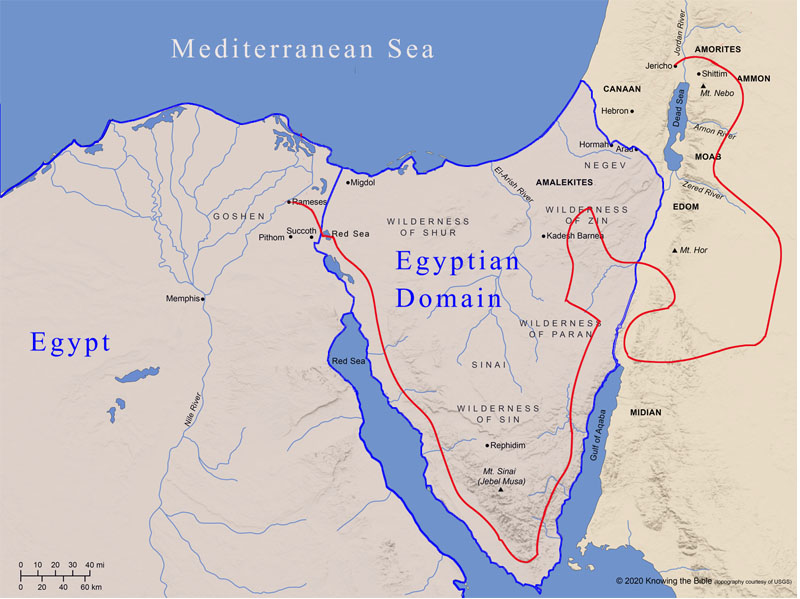
Israelite Journeys Rameses
|
Numbers 17 God Confirmed Aaron's Leadership Presumably upon the same day, after all the sin and punishment that the Israelites witnessed, God is putting a stop to the people complaining against Moses and Aaron. God took definitive action to prevent any recurrence, confirm Aaron's priesthood and reinforce His chosen leadership. Numbers 17:1 And the LORD said to Moses, "Speak to the Israelites and take from them twelve staffs, one from the leader of each tribe. Write each man's name on his staff, and write Aaron's name on the staff of Levi, because there must be one staff for the head of each tribe. Place the staffs in the Tent of Meeting in front of the Testimony, where I meet with you. The staff belonging to the man I choose will sprout, and I will rid Myself of the constant grumbling of the Israelites against you." In the ancient Middle East, the staff was a sacred symbol of leadership. Moses' rod served as a divine instrument for miracles, used to unleash the plagues and part the Red Sea in Egypt. While each staff was to be inscribed with the name of the head of their fathers' houses, Aaron's name, rather than Levi, was specifically used to represent the Levite tribe. Numbers 17:6 So Moses spoke to the Israelites, and each of their leaders gave him a staff—one for each of the leaders of their tribes, twelve staffs in all. And Aaron's staff was among them. Then Moses placed the staffs before the LORD in the Tent of the Testimony. The phrase "Tent of Meeting" refers specifically to what is called the "Holy Place," the first chamber of the tent, where Moses goes to meet with God. The "Testimony" refers to the Ark which is located in the Holy of Holies because the covenant law—the Ten Commandments—was placed inside it as a testimony to the covenant relationship between God and Israel. Numbers 17:8 The next day Moses entered the Tent of the Testimony and saw that Aaron's staff, representing the house of Levi, had sprouted, put forth buds, blossomed, and produced almonds. Then Moses brought out all the staffs from the LORD's presence to all the Israelites. They saw them, and each man took his own staff.
The word almond in Hebrew meaning "to watch." The almond tree, is the first to bloom in Israel. The golden lampstand (menorah) in the Tabernacle featured cups designed specifically to look like almond blossoms, symbolizing God's wakeful watchfulness and quickness to fulfill His word. Aaron's staff not only produced blossoms, it also produced almonds serving as a divine sign of his authority. Aaron's authority was confirmed over the Levites, but he remained secondary to Moses, who held the highest authority over the nation, including Aaron. Numbers 17:10 The LORD said to Moses, "Put Aaron's staff back in front of the Testimony, to be kept as a sign for the rebellious, so that you may put an end to their grumbling against Me, lest they die." So Moses did as the LORD had commanded him. The Testimony (Ark of the Covenant) contained items representing Israel's rebellion—the tablets of the Law, Aaron's budding rod, and manna—which served as a testimony against them. The gold-covered lid, known as the mercy seat, sat above these items and served as the spot where God met the high priest, covering the condemnation of the law with atonement and mercy. A standard walking cane today is about 3 feet long. Although its exact length is never recorded in the biblical text, based on the Ark's internal length of roughly 45 inches, Aaron's staff would be no longer than 4.3 feet in order to fit within the Ark. Numbers 17:12 Then the Israelites declared to Moses, "Look, we are perishing! We are lost; we are all lost! Anyone who comes near the tabernacle of the LORD will die. Are we all going to perish?" In spite of their rebellion against Moses, they turn to him with their fears and realized the consequences of their sinfulness. The Israelites knew they could not go near the tabernacle because lest they die. They realized that they needed a mediator. When they saw the miracle, they were convicted of their sin and feared God's anger. The obvious answer to their question was, despite their transgressions and the resulting judgments, God still offered them a way to be forgiven and to live. |