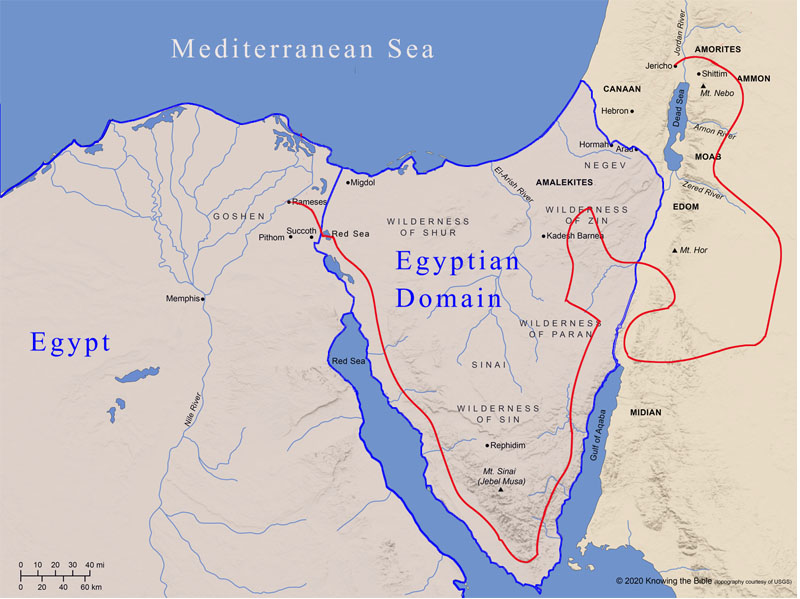
Numbers 13 — Twelve Spies Explore Canaan
Timeline: 1445 BC
|
Israelite Journeys Rameses
|
The Spies Explore Canaan These verses from Deuteronomy were spoken by Moses to the next generation who were about to enter into the Promised Land. In these verses, He recounted the experience of the Israelites' journey giving some insight into the real reason he sent spies into Canaan.
Numbers 13:1 And the LORD said to Moses, "Send out for yourself men to spy out the land of Canaan, which I am giving to the Israelites. From each of their fathers' tribes send one man who is a leader among them." The mission of the spies was a direct command from God through Moses who instructed them to scout the land of Canaan and report back to the people.
Numbers 13:3 So at the command of the LORD, Moses sent them out from the Wilderness of Paran. All the men were leaders of the Israelites, and these were their names:
These were not the same men who were chosen as heads of the tribes. These were specific, high-ranking subset of those leaders, who were the most suitable for such a mission, representing the whole nation. The Masoretic Text, Septuagint, Samaritan Pentateuch, and Dead Sea Scroll fragments, all record the same names listed here, underscoring both antiquity and accuracy. Numbers 13:16 These were the names of the men Moses sent to spy out the land; and Moses gave to Hoshea son of Nun the name Joshua. Moses renamed Hoshea, whose name meant "Save" or "Deliverance," by adding the divine prefix "Yeho" to create the name Yehoshua (יְהוֹשֻׁעַ). This new Hebrew name, which is transliterated as Joshua in English, signifies "Yahweh is salvation." The original Hebrew name essentially combined "Yahweh" (God's name) and the verb "yasha" (to save). A shortened, widely recognized form of Yehoshua is the name Jesus. Joshua was 40 years old when Moses sent him to scout out the land. Numbers 13:17 When Moses sent them to spy out the land of Canaan, he told them, "Go up through the Negev and into the hill country. See what the land is like and whether its people are strong or weak, few or many. Is the land where they live good or bad? Are the cities where they dwell open camps or fortifications? Is the soil fertile or unproductive? Are there trees in it or not? Be courageous and bring back some of the fruit of the land." (It was the season for the first ripe grapes.) The Negev is a hot, dry region in the southern part of Israel. The region extends about 70 miles wide between Beersheba and Kadesh Barnea. The Hebrews set up camp near the Kadesh Barnea oasis in the Negev desert's southern region during most of their 40-year wilderness journey. The hill country refers to the central mountain range of Canaan, fertile and well-watered, particularly compared to surrounding desert regions or areas. The environment was a stark contrast to the barren desert areas found in the southern parts of Canaan or the wilderness areas where the Israelites wandered. Numbers 13:21 So they went up and spied out the land from the Wilderness of Zin as far as Rehob, toward Lebo-hamath. They went up through the Negev and came to Hebron, where Ahiman, Sheshai, and Talmai, the descendants of Anak, dwelled. It had been built seven years before Zoan in Egypt. Representatives from each of the twelve tribes of Israel traveled a distance of around 300 miles round trip, passing through the whole land all the way to Rehob which is in the northern part of Canaan. The Anakim were warlike people known for their colossal size and were feared for their size and strength. They are often linked to other giant groups like the Nephilim, the offspring of fallen angels and human women, suggesting a celestial or hybrid origin. The giant Goliath, whom David fought, was probably a descendant of Anak. Hebron is one of the oldest continuously inhabited places in the Middle East, holding significance in Abrahamic traditions. It's where Abraham bought the Cave of Machpelah to bury his family. Zoan (also known as Tanis) was a major capital and powerful city in Egypt, symbolizing the kingdom's strength, wisdom, and pride. It's where God sent the plagues. Moses used Zoan to compare it to Hebron, highlighting that God promised the surrounding Hebron long before freeing His people. Skip Heitzig explains some interesting facts about Zoan and Hebron. Numbers 13:23 When they came to the Valley of Eshcol, they cut down a branch with a single cluster of grapes, which they carried on a pole between two men. They also took some pomegranates and figs. Because of the cluster of grapes the Israelites cut there, that place was called the Valley of Eshcol. Eshcol, (which means "cluster") is located immediately to the north of Hebron. The bundle of grapes is said to weighs ten or twelve pounds. Two men carried it in order to prevent the grapes from being crushed. The pomegranates and figs were probably carried on the same pole. The region continues to produce excellent grapes, and the tradition of large, abundant fruit endures. The Reports of the Spies Numbers 13:25 After forty days the men returned from spying out the land, and they went back to Moses, Aaron, and the whole congregation of Israel in the Wilderness of Paran at Kadesh. They brought back a report for the whole congregation and showed them the fruit of the land. Throughout the Bible, the number 40 symbolizes a period of transition, testing, or preparation, signifying a shift from an old condition to a new one, which ultimately leads to a new state, whether that be fulfillment or judgment. This pattern is exemplified by the story of the spies who scouted the land for 40 days; their subsequent negative report led the people to make a poor decision, resulting in divine judgment and a prolonged period of wandering. Numbers 13:27 And they gave this account to Moses: "We went into the land to which you sent us, and indeed, it is flowing with milk and honey. Here is some of its fruit! Nevertheless, the people living in the land are strong, and the cities are large and fortified. We even saw the descendants of Anak there. The Amalekites live in the land of the Negev; the Hittites, Jebusites, and Amorites live in the hill country; and the Canaanites live by the sea and along the Jordan." The milk signifies the livestock/dairy and honey refers to the syrup that comes from dates. The phrase "a land flowing with milk and honey" describes a rich, fruitful land with plenty of livestock (milk) and crops (honey/fruit). Amalek was a grandson of Esau and grew up hearing of his grandfather's hatred for Jacob. The Amalekites first attacked the Israelites when they camped in Rephidim (Exodus 17:8-16). It was there that the Lord declared war against their decedents from generation to generation. The Hittites were the giants who were the descendants of Heth, son of Canaan. It was a Hittite who sold Abraham the cave which served a family tomb. Esau married wives from the Hittites. The Jebusites were descended from Noah's son Ham who dwelt in the mountains beside Jerusalem. They, along with the other tribes in Canaan, were judged by God for their wickedness and pagan worship which may have included child sacrifice. The Amorites lived in the highlands of Canaan and were known for their fortified cities and influence in the region. Their religious practices involved worship of multiple deities and rituals. Amos 2:9 describes the Amorites as giants the height of the cedars and strong as oak. Canaanites worshiped various gods (Baal, Asherah) which involved practices like adultery, incest, homosexuality, bestiality and child sacrifice by placing their children on the outstretched arms of an idol as a roaring fire consumed them alive. These are some of the people whom God commanded to remove from the Promised land as judgment against their abominations. Numbers 13:30 Then Caleb quieted the people before Moses and said, "We must go up and take possession of the land, for we can certainly conquer it!" Caleb and Joshua, both 40 when they scouted Canaan, trusted God's promise, unlike the other ten spies who focused on giants and obstacles, creating fear; instead, Caleb and Joshua saw God's ability to help them conquer the strong inhabitants and fortified cities, emphasizing faith and God's provision over challenges to encourage the people to take the promised land. Numbers 13:31 But the men who had gone up with him replied, "We cannot go up against the people, for they are stronger than we are!" The Canaanites were actually afraid of the Israelites, a fact the Israelites were unaware of. News of the Israelites' God, who had famously parted the sea, and their victories over the two giant Amorite kings and their armies had spread, intimidating the local populace. However, they let their fear cloud their faith.
Numbers 13:32 So they gave the Israelites a bad report about the land that they had spied out: "The land we explored devours its inhabitants, and all the people we saw there are great in stature. We even saw the Nephilim there—the descendants of Anak that come from the Nephilim! We seemed like grasshoppers in our own sight, and we must have seemed the same to them!" Canaan was known for its fortified cities and warrior cultures. Because of the 10 reports, the Israelites' focused on human strength rather than divine power which served to amplify their fear and intimidation. The spies spent 40 days, checking out the land. As result of the people's rebellion, they spent 40 years in the wilderness. |