Numbers 12 — Mariam and Aaron Criticize Moses
Timeline: 1445 BC
|
Israelite Journeys Rameses
|
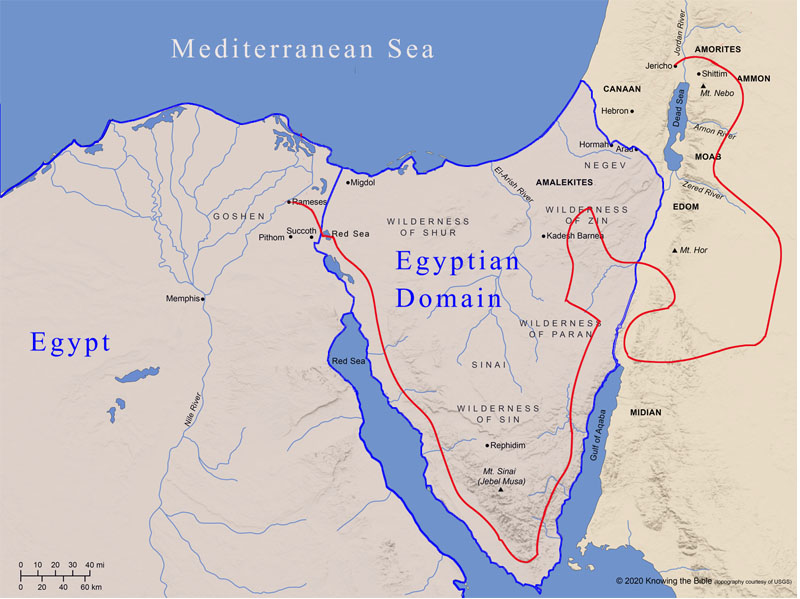
There is a story, untold in the bible, about the marriage of a Cushite woman to Moses. According to Jewish historian Joseph as well as other extra-biblical traditions, Moses married an Ethiopian King's daughter. Mariam and Aaron Criticize Moses Flavius Josephus, a Jewish historian from the first century, detailed Moses' birth and early life in his book, "Antiquities of the Jews", This account includes extra-biblical elements, such as a detailed description of Moses' military campaign in Ethiopia. Josephus recounts that a major conflict erupted between Ethiopia and Egypt around the time Moses departed Egypt. The Ethiopians constructed a dam to control the Nile's flow, prompting the Egyptians to mobilize an army. Pharaoh, hoping to eliminate Moses, placed him in command of this army to counter the Ethiopian threat. Moses then besieged the Ethiopian capital. Impressed by his leadership, the Cushite princess fell in love with him, and Moses subsequently became king of Cush, marrying her. Similar accounts of Moses and the Cushite woman, with minor variations, are also found in the writings of other figures. These include the fifth-century BC Greek historian Herodotus, the second-century BC Jewish writer Artapanus, and Bishop Irenaeus, a prominent Christian theologian from the 2nd century AD. Numbers 12:1 Then Miriam and Aaron criticized Moses because of the Cushite woman he had married, for he had taken a Cushite wife. "Does the LORD speak only through Moses?" they said. "Does He not also speak through us?" And the LORD heard this. Miriam's name occurs before that of Aaron indicating that she was the instigator of the criticism. In Exodus 15, Miriam was called a prophet, who led the women in the camp. There appears to have been some jealousy over the leadership between her and Moses. Aaron seems to be easily influenced by those around him, as evidenced by the golden calf incident. Numbers 12:3 Now Moses was a very humble man, more so than any man on the face of the earth. Some commentators say it is likely that someone added this comment later by someone who would have known Moses well. Joshua, may have been the editor who also probably added the account of Moses' death in Deuteronomy 34. Others suggest that "humble" is better understood as "low" or "miserable" describing the low point in Moses' life. Moses might also have heard what they said. If so, it added to his already troubled heart. Numbers 12:4 And suddenly the LORD said to Moses, Aaron, and Miriam, "You three, come out to the Tent of Meeting." So the three went out, and the LORD came down in a pillar of cloud, stood at the entrance to the Tent, and summoned Aaron and Miriam. When both of them had stepped forward, Numbers 12:6 He said, "Hear now My words:
Although Moses took no steps to defend himself, God took immediate action in order to prevent the complaint from spreading among the people. The word for suddenly (Hebrew "pith'om") occurs twenty-five times in the Old Testament and was used in a context of disaster or judgment. While God normally spoke to Miriam in a vision or dream, on this occasion He made Himself perfectly clear. His communication with Moses was always in person, not that Moses ever literally saw his face, but that they spoke to each other as we would talk together personally. This privilege was given to Moses alone and no other. God declared Moses to be a faithful servant and He let Aaron and Miriam know it in no uncertain terms. Numbers 12:10 As the cloud lifted from above the Tent, suddenly Miriam became leprous, white as snow. Aaron turned toward her, saw that she was leprous, and said to Moses, "My lord, please do not hold against us this sin we have so foolishly committed. Please do not let her be like a stillborn infant whose flesh is half consumed when he comes out of his mother's womb." Ham (Hebrew meaning hot, burnt, or black) was Noah's second oldest son. After the flood, his descendants, including his son Cush, populated Ethiopia. It is from this that we can assume that the Ethiopian woman was black and that there may have been some prejudice involved although that was not the main reason for the complaint. Leprosy was often used by God to punish sin and ironically turning her skin white for criticizing a darker-skinned woman. Aaron did not receive the same punishment. Because of his high priestly office, he must be physically unblemished to serve, If he became ritually unclean, he would have to abstain from his priestly duties. Another reason is that he immediately confessed of his sin. Although, rather than speaking directly to God, Aaron turned to his brother and ask that Miriam be healed. Numbers 12:13 So Moses cried out to the LORD, "O God, please heal her!" Probably not only because Aaron begged Moses, but also having compassion for his sister, Moses appealed God and asked for healing. Numbers 12:14 But the LORD answered Moses, "If her father had but spit in her face, would she not have been in disgrace for seven days? Let her be confined outside the camp for seven days; after that she may be brought back in." Her punishment was compared to spitting on her face which was a significant insult. Her shame required her to be ritually isolated outside the camp for seven days. In addition, although Miriam healed, she was ritually unclean and could not be allowed back until the required period of isolation was complete. Numbers 12:15 So Miriam was confined outside the camp for seven days, and the people did not move on until she was brought in again. After that, the people set out from Hazeroth and camped in the Wilderness of Paran. The Israelites continued their trek toward the Promised Land and arrived at Rithmah in the Wilderness of Paran, eight miles from Hazeroth. "Rithmah" comes from the Hebrew word for the broom plant, also known as a juniper, with which the valley is covered. There were two cisterns of excellent water which might be the reason of the Israelites pitching in this place. |
| Cassie, Matt, Joe |