Numbers 10 — Two Silver Trumpets, Departure from Sinai
Timeline: 1445 BC
|
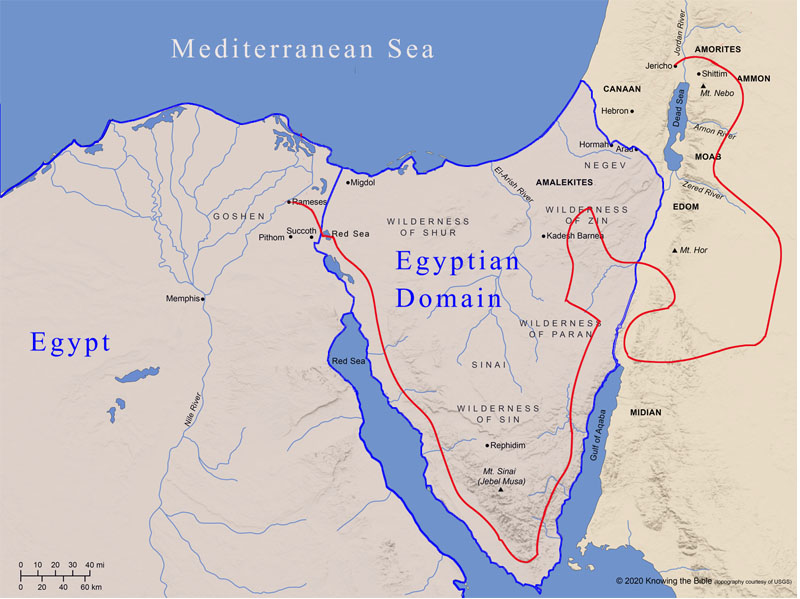
Israelite Journeys Rameses
|
The Two Silver Trumpets Numbers 10:1 Then the LORD said to Moses, "Make two trumpets of hammered silver to be used for calling the congregation and for having the camps set out. When both are sounded, the whole congregation is to assemble before you at the entrance to the Tent of Meeting. But if only one is sounded, then the leaders, the heads of the clans of Israel, are to gather before you. There are two different kinds of Trumpets mentioned in the Old Testament; the Shofar and the two Silver Trumpets. A shofar is traditionally crafted from a hollowed ram's horn. The process involves cleaning the horn and removing the marrow, then sawing off the tip to fashion a mouthpiece. Finally, the horn is heated and straightened before being sanded to achieve a smooth finish. The shofar was used to announce the new moon, Jubilee years, and in religious festivals like Rosh Hashanah. It was also used in warfare to warn of approaching enemies or calamities and to rally troops. God instructed Moses to make two trumpets, one for each of Aaron's sons. An artisan textured pure silver with a hammer creating an organic and handcrafted look to make the trumpets. The piece is polished so the indentations catch the light, creating a sparkling or glittering effect. Its shape was that of a straight slender tube with an expanding mouth. They were used by priests for calling the congregation and directing the movement of the camp. On certain days, the trumpets were used in place of the shofar in a different ceremonial capacity. The use of trumpets in ancient Israel served as a means of communication, particularly in signaling movement or gathering. Two long blasts of both trumpets were a signal for the entire congregation to gather in front of the tabernacle. A long blast on one trumpet called the leaders of the tribes to gather. This system provided a clear chain of command and response within the Israelite community. Numbers 10:5 When you sound short blasts, the camps that lie on the east side are to set out. When you sound the short blasts a second time, the camps that lie on the south side are to set out. The blasts are to signal them to set out. To convene the assembly, you are to sound long blasts, not short ones. The sons of Aaron, the priests, are to sound the trumpets. This shall be a permanent statute for you and the generations to come. Although it is not mentioned in the Hebrew text, the Septuagint states that three alarms were sounded for those on the west, and four blasts for those on the north to set out. 1 Thessalonians 4:14-16 describes the second coming of Jesus when He will descend from Heaven and the trumpet of God will signal the resurrection and gathering of believers. In Revelation, trumpets are sounded to announce angels that bring about cataclysmic events on earth. It will be a time of judgment and the coming of God's kingdom. Numbers 10:9 When you enter into battle in your land against an adversary who attacks you, sound short blasts on the trumpets, and you will be remembered before the LORD your God and saved from your enemies. And on your joyous occasions, your appointed feasts, and the beginning of each month, you are to blow the trumpets over your burnt offerings and peace offerings to serve as a reminder for you before your God. I am the LORD your God." In times of war, the trumpet blast was a signal to the people to pray for divine intervention, reminding God of His promises to them. They were also used on other occasions to remind the people to keep His covenant and ordinances. The sound celebrated peace with God and a right relationship with Him. From Sinai to Paran The cloud lifted and short blasts on the trumpets were sounded, indicating it was time for the congregation to begin their journey. God chose an indirect path for the people, guiding them away from Philistine lands and towards the southernmost edge of the Wilderness of Paran to shield them from immediate battle. Their journey south lasted three days, during which they made stops at the locations of Kibroth-hattaavah and Hazeroth. Numbers 10:11 On the twentieth day of the second month of the second year, the cloud was lifted from above the tabernacle of the Testimony, and the Israelites set out from the Wilderness of Sinai, traveling from place to place until the cloud settled in the Wilderness of Paran. They set out this first time according to the LORD's command through Moses. The cloud lifted and short blasts on the trumpets were sounded, indicating it was time for the congregation to begin their journey. They traveled northward for three days making stops at Kibroth-hattaavah and Hazeroth, located in the southernmost extremity of the wilderness of Paran. Numbers 10:14 First, the divisions of the camp of Judah set out under their standard, with Nahshon son of Amminadab in command. Nethanel son of Zuar was over the division of the tribe of Issachar, and Eliab son of Helon was over the division of the tribe of Zebulun. Then the tabernacle was taken down, and the Gershonites and the Merarites set out, transporting it. The second chapter of the Book of Numbers outlines the specific arrangement and marching order for the twelve tribes of Israel during their travels. The first group to set out was the three-tribe division led by the standard of Judah. Their camp was located on the east side of the Tent of Meeting, facing the entrance. They were followed by the Gershonite clan of Levites, who transported the tabernacle's outer elements—its coverings, curtains, and screens—using two carts. The next group in the sequence was the Merarites, who carried the heavier structural framework, such as the poles, beams, and frames, using four carts. When arriving at the new encampment, they would begin setting up the framework of the tabernacle before the Kohathites arrived. Numbers 10:18 Then the divisions of the camp of Reuben set out under their standard, with Elizur son of Shedeur in command. Shelumiel son of Zurishaddai was over the division of the tribe of Simeon, and Eliasaph son of Deuel was over the division of the tribe of Gad. Then the Kohathites set out, transporting the holy objects; the tabernacle was to be set up before their arrival. Following the first group, the tribes of Reuben, Simeon, and Gad moved out from their position on the south side of the tabernacle, forming the second division to march. Next, Moses and Aaron lead the Kohathite division of the Levites carrying the most sacred objects of the Tabernacle, which included the Ark of the Covenant, altar, and other holy utensils on their shoulders using poles. Even while the other Israelite tribes formed a protective perimeter around them to safeguard the tabernacle and its contents, the Levites still maintained an approximate half-mile gap during their march. Numbers 10:22 Next, the divisions of the camp of Ephraim set out under their standard, with Elishama son of Ammihud in command. Gamaliel son of Pedahzur was over the division of the tribe of Manasseh, and Abidan son of Gideoni was over the division of the tribe of Benjamin. The troops under Ephraim's command began their march after the ark, accompanied by their allied tribes, Manasseh and Benjamin, all of whom had been positioned on the west side of the sacred tent. Numbers 10:25 Finally, the divisions of the camp of Dan set out under their standard, serving as the rear guard for all units, with Ahiezer son of Ammishaddai in command. Pagiel son of Ocran was over the division of the tribe of Asher, and Ahira son of Enan was over the division of the tribe of Naphtali. The tribes of Dan, Asher, and Nphtali, whose designated encampment was to the north of the tabernacle, functioned as a crucial rear guard for the migrating nation. Their primary responsibilities were twofold: to hinder or delay enemy pursuit, a maneuver considered one of the most challenging tactical operations in military strategy, and to gather and reorganize any soldiers or groups who had been scattered or separated from the main contingent during movement or conflict. Numbers 10:28 This was the order of march for the Israelite divisions as they set out. The twelve tribes set out in groups corresponding to their encampment locations while the Levites were organized in the precise order necessary for setting up the sacred tent: Judah, Issachar, Zebulun, Gershonites, Merarites, Reuben, Simeon, Gad, Moses and Aaron, Kohathites, Ephraim, Manasseh and Benjamin. Numbers 10:29 Then Moses said to Hobab, the son of Moses' father-in-law Reuela the Midianite, "We are setting out for the place of which the LORD said: 'I will give it to you.' Come with us, and we will treat you well, for the LORD has promised good things to Israel." Reuel the Midianite (also referred to by the name Jethro) was Moses' father-in-law who returned to his own country after giving advice to Moses (Exodus 18). Although the cloud led the march, Moses sought Hobab' guidance for navigating the wilderness and to teach the helpless slaves from Egypt the secrets of camp life. Hobab, knew all about the oases and the wells, the situation of which was known only to the desert-born tribes. Numbers 10:30 "I will not go," Hobab replied. "Instead, I am going back to my own land and my own people." Cultural and family bonds were important in the ancient Near East. A person's sense of belonging and identity was intricately connected to their place of origin and relatives. Midian was approximately 25 miles, about a days journey, from the Israelite camp. Numbers 10:31 "Please do not leave us," Moses said, "since you know where we should camp in the wilderness, and you can serve as our eyes. If you come with us, we will share with you whatever good things the LORD gives us." The scripture does not indicate whether Moab stayed or went back to his people. However, some sources indicate that his descendants had settled in the land of Canaan with the people of Judah. Numbers 10:33 So they set out on a three-day journey from the mountain of the LORD, with the ark of the covenant of the LORD traveling ahead of them for those three days to seek a resting place for them. And the cloud of the LORD was over them by day when they set out from the camp. Under normal circumstances, the ark was carried in the center of the camp. Some commentators suggest that to "travel ahead of them" is meant figuratively. Others believe that on certain occasions it was carried in front in order to lead the Israelites. Either way, the Lord was always with them continuously. Prayer was a way for Moses to acknowledge God's power and to ask for His protection. His prayer of faith also encouraged the children of Israel in their journeys. Numbers 10:35 Whenever the ark set out, Moses would say, "Rise up, O LORD! May Your enemies be scattered; may those who hate You flee before You." And when it came to rest, he would say: "Return, O LORD, to the countless thousands of Israel." The prayers Moses are still used today in both Jewish and Christian traditions. Many believers use these verses as powerful warfare prayers, asking God to go before them, clear obstacles, and defeat spiritual adversaries in their lives. |
| Cassie, Matt, Joe |