Numbers 1 & 26 - The First and Second Census
Timeline: 1451 BC
|
Israelite Journeys Rameses
|
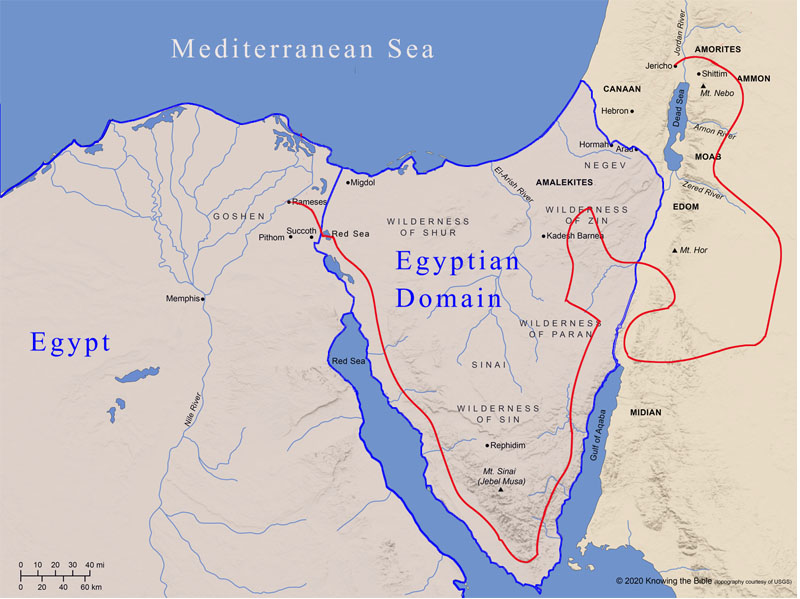
The journey from Mount Sinai to Kadesh-barnea near the border of the Promised Land that they were to invade, should have taken eleven days. The first chapter in Numbers outlines a census that was taken, detailing every man over twenty who was able to go to war. However, when it came time to charge they became fearful and refused to enter the Promised Land. They were not prepared to trust God so He decreed that all those who had been adults when the Israelites left Egypt would wander the wilderness for forty years. That generation of fighting men died except for Joshua and Caleb. A second census was then recorded in Numbers chapter 26 to again count the number of men eligible for military service, which was essential for conquering the land. The second census was also conducted to apportion the Promised Land as an inheritance among the tribes. The First Census of Israel Numbers 1:1 On the first day of the second month of the second year after the Israelites had come out of the land of Egypt, the LORD spoke to Moses in the Tent of Meeting in the Wilderness of Sinai. He said: "Take a census of the whole congregation of Israel by their clans and families, listing every man by name, one by one. Notice that there are twelve tribes mentioned throughout the Bible. Jacob had twelve sons but thirteen tribes are listed. Jacob adopted Joseph's two sons, so Joseph is often replaced by Ephraim and Manasseh. In other places, The tribe of Levi is not mentioned since they did not receive an inheritance. In Revelation, the tribe of Dan was omitted from the list as a consequence of idolatry and rebellion against God. Jesus chose twelve disciples and when Judas betrayed Him, Matthias replaced him to restore the number of the twelve. The number twelve is a symbol of completeness and divine organization. The tribes in Numbers chapter 1 are listed according to the order or quality of their birth, beginning with the children of Leah: Reuben, the firstborn, then Simeon and Judah. Levi was omitted because they were exempt from warfare due to their sacred duties, then Issachar and Zebulun. Next came the son's of Rachel. Joseph's sons were adopted by Jacob, giving Ephraim the firstborn status over Manasseh. Benjamin was Rachel's second son. Bilhah's son Dan, was the firstborn of the handmaids followed by Zilpah's two sons, Asher and then Gad, and finally Naphtali who was Bilhah's son. Numbers 1:3 You and Aaron are to number those who are twenty years of age or older by their divisions—everyone who can serve in Israel's army. And one man from each tribe, the head of each family, must be there with you. The Leaders of the Tribes Numbers 1:5 These are the names of the men who are to assist you:
These men were appointed from the congregation; they were the leaders of the tribes of their fathers, the heads of the clans of Israel. The Second Census of Israel In Numbers chapter 25, the Israelites bowed down to Baal. This act of idolatry incited the Lord's anger. A devastating plague of pestilence broke out among the Israelites, which killed the rebellious adults who had been in Egypt (Numbers 14). As a result, not one of the men of that generation remained, with the exception of Moses, Joshua and Caleb. Those of the tribes of Levi also survived, and one of their priests were instrumental in stopping it. Numbers 26:1 After the plague had ended, the LORD said to Moses and Eleazar son of Aaron the priest, "Take a census of the whole congregation of Israel by the houses of their fathers—all those twenty years of age or older who can serve in the army of Israel." Numbers 26:3 So on the plains of Moab by the Jordan, across from Jericho, Moses and Eleazar the priest issued the instruction, "Take a census of the men twenty years of age or older, as the LORD has commanded Moses." The Number of Every Tribe Numbers 1:17 So Moses and Aaron took these men who had been designated by name, and on the first day of the second month they assembled the whole congregation and recorded their ancestry by clans and families, counting one by one the names of those twenty years of age or older, just as the LORD had commanded Moses. Genealogies were essential for the Israelites. They recorded their ancestry by clans and families and were used to establish lineage, validate the legitimacy of rulers and priests, define land rights and trace the ancestry of Jesus. The following lists are from the census taken in chapter 1 compared to the records from a second census taken in chapter 26: Numbers 1:19 So Moses numbered them in the Wilderness of Sinai: From the sons of Reuben, the firstborn of Israel, according to the records of their clans and families, counting one by one the names of every male twenty years of age or older who could serve in the army, those registered to the tribe of Reuben numbered 46,500.
It was Dathan and Abiram, chosen by the congregation, who rebelled against Moses and Aaron with the followers of Korah who rebelled against the LORD. And the earth opened its mouth and swallowed them along with Korah, whose followers died when the fire consumed 250 men. They serve as a warning sign. However, the line of Korah did not die out. Numbers chapter 16 describes the challenge of Moses and Aaron, by the followers of Korah, asserting that all the congregation were holy and that Moses and Aaron were taking too much authority. Numbers 1:22 From the sons of Simeon, according to the records of their clans and families, counting one by one the names of every male twenty years of age or older who could serve in the army, those registered to the tribe of Simeon numbered 59,300.
Simeon lost a total of 37,100 men after the plaque. Numbers 1:24 From the sons of Gad, according to the records of their clans and families, counting the names of all those twenty years of age or older who could serve in the army, those registered to the tribe of Gad numbered 45,650.
Gad lost a total of 5,150 men after the plaque. Numbers 1:26 From the sons of Judah, according to the records of their clans and families, counting the names of all those twenty years of age or older who could serve in the army, those registered to the tribe of Judah numbered 74,600. Judah gained a total of 1,900 men after the plaque. Numbers 1:28 From the sons of Issachar, according to the records of their clans and families, counting the names of all those twenty years of age or older who could serve in the army, those registered to the tribe of Issachar numbered 54,400.
Issachar gained a total of 9,900 men after the plaque. Numbers 1:30 From the sons of Zebulun, according to the records of their clans and families, counting the names of all those twenty years of age or older who could serve in the army, those registered to the tribe of Zebulun numbered 57,400.
Zebulun gained a total of 3,100 men after the plaque. Numbers 1:32 From the sons of Joseph:
Jacob had prophesied that Ephraim would become greater than his older brother Manasseh. Numbers chapter 1 lists Ephraim first and then Manasseh but in Numbers chapter 26 Manasseh is listed before Ephraim. The most common explanation among biblical commentators for the reversal is the change in the tribes' population numbers. During the second census, Manasseh had gained 20,500, the largest increase of all of the tribes, while Ephraim lost 8,000. In Deuteronomy 33, Ephraim will again be listed before Manasseh. Numbers 1:33 From the sons of Ephraim, according to the records of their clans and families, counting the names of all those twenty years of age or older who could serve in the army, those registered to the tribe of Ephraim numbered 40,500. Numbers 26:35 These were the descendants of Ephraim by their clans: Ephraim lost a total of 3,100 men after the plaque. Numbers 1:34 And from the sons of Manasseh, according to the records of their clans and families, counting the names of all those twenty years of age or older who could serve in the army, those registered to the tribe of Manasseh numbered 32,200.
Manasseh gained a total of 20,500 men after the plaque. Numbers 1:36 From the sons of Benjamin, according to the records of their clans and families, counting the names of all those twenty years of age or older who could serve in the army, those registered to the tribe of Benjamin numbered 35,400.
Benjamin gained a total of 10,200 men after the plaque. Numbers 1:38 From the sons of Dan, according to the records of their clans and families, counting the names of all those twenty years of age or older who could serve in the army, those registered to the tribe of Dan numbered 62,700.
Dan gained a total of 1,700 men after the plaque. Numbers 1:40 From the sons of Asher, according to the records of their clans and families, counting the names of all those twenty years of age or older who could serve in the army, those registered to the tribe of Asher numbered 41,500.
Asher gained a total of 11,900 men after the plaque. Numbers 1:42 From the sons of Naphtali, according to the records of their clans and families, counting the names of all those twenty years of age or older who could serve in the army, those registered to the tribe of Naphtali numbered 53,400.
Naphtali lost a total of 8,000 men after the plaque.
Numbers 1:44 These were the men numbered by Moses and Aaron, with the assistance of the twelve leaders of Israel, each one representing his family. So all the Israelites twenty years of age or older who could serve in Israel's army were counted according to their families. And all those counted totaled 603,550. In spite of physical obstacles, spiritual failures, and harsh judgment from the Lord, the total loss of men after the plaque was 1,820 men just before entering the Promised Land.
Proverbs 16:33 The lot is cast into the lap, but its every decision is from the LORD. - In other words, much that we attribute to chance is due to the providence of God. The process of dedicating the firstborn involved specific rituals. For animals, the firstborn of clean animals were to be sacrificed, while unclean animals, such as donkeys, were to be redeemed with a lamb which was sacrificed in its place. Human firstborn sons were consecrated to serve in the tabernacle and perform sacred duties. This dedication was in memory of God's great deliverance and a sign to their children that God had brought them out of Egypt. God selected all the males from the tribe of Levi to work instead of the firstborn males from other tribes as an act of redemption, giving the Levites the responsibility for maintaining His place of worship. This declaration signifies ownership and a special relationship between God and the Levites. The Exemption of the Levites Numbers 1:47 The Levites, however, were not numbered along with them by the tribe of their fathers. For the LORD had said to Moses: "Do not number the tribe of Levi in the census with the other Israelites. Instead, you are to appoint the Levites over the tabernacle of the Testimony, all its furnishings, and everything in it. They shall carry the tabernacle and all its articles, care for it, and camp around it. Levites were not counted among those eligible for military service. When camping around the Tabernacle, they acted as a protective barrier, safeguarding God's holy presence from the rest of the community. Israelites that were not part of the tribe of Levi, were prohibited from approaching God's dwelling place, the Tabernacle, and its holy objects under penalty of death. During war, the Levites were involved in the distribution of plunder and the treatment of captives. Numbers 1:51 Whenever the tabernacle is to move, the Levites are to take it down, and whenever it is to be pitched, the Levites are to set it up. Any outsider who goes near it must be put to death. Anyone who was not of the Levite clan was considered an outsider. The tabernacle was a sacred place that symbolized the presence of God among His people. The priests and the Levites, were held to stringent standards of purity and conduct, reflecting the honor and sacredness of their consecrated role. Therefore they alone, were responsible for the physical care, assembly, disassembling, and transport of the Tabernacle. Numbers 1:52 The Israelites are to camp by their divisions, each man in his own camp and under his own standard. But the Levites are to camp around the tabernacle of the Testimony and watch over it, so that no wrath will fall on the congregation of Israel. So the Levites are responsible for the tabernacle of the Testimony." The Israelites were instructed by God to pitch their tents in a specific order, each man in his own camp and under his own standard. But the Levites were to camp around the centrally located Tabernacle of the Testimony and were responsible to watch over it, so that no wrath will fall on the congregation of Israel. The twelve tribes were then arranged in groups of three to the North, South, East and West to provide a system of protection for the Levites and the tabernacle.
The three principal families were from Levi's sons. Each had specific roles related to the service of the tabernacle. Gershon was the first son of Levi. The Libnites were descendants of Gershon. Their clans were responsible for the care of the outer tabernacle including components such as the tent and its covering, screens, doors, and hangings. Kohath was the second son of Levi, grandfather of Moses, Aaron and Miriam. His family included the Hebronite family. They were tasked with the care of the most sacred objects of the Tabernacle, including the Ark of the Covenant, the table, the lampstand, and the altars. Merari was the youngest son of Levi, father of Mahli and Mushi. Their duties involved carrying and assembling the heavy parts of the Tabernacle, including the wooden framework, crossbars, posts, and bases.
In Numbers chapter 3, God told Moses to count the Levites by their families and clans in the Wilderness of Sinai. The total number of Levites, at that time, including all the males a month old or more, was 22,000. The results of the second census reveal a population growth of one thousand.
The Levites were counted separately from the rest of the Israelites. This verse refers to the total number of Israelites not including the Levites.
Moses numbered the people twice: on the first occasion at the beginning of the forty years, Aaron was his colleague. On the second occasion, Eleazar assisted Moses at the end of the wanderings, on the threshold of Canaan. From the twelve tribes who left Egypt, only two men had survived, Joshua and Caleb, because only they followed the Lord. Numbers 1:54 Thus the Israelites did everything just as the LORD had commanded Moses. The Israelites pitched their tents according to the order given by God. Each tribe was organized by tribe, with each one camping in it's designated area, and its banner. |
| Cassie, Matt | |