Leviticus — Uncleanness in the Camp
Timeline: 1445 BC
((Leviticus 7:22-38; 17:10-16; 22:31-33)
|
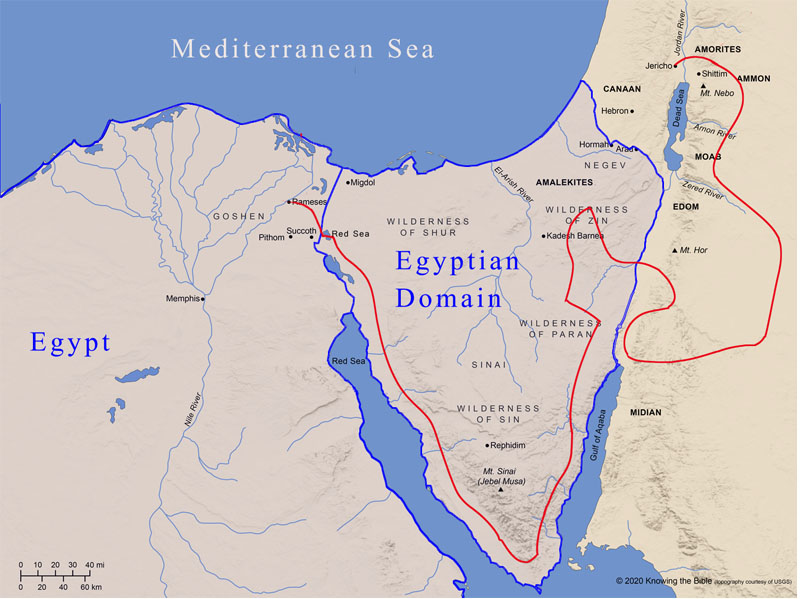
Israelite Journeys Rameses
|
The first sacrifice in the Bible was used as a payment for sin when God sacrificed an animal to provide clothing for Adam and Eve. The Bible tells the story of Cain and Abel who evidently had an idea of what kinds of offerings God expected. The patriarchs built altars or pillars and offer animals and oil to God. So from the beginning, God laid down a tradition of shedding innocent blood to cover up sins. The book of Leviticus provides instruction and laws to guide the priests in their work as they ministered to the nation. A burnt offering symbolized a complete surrender to God, where the entire animal was consumed by fire. This was considered as a sweet "savor" (fragrance) unto the lord. A burnt offering was the most common of all sacrifices in Israel. It was often offered in conjunction with another sacrifice. Among these were the guilt offering, the sin offering, the votive or freewill offering, the sheaf offering, and the new grain offering. The burnt offering:
Uncleanness of Men and Women Leviticus 15:32 This is the law of him who has a discharge, of the man who has an emission of semen whereby he is unclean, of a woman in her menstrual period, of any male or female who has a discharge, and of a man who lies with an unclean woman.'" The tabernacle served as more than a mere center for ritual sacrifice; it was the designated earthly dwelling place of God. Consequently, strict cleanliness laws were necessary to ensure the people remained fit to exist in God's holy presence. Bodily emissions and blood were considered sources of ritual impurity because they symbolized a loss of life-force, which was deemed incompatible with the sacred, life-giving nature of the sanctuary. These purification regulations were designed to both identify impurity and provide a, solution for restoration, allowing the community to be re-consecrated. Uncleanness of Women Leviticus 15:19 When a woman has a discharge consisting of blood from her body, she will be unclean due to her menstruation for seven days, and anyone who touches her will be unclean until evening. Anything on which she lies or sits during her menstruation will be unclean, and anyone who touches her bed must wash his clothes and bathe with water, and he will be unclean until evening. A woman who is unclean due to her menstruation was not sent out of the camp, nor out of the house. She was merely declared unclean. Food or objects that required a ritual state of purity could not be touched by menstruating women without becoming contaminated or made unfit for consumption. No one was allowed to touch or anything that she has been in contact with so that they might be also become unclean. Rachel, the wife of Jacob, stole household idols from her father, Laban's household, she hid them in her camel's saddle and sat on them. She claimed she could not stand up because she was menstruating. While some laws were, in a sense, pre-existing, they were formally documented and organized by Moses during the wilderness journey. Leviticus 15:22 Whoever touches any furniture on which she was sitting must wash his clothes and bathe with water, and he will be unclean until evening. And whether it is a bed or furniture on which she was sitting, whoever touches it will be unclean until evening. This regulation was part of the Levitical purity laws which lasted until evening. They were designed for temporary separation only and did not warrant a sin or burnt offering, only bathing and laundering clothes in a spring or running water and waiting until sunset. Leviticus 15:24 If a man lies with her and her menstrual flow touches him, he will be unclean for seven days, and any bed on which he lies will become unclean. If a man simply comes in contact with the blood, he becomes unclean. The period of seven days represents a complete cycle of impurity, after which the individual can be restored to a state of ritual cleanliness. Leviticus 20:18 If a man lies with a menstruating woman and has sexual relations with her, he has exposed the source of her flow, and she has uncovered the source of her blood. Both of them must be cut off from among their people. Sexual intimacy with a woman during her menstruation was viewed so seriously that it carried harsh penalties—potentially death or being cut off from the community—highlighting the importance of strict adherence to divine law. Leviticus 15:25 When a woman has a discharge of her blood for many days at a time other than her menstrual period, or if it continues beyond her period, she will be unclean all the days of her unclean discharge, just as she is during the days of her menstruation. Any bed on which she lies or any furniture on which she sits during the days of her discharge will be unclean, like her bed during her menstrual period. Anyone who touches these things will be unclean; he must wash his clothes and bathe with water, and he will be unclean until evening. A woman may experience bleeding outside her normal menstrual cycle or her period may last longer than usual, may be due to carcinoma, hormonal imbalance, a threatened or incomplete abortion, uterine cysts, or many other conditions. In this case, she was considered ceremonially unclean for the entire duration of the flow. During this time, anything she sat or lay on was also unclean. Cleansing of Women Leviticus 15:28 When a woman is cleansed of her discharge, she must count off seven days, and after that she will be ceremonially clean. On the eighth day she is to take two turtledoves or two young pigeons and bring them to the priest at the entrance to the Tent of Meeting. The priest is to sacrifice one as a sin offering and the other as a burnt offering. In this way the priest will make atonement for her before the LORD for her unclean discharge. On the eighth day after abnormal uterine bleeding stopped, a woman was required to bring two doves or two young pigeons to the priest at the entrance to the tent of meeting. The priest would offer one bird as a purification (sin) offering and the other as a burnt offering to make atonement for her and cleanse her of her uncleanness. No sin was committed, but the offering was required to purify the person to ensure that unintentionally defiling God's sanctuary was avoided. Purification after Childbirth Leviticus 12:1 Then the LORD said to Moses, "Say to the Israelites, 'A woman who becomes pregnant and gives birth to a son will be unclean for seven days, as she is during the days of her menstruation. And on the eighth day the flesh of the boy's foreskin is to be circumcised. For seven days after the birth of a child, a woman is unclean for seven days, just as after her regular menstruation, under the Levitical purity laws. Everything she touched would be unclean. Anyone who came in contact with her or anything she touches, including her husband, became ceremonially unclean until evening. Genesis 17 goes into further details about Circumcision. Leviticus 12:4 The woman shall continue in purification from her bleeding for thirty-three days. She must not touch anything sacred or go into the sanctuary until the days of her purification are complete. Following the initial seven-day period of severe impurity, the mother was no longer considered contagiously unclean, meaning she did not make others or objects unclean by touching them. However, she remained in a state of purification for an additional 33 days (for a son), during which she was restricted from entering the sanctuary, touching sacred items, or participating in holy meals. Purification began the day the child is born. She had to wait for this entire 40-day, or "purification" period, to conclude before being fully considered ritually clean. Leviticus 12:5 If, however, she gives birth to a daughter, the woman will be unclean for two weeks as she is during her menstruation. Then she must continue in purification from her bleeding for sixty-six days. In the case of a daughter the days of purification in both stages is exactly double that prescribed at the birth of a son. Scholars offer several interpretations for why the purification is different for male and female births. Male children are circumcised on the eighth day, immediately initiating them into the covenant, which may shorten the mother's purification period. A baby girl represents the potential to bear another life, leading to a longer, symbolic, 80-day purification period. The birth of a girl was commonly believed to be accompanied by more complications than a boy, and/or that the vaginal discharge was greater or lasted longer for girls than boys. If this were the case, the baby girl was considered as subject to the laws around abnormal bleeding. Motherhood was considered critical and valuable in those days. They looked at the birth of a daughter as involving two mothers – the one giving birth, and the one being born and so the period of purification had to be twice as long.
For Practical reasons, the period of uncleanness also provided a time for rest and recovery for the mother, emphasizing the importance of community support and care for new mothers. Leviticus 12:6 When the days of her purification are complete, whether for a son or for a daughter, she is to bring to the priest at the entrance to the Tent of Meeting a year-old lamb for a burnt offering and a young pigeon or a turtledove for a sin offering. And the priest will present them before the LORD and make atonement for her; and she shall be ceremonially cleansed from her flow of blood. This is the law for a woman giving birth, whether to a male or to a female. A yearling lamb for a burnt offering was an expression of gratitude for the mercies she had received in childbearing. The young pigeon or turtledove was a sin offering, not a punishment for sin or a consequence of iniquity, but was simply part of the purification ritual. This would be similar to one who suffered an unnatural bodily discharge or a person being purified of leprosy. Leviticus 12:8 But if she cannot afford a lamb, she shall bring two turtledoves or two young pigeons, one for a burnt offering and the other for a sin offering. Then the priest will make atonement for her, and she will be clean.'" According to Rabbinic sources, after the Israelites entered the Promised Land, and especially during the Second Temple period, it was impractical for women to travel to Jerusalem immediately after childbirth or discharge, so they often postponed purification sacrifices until a scheduled pilgrimage or after multiple births. While some, like Mary, adhered strictly to the 40-day timeline, others waited until after multiple births. After purification via immersion, women could safely enter the temple. Uncleanness of Men
The proximity of God's presence required a high standard of purity in the daily lives of the Israelites. Purification laws highlight the serious nature of holiness and the danger of approaching God in a state of impurity. Unclean individuals, such as those with specific bodily discharges, risked divine judgment if they defiled the tabernacle.
Various discharges (menstrual, seminal, and chronic illness) render an Israelite "unclean". It is not a matter of sin, but rather that they were temporarily disqualified from participating in public worship. These regulations taught the distinction between the physical and the holy, ensuring that individuals approached the sacred presence of God in a state of ritual cleanliness. In addition, these laws likely served a practical, hygienic purpose in controlling the spread of disease in the community. Leviticus 15:1 And the LORD said to Moses and Aaron, "Say to the Israelites, 'When any man has a bodily discharge, the discharge is unclean. This uncleanness is from his discharge, whether his body allows the discharge to flow or blocks it. So his discharge will bring about uncleanness. Human sexuality is a natural bodily function as a part of God's creation. However, even that could result in temporary ritual impurity and the need for purity in approaching the divine. When in a state of impurity, the Hebrews were forbidden to enter the sanctuary, to keep the Passover, and to partake of holy food, whether of sacrificial meat, of sacred offerings and gifts, or of shew-bread, because the clean only were fit to approach the holy God and all that appertains to him Leviticus 15:4 Any bed on which the man with the discharge lies will be unclean, and any furniture on which he sits will be unclean. Anyone who touches his bed must wash his clothes and bathe with water, and he will be unclean until evening. Whoever sits on furniture on which the man with the discharge was sitting must wash his clothes and bathe with water, and he will be unclean until evening. Based on Levitical law, the regulations regarding ritual impurity are applicable to both men and women, requiring purification for similar bodily discharges. This type of uncleanness is highly contagious and spreads mechanically, contaminating objects like beds and chairs upon contact. Leviticus 15:7 Whoever touches the body of the man with a discharge must wash his clothes and bathe with water, and he will be unclean until evening. If the man with the discharge spits on one who is clean, that person must wash his clothes and bathe with water, and he will be unclean until evening. Anyone who touches these contaminated items or the person with the discharge is rendered ritually unclean and must wash their clothes, bathe, and wait until evening to be purified. Leviticus 15:9 Any saddle on which the man with the discharge rides will be unclean. Whoever touches anything that was under him will be unclean until evening, and whoever carries such things must wash his clothes and bathe with water, and he will be unclean until evening. In ancient Israel, saddles were essential for transportation, especially for those traveling long distances. The mention of a saddle here indicates the practical aspects of daily life and the need for purity in all areas. Saddles were typically made of leather or woven materials, which could easily absorb impurities, making them a focus in the laws of cleanliness. Leviticus 15:11 If the man with the discharge touches anyone without first rinsing his hands with water, the one who was touched must wash his clothes and bathe with water, and he will be unclean until evening. Any clay pot that the man with the discharge touches must be broken, and any wooden utensil must be rinsed with water. If an unclean man or woman touched an object, the item was contaminated and must be washed or, if it was made from clay, it was to be broken. The Cleansing of Men The law distinguishes between natural discharges (like semen or menstruation, which required washing and waiting until evening) and chronic/abnormal discharges, often and probably correctly translated as gonorrhea, which required the full sacrificial ritual. Leviticus 15:13 When the man has been cleansed from his discharge, he must count off seven days for his cleansing, wash his clothes, and bathe himself in fresh water, and he shall be clean. On the eighth day he is to take two turtledoves or two young pigeons, come before the LORD at the entrance to the Tent of Meeting, and give them to the priest. The priest is to sacrifice them, one as a sin offering and the other as a burnt offering. In this way the priest will make atonement for the man before the LORD because of his discharge. The man was ceremonially unclean while the discharge lasted, as well as for seven days after it stopped. After bathing and washing his clothes on the eve of the seventh day he is to bring offer one bird for a sin offering and the other for a burnt offering to the tabernacle. If no sign of the infirmity is seen then the priest will pronounce the man clean. Leviticus 15:16 When a man has an emission of semen, he must bathe his whole body with water, and he will be unclean until evening. Any clothing or leather on which there is an emission of semen must be washed with water, and it will remain unclean until evening. If a man lies with a woman and there is an emission of semen, both must bathe with water, and they will remain unclean until evening. Normal bodily emissions were often associated with impurity, not due to sinfulness but because they involved the loss of life-giving fluids. The requirement for purification after such emissions highlights the importance of maintaining ritual purity in the camp, which was considered a dwelling place for God's presence. Washing clothing and bathing is required but not a sacrifice. Deuteronomy 23:9 When you are encamped against your enemies, then you shall keep yourself from every wicked thing. If any man among you becomes unclean because of a nocturnal emission, he must leave the camp and stay outside. When evening approaches, he must wash with water, and when the sun sets he may return to the camp. This law was especially relevant during military campaigns, where soldiers needed to maintain a sanctified state for God's protection. Wet dreams / nocturnal emissions are fairly common in the lives of men, usually triggered by impure thoughts and imaginations in dreams. A solider having a wet dream really is clearly not on the war at hand. It is a mind distracted, focused on things other than the life or death struggle forthcoming, he poses a threat to himself and the rest of the army. While in their own homes, they had private areas to separate themselves from others. However, in a military camp, where soldiers lived in crowded, close quarters, it was nearly impossible to avoid touching something or someone ritually unclean. Therefore, if a man became unclean, he was required to leave the camp entirely until evening, cleanse himself, and only then return.
God had promised to go with them when they engaged in a just and necessary war and in his presence there must be nothing that would offend Him and drive Him out of the camp leading Him to turn away.
Practical sanitation is intertwined with spiritual reverence. In contrast to other ancient cultures that often had poor sanitation, this law ensured a healthy environment for the Israelites. |