Resources
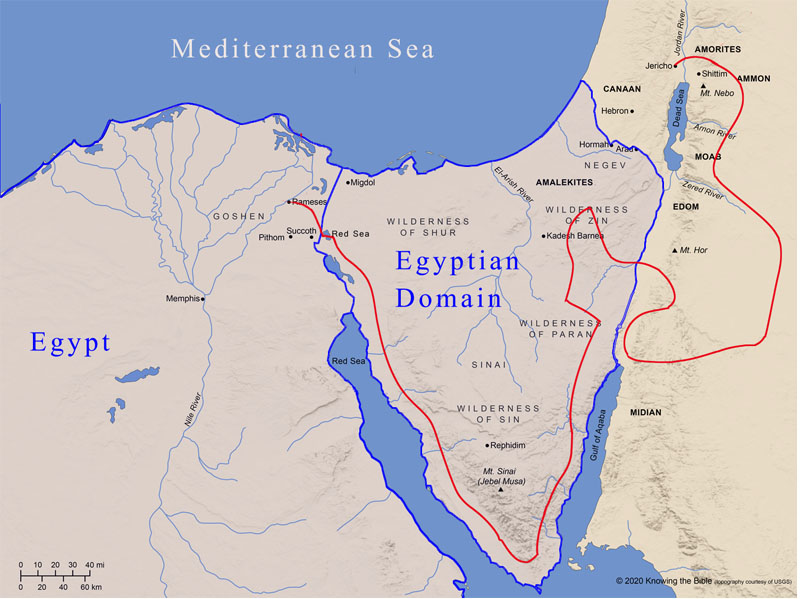
Israelite Journeys
Rameses
Succoth
Etham
Pi-hahiroth
By the Red Sea
Wilderness of Etham
Marah
Elim
By the Red Sea
Wilderness of Sin
Dophkah
Alush
Rephidim
Wilderness of Sinai
Kibroth-hattaavah
Hazeroth
Rithmah
Rimmon-perez
Libnah
Rissah
Kehelathah
Mount Shepher
Haradah
Makheloth
Tahath
Terah
Mithkah
Hashmonah
Moseroth
Bene-jaakan
Hor-haggidgad
Jotbathah
Abronah
Ezion-geber
Kadesh
Mount Hor
Zalmonah
Punon
Oboth
Iye-abarim
Dibon-gad
Almon-diblathaim
Abarim
Moab
Beth-jeshimoth
Abel-shittim
On the first day after the week of consecration, it's time for Aaron and his sons to begin their priestly duties. The eighth day is the first day of the week which began on Sunday, the day of new beginnings. According to ancient tradition this was the first of the month Nisan, or March. Their duties begin with a solemn sacrifice first for themselves and then for the Israelite nation.
Leviticus 22:27 "When a bull or a sheep or a goat is born, it shall be seven days with its mother; and from the eighth day and thereafter it shall be accepted as an offering made by fire to the LORD.
Leviticus 9:1-4 It came to pass on the eighth day that Moses called Aaron and his sons and the elders of Israel. And he said to Aaron, "Take for yourself a young bull as a sin offering and a ram as a burnt offering, without blemish, and offer them before the Lord. And to the children of Israel you shall speak, saying, 'Take a kid of the goats as a sin offering, and a calf and a lamb, both of the first year, without blemish, as a burnt offering, also a bull and a ram as peace offerings, to sacrifice before the Lord, and a grain offering mixed with oil; for today the Lord will appear to you.'"
The newly ordained priests offered sacrifices for themselves, and for the people with the elders as witnesses. Jewish writers suggest that a calf was appointed for a sin-offering to remind Aaron of his sin in making the golden calf.
Leviticus 9:5-7 So they brought what Moses commanded before the tabernacle of meeting. And all the congregation drew near and stood before the Lord. Then Moses said, "This is the thing which the Lord commanded you to do, and the glory of the Lord will appear to you." And Moses said to Aaron, "Go to the altar, offer your sin offering and your burnt offering, and make atonement for yourself and for the people. Offer the offering of the people, and make atonement for them, as the Lord commanded."
Moses led Aaron and his sons through the first offerings that ever were offered by the Levitical priesthood, he step by step processes by which the sacrifices were to be made. Before Aaron could begin his service, he had to offer all the sin-offering and burnt-offering for himself. Once completed, Aaron was qualified to offer the sin offering of the people.
These are the offerings which were brought to the tabernacle:
- Sin-Offering for Aaron—A young bull
- Burnt-Offering for Aaron—A ram
Leviticus 9:8-11 Aaron therefore went to the altar and killed the calf of the sin offering, which was for himself. Then the sons of Aaron brought the blood to him. And he dipped his finger in the blood, put it on the horns of the altar, and poured the blood at the base of the altar. But the fat, the kidneys, and the fatty lobe from the liver of the sin offering he burned on the altar, as the Lord had commanded Moses. The flesh and the hide he burned with fire outside the camp.
Although it is not indicated here, it is assumed that the blood from this offering was put on the horns of the incense altar as demonstrated in Leviticus 4:4-12.
The blood was put on the horns of the altar to provide a covering—an atonement—for unintentional sin. The act of pouring blood at the base of the brazen altar represented the complete surrender of the offering to God. The fat was the very best part of the animal recognizing that the Lord was the One who deserved the very best. The kidneys were viewed as the seat of the emotions and desires, a symbol for the most hidden part of a man. The liver symbolized the very essence of life and signified a complete dedication to God. Burning the flesh and hide outside the camp where the ashes from the altar are also thrown to indicate that sin of the people is removed from the camp and carried outside.
Leviticus 9:12-14 And he killed the burnt offering; and Aaron's sons presented to him the blood, which he sprinkled all around on the altar. Then they presented the burnt offering to him, with its pieces and head, and he burned them on the altar. And he washed the entrails and the legs, and burned them with the burnt offering on the altar.
A simple kind of sprinkler was made by fastening a bunch of hyssop to a cedar rod by a piece of scarlet thread or wool. It was dipped into the blood and then splattered on the altar to cleanse it and consecrate it from the uncleanness of the Israelites. Washing the animal's internal organs before burning may have suggested the need for inner cleansing before offering oneself to God.
The procedure for the burnt offering can be found in Leviticus 6:8-13.
Leviticus 9:15-17 Then he brought the people's offering, and took the goat, which was the sin offering for the people, and killed it and offered it for sin, like the first one. And he brought the burnt offering and offered it according to the prescribed manner. Then he brought the grain offering, took a handful of it, and burned it on the altar, besides the burnt sacrifice of the morning.
- Sin-Offering for people—Leviticus 16:15-19
- Burnt-Offering for people—Leviticus 8:14-21
- Grain-Offering for people—Leviticus 2:1-16
- Peace-Offering for people—Leviticus 3:1-16
Aaron offered four sacrifices on behalf of the congregation. A sin offering indicated that the people were cleansed from sin. This was followed by the burnt offering to dedicated the people to God. A handful of the grain offering was also burnt on the altar to thank God for the atonement made in the burnt offering. Last of all, the peace offering was given to celebrate their communion with God.
Leviticus 9:18-21 He also killed the bull and the ram as sacrifices of peace offerings, which were for the people. And Aaron's sons presented to him the blood, which he sprinkled all around on the altar, and the fat from the bull and the ram—the fatty tail, what covers the entrails and the kidneys, and the fatty lobe attached to the liver; and they put the fat on the breasts. Then he burned the fat on the altar; but the breasts and the right thigh Aaron waved as a wave offering before the Lord, as Moses had commanded.
The purpose of these sacrifices were for the general sinfulness of the people. The young bull and the ram each carried deep theological significance to the sacrificial practices of ancient Israel. They underscore themes of atonement. The peace offering was a way for the Israelites to express their gratitude to God, celebrate their relationship with Him, and seek His blessing. Leviticus 3 outlines the details of the peace offering.
Leviticus 9:22 Then Aaron lifted his hand toward the people, blessed them, and came down from offering the sin offering, the burnt offering, and peace offerings.
Numbers 6:22-27 And the Lord spoke to Moses, saying: "Speak to Aaron and his sons, saying, 'This is the way you shall bless the children of Israel. Say to them:
"The Lord bless you and keep you;
The Lord make His face shine upon you,
And be gracious to you;
The Lord lift up His countenance upon you,
And give you peace."'
"So they shall put My name on the children of Israel, and I will bless them."
Leviticus 9:23-24 And Moses and Aaron went into the tabernacle of meeting, and came out and blessed the people. Then the glory of the Lord appeared to all the people, and fire came out from before the Lord and consumed the burnt offering and the fat on the altar. When all the people saw it, they shouted and fell on their faces.
After Aaron had finished the sacrifices for himself and the people, he blessed them, exercising another of his priestly functions. He then stepped down from the stage surrounding the altar which was on raised ground and entered the tabernacle with Moses to perform the last act of the ritual, burning the incense, lighting the lamps, etc.
Exodus 30:7 "Aaron shall burn on it sweet incense every morning; when he tends the lamps, he shall burn incense on it.
The people received a second blessing from Aaron as he came out from the tabernacle. Then God testified his approval by consuming the sacrifice with fire.
Leviticus 6:12 And the fire on the altar shall be kept burning on it; it shall not be put out. And the priest shall burn wood on it every morning, and lay the burnt offering in order on it; and he shall burn on it the fat of the peace offerings.
The scripture indicates that the offerings were put on the altar in the morning. Under normal circumstances, the altar was cleansed in the evening, the ashes taken away, and a new fire made. When God revealed his Glory and confirmed Aaron and his sons as the priestly line, God ignited the flames into a blazing fire that consumed what was left of the offering thus consecrating the fire. The Lord instructed Moses to ensure the priests would never let the fire go out. According to Rabbinical text, whenever they moved to a new location in the wilderness, they would put a cooper hood over altar to preserve the embers and reignite the fire by adding wood. A continuing fire suggests the continual presence of God.