Leviticus - Peace Offerings
Timeline: 1451 BC
(Leviticus 3:1-17; 7:11-21; 7:28-36; 17:1-7; Leviticus 19:5-8; Leviticus 22:21-22; Numbers 30:1-2)
|
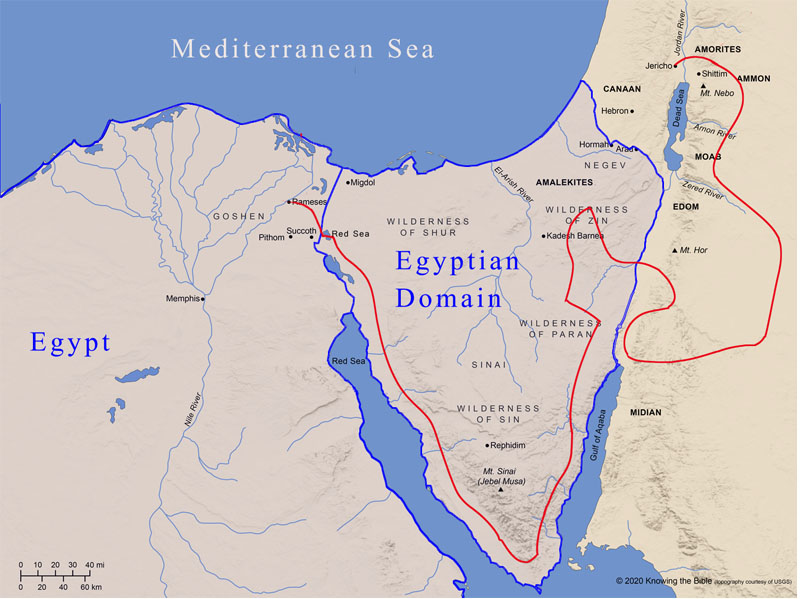
Israelite Journeys Rameses
|
Shalom! Along with truth and justice, peace is among the most hallowed of Jewish values. The word shalom is more than just hello or goodbye, and more than just a simple 'peace be with you'. It is more along the lines of, "may you be filled with a complete and perfect peace and be full of well-being". The word suggests a state of fullness and perfection; overflowing inner and outer joy and peaceful serenity. The peace offering took place after all the other offerings. The peace offering was not for forgiveness (atonement), it was a celebration of communion with God. The Hebrew word for the peace offering is "Shelamin," which like Shalom represented a sacrificial gift brought by the Israelite in thanksgiving for the peace, friendship, and fellowship he experienced with God. After God's portion was burnt on the altar, a meal between two or more parties would share the meal together in fellowship of peace and a commitment to each others' future prosperity. For many Hebrews, this may have been the only time they ever ate meat. The Peace Offering:
Leviticus 22:21-22 When a man presents a peace offering to the LORD from the herd or flock to fulfill a vow or as a freewill offering, it must be without blemish or defect to be acceptable. You are not to present to the LORD any animal that is blind, injured, or maimed, or anything with a running sore, a festering rash, or a scab; you must not put any of these on the altar as a food offering to the LORD. Instructions for the sacrifice from the herd (cow or bull) or from the flock (sheep or goat). In all cases, only the fat and kidneys were offered to the Lord and the meat was divided between the priests and the offeror. The sacrifice was similar to the burnt-offering. It must be free of defects, he must offer it in the court of the tabernacle, place his hand upon its head and kill it at the door of the tabernacle. The priest had to sprinkle blood around the altar. However, birds were not permitted as a sacrifice in the peace offering, since there was no fat to be burnt on the altar. Leviticus 3:1-5 'When his offering is a sacrifice of a peace offering, if he offers it of the herd, whether male or female, he shall offer it without blemish before the Lord. And he shall lay his hand on the head of his offering, and kill it at the door of the tabernacle of meeting; and Aaron's sons, the priests, shall sprinkle the blood all around on the altar. Then he shall offer from the sacrifice of the peace offering an offering made by fire to the Lord. The fat that covers the entrails and all the fat that is on the entrails, the two kidneys and the fat that is on them by the flanks, and the fatty lobe attached to the liver above the kidneys, he shall remove; and Aaron's sons shall burn it on the altar upon the burnt sacrifice, which is on the wood that is on the fire, as an offering made by fire, a sweet aroma to the Lord. These initial instructions apply only if the animal being sacrificed is from the herd (a cow or ox), either male or female, giving the worshiper choices. Blood was so scattered that the whole altar was covered. The offering was burnt on the altar as a "sweet aroma to the Lord." The burning was the visible evidence that the sacrifices were accepted by God. Four portions, which contained practically all the fat inside the animal were to be burnt as an offering to God. (1) the fat (suet) that covered the inards, (2) all the fat that is closely attached to the intestines, (3) the two kidneys, and the fat by the flanks, and (4) the caul—the thin net-like membrane which contains fat which is located above the liver that surrounds the internal organs. Leviticus 3:6-8 'If his offering as a sacrifice of a peace offering to the Lord is of the flock, whether male or female, he shall offer it without blemish. If he offers a lamb as his offering, then he shall offer it before the Lord. And he shall lay his hand on the head of his offering, and kill it before the tabernacle of meeting; and Aaron's sons shall sprinkle its blood all around on the altar. Putting the hand on the head was intended to be more than just touching the animal's head. The Hebrew word "semicha" implies pressure or leaning upon an object. Thus, the laying on of hands was to be done with all one's strength. The offeror made some statement of his intention in bringing his offering, and prayed that the sacrifice might be graciously accepted. The expression 'all his strength' might then refer to mental as well as physical energy. In the case of the peace offering, a worshiper would give thanks to God instead of confessing sins. Leviticus 3:9-11'Then he shall offer from the sacrifice of the peace offering, as an offering made by fire to the Lord, its fat and the whole fat tail which he shall remove close to the backbone. And the fat that covers the entrails and all the fat that is on the entrails, the two kidneys and the fat that is on them by the flanks, and the fatty lobe attached to the liver above the kidneys, he shall remove; and the priest shall burn them on the altar as food, an offering made by fire to the Lord. All the sacrifices were to be in perfect condition, without any imperfections or defects. In North America, most of our sheep breeds don't have fatty tails like the ones mentioned in here but in Palestine, a species of sheep still exists of which the tails are not less than four and a half feet length, the broad part often weighing fifteen pounds and upwards. Lambs had a great deposit of fat in the tail. Another great deposit of fat was the part near the backbone. Next are the instruction for a ram or ewe. In the sacrificial system, the fat was considered the richest part and was reserved for God alone. This symbolizes giving God the best of what we have, acknowledging His supreme worthiness and our dependence on Him. The liver was seen as a vital organ, essential for life, and its inclusion in the sacrifice highlights the totality of the offering. It represents the surrender of one's life force and vitality to God, acknowledging Him as the source of life. Leviticus 3:12-16 'And if his offering is a goat, then he shall offer it before the Lord. He shall lay his hand on its head and kill it before the tabernacle of meeting; and the sons of Aaron shall sprinkle its blood all around on the altar. Then he shall offer from it his offering, as an offering made by fire to the Lord. The fat that covers the entrails and all the fat that is on the entrails, the two kidneys and the fat that is on them by the flanks, and the fatty lobe attached to the liver above the kidneys, he shall remove; and the priest shall burn them on the altar as food, an offering made by fire for a sweet aroma; all the fat is the Lord's. Although the goat could not be compared with the worth of the bullock or sheep, God accepted goats in the peace offering. It was suitable to represent the Jew who could not bring either. The same general directions were similar to the lamb but the goat does not have the fat tail. The kidneys were considered the seat of emotion and thought in ancient Hebrew culture, symbolizing the innermost being of a person. Offering the kidneys in a sacrifice represented a deep, personal surrender to God, signifying the worshiper's desire to give their innermost thoughts and emotions to the Lord. Leviticus 3:17 'This shall be a perpetual statute throughout your generations in all your dwellings: you shall eat neither fat nor blood.'" Teaching and passing down God's laws to future generations, ensures that His statutes remain a central part of the community's life and identity. It applies universally to the Israelites wherever they reside. Blood and fat was universally forbidden, for the same reason because it was God's part of every sacrifice. As for the fat, it means the fat of the inwards, the suet. Whatever adhered to other parts, or was intermixed with them, was not forbidden. It is a common practice of idolaters to to drink the blood of their sacrifices during their rituals both ancient and modern times. God wanted His people separated from these pagan rituals, and to instead recognize that life and blood are strongly connected. Leviticus 7:11-14 'This is the law of the sacrifice of peace offerings which he shall offer to the Lord: If he offers it for a thanksgiving, then he shall offer, with the sacrifice of thanksgiving, unleavened cakes mixed with oil, unleavened wafers anointed with oil, or cakes of blended flour mixed with oil. Besides the cakes, as his offering he shall offer leavened bread with the sacrifice of thanksgiving of his peace offering. And from it he shall offer one cake from each offering as a heave offering to the Lord. It shall belong to the priest who sprinkles the blood of the peace offering. The phrase, "Thanksgiving Peace Offering," comes from the Hebrew word "todah" which means thank you. The peace offering might be used, for example, to express gratitude for blessings that have been granted to the individuals or prayers that have been answered such as deliverance from illness, enemies or adversity.
There were three different kinds of peace offerings: a thanksgiving offering, a freewill offering, or to fulfill a vow. If the offering was for a sacrifice of thanksgiving, the offeror was to bring three types of unleavened bread, loaves of bread, and cakes of oiled bread, and wafers. Although these verses do not specify how many of each, there was a rule in the second Temple with regard to this offering: The offeror brought twenty tenths or a half gallon of fine flour; ten of them he made leavened and ten he left unleavened. He made the leavened into ten cakes, and of the ten that were unleavened he made thirty cakes. These thirty unleavened cakes, which were made with half a pint of oil, were divided into three tens, and each ten was prepared in a different manner; that is, ten with an eighth of the oil were baked in the oven, ten with another eighth of the oil were made into wafers, and ten with a fourth of the oil were hastily fried. This is one of the unique places that leavened bread is used. Using leavened bread during an offering occurs only in two other places, at the feast of first fruits and the feast of Pentecost. Leviticus 7:35-36 This is the consecrated portion for Aaron and his sons, from the offerings made by fire to the Lord, on the day when Moses presented them to minister to the Lord as priests. The Lord commanded this to be given to them by the children of Israel, on the day that He anointed them, by a statute forever throughout their generations. Of the forty cakes the priest received four, one of each sort, thus obtaining a tenth part. No portion of the leavened bread was burnt, for leaven was forbidden to be on the altar. Instead, the priest ceremonially raised and lowered the breads in dedication to God as a heave offering–lifting it up to the Lord and receiving it back from Him. Leviticus 7:15-18 'The flesh of the sacrifice of his peace offering for thanksgiving shall be eaten the same day it is offered. He shall not leave any of it until morning. But if the sacrifice of his offering is a vow or a voluntary offering, it shall be eaten the same day that he offers his sacrifice; but on the next day the remainder of it also may be eaten; the remainder of the flesh of the sacrifice on the third day must be burned with fire. And if any of the flesh of the sacrifice of his peace offering is eaten at all on the third day, it shall not be accepted, nor shall it be imputed to him; it shall be an abomination to him who offers it, and the person who eats of it shall bear guilt. A vow or votive offering is a solemn promise, oath or pledge to give something or do a particular thing for God's glory in return for some blessings expected from Him. Someone might vow to consecrate themselves, or their children to the service of the tabernacle, offer a specific animal as a sacrifice, or even real estate to God if a particular situation is resolved favorably. A voluntary offering, was given without any particular condition or obligation. It was a testimony of one's faith and love rejoicing in his peace with God. Unlike other sacrifices that had to be consumed on the first day, the votive and voluntary offering could be left for one night and finished on the next day. A thanksgiving offering must be eaten on the day it is offered, the day ending at midnight, according to the Jewish canons. However, if it was a vow or voluntary offering, it was to be consumed within two days. Anything left over was to be destroyed by burning to guard against the danger of a desecration of the meal. If the sacrifice was not accompanied with obedience, and consumed within two days, it was not accepted and threatens transgressors with severe punishment.
Vows held profound spiritual and moral significance, serving as solemn promises made to God. These commitments were not to be taken lightly, as they represented a binding agreement between the individual and the Lord. Leviticus 27:1-29 contains some rules and instructions concerning vows, which were not required by a command of the law, but given of his own freewill to God. The gravity of making a vow is underscored by the potential consequences of breaking it. This undertaking is binding upon the person it is fulfilled. Leviticus 19:5-8 'And if you offer a sacrifice of a peace offering to the Lord, you shall offer it of your own free will. It shall be eaten the same day you offer it, and on the next day. And if any remains until the third day, it shall be burned in the fire. And if it is eaten at all on the third day, it is an abomination. It shall not be accepted. Therefore everyone who eats it shall bear his iniquity, because he has profaned the hallowed offering of the Lord; and that person shall be cut off from his people. Under no condition in the Israelite system of sacrifices could an offering be eaten after the second day. Individuals who blatantly chose not to obey, merited God's judgment. The phrase "shall be cut off from his people" likely refers to either excommunication from the community or divine judgment. The penalty shows that there were severe consequences for disobedience and rebellion against God's holy commands. Leviticus 7:28-34 Then the Lord spoke to Moses, saying, "Speak to the children of Israel, saying: 'He who offers the sacrifice of his peace offering to the Lord shall bring his offering to the Lord from the sacrifice of his peace offering. His own hands shall bring the offerings made by fire to the Lord. The fat with the breast he shall bring, that the breast may be waved as a wave offering before the Lord. And the priest shall burn the fat on the altar, but the breast shall be Aaron's and his sons'. Also the right thigh you shall give to the priest as a heave offering from the sacrifices of your peace offerings. He among the sons of Aaron, who offers the blood of the peace offering and the fat, shall have the right thigh for his part. For the breast of the wave offering and the thigh of the heave offering I have taken from the children of Israel, from the sacrifices of their peace offerings, and I have given them to Aaron the priest and to his sons from the children of Israel by a statute forever.'" It was not enough to simply provide the offering. The worshiper had to present it with their own hands to signify that the sacrifice was voluntary. This act of participation signified a personal commitment and dedication to God. The officiating priest would lay the breast on the hands of the offeror. He would support the hands of the offeror moving his hands towards the altar and back several times. This was to acknowledge God's presence and then it was given to the Aaron and his sons. One of the ways the priests and their families were taken care of was through the portions of some of the offerings that were brought to the worship of the Lord. The right thigh of the sacrifice was a heave offering which was "heaved" or lifted up once before the Lord as a symbolic gesture of dedication and dependence on God. This portion was given to the priest who offers the blood and the fat of the peace offering. The heave-offering could take various forms, including portions of grain, oil, wine, and meat. The idea conveyed by a heave-offering was the taking up a part to offer it to God; whereas the idea of the wave-offering is more general, implying consecration to God, for it was waved before the Lord. If two persons brought a peace offering in partnership, one of them waved for both; and if a woman brought it, the waving was performed by the officiating priest, since women were not allowed to perform the wave offering. Leviticus 17:1-7 And the Lord spoke to Moses, saying, "Speak to Aaron, to his sons, and to all the children of Israel, and say to them, 'This is the thing which the Lord has commanded, saying: "Whatever man of the house of Israel who kills an ox or lamb or goat in the camp, or who kills it outside the camp, and does not bring it to the door of the tabernacle of meeting to offer an offering to the Lord before the tabernacle of the Lord, the guilt of bloodshed shall be imputed to that man. He has shed blood; and that man shall be cut off from among his people, to the end that the children of Israel may bring their sacrifices which they offer in the open field, that they may bring them to the Lord at the door of the tabernacle of meeting, to the priest, and offer them as peace offerings to the Lord. And the priest shall sprinkle the blood on the altar of the Lord at the door of the tabernacle of meeting, and burn the fat for a sweet aroma to the Lord. They shall no more offer their sacrifices to demons, after whom they have played the harlot. This shall be a statute forever for them throughout their generations." ' Prior to the building of the tabernacle, people were allowed to build altars, and offer sacrifices to God, in various locations. Priests were not ordained as of yet so every master of a family was a priest to his own family. However, when the Israelites were in Egypt, they were not immune to the temptations of superstition and idolatry. Meat offered to idols was eaten as a form of worship. God gave animal flesh to humankind as food but eating meat was a luxury; something usually reserved for special occasions. When they did kill a lamb or a kid for food, it would almost always be an occasion of a feast, to be eaten in company. The Israelites, like other people living in the desert, had a limited supply of livestock. The animals were reserved for sacrifices, producing milk, wool, bearing burdens, and doing hard work. In addition they preserved what cattle they had, for breeding in anticipation of entering the Promised Land. Part of their wealth included the amount of livestock they owned. The desert did not have pastures for the cattle so their herds may have been nearly exhausted during their prolonged wilderness journey. The people lived primarily on manna which may have also provided food for the animals. Killing an ox or lamb or goat refers specifically to killing for the sake of sacrifice. These rules were meant to protect the integrity of the sacrificial system that God designed and the priesthood God instituted. God insisted that Israel was forbidden to kill any animal in any place but the tabernacle in order to block them from any form of sacrifice that might be used to worship the pagan gods. He established a place for the Israelites to bring their sacrifices. No sacrifice should be offered by anyone except the priests, and only at the door of the tabernacle. The statute they were to "keep throughout their generations" referred to the sacrifices to demons. While the Israelites were in the wilderness and the tabernacle was in the midst of their camp, they were only to eat the meat of the peace offering that had first been offered to God. God changed that regulation just before Israel entered into Canaan. Once they were settled in the land, a new provision was given. Leviticus 7:19-21 'The flesh that touches any unclean thing shall not be eaten. It shall be burned with fire. And as for the clean flesh, all who are clean may eat of it. But the person who eats the flesh of the sacrifice of the peace offering that belongs to the Lord, while he is unclean, that person shall be cut off from his people. Moreover the person who touches any unclean thing, such as human uncleanness, an unclean animal, or any abominable unclean thing, and who eats the flesh of the sacrifice of the peace offering that belongs to the Lord, that person shall be cut off from his people.'" An offering must be made with great reverence. It is considered "consecrated" or dedicated to God, and anything that comes into contact with it must share that sacred status. The flesh, and those that eat it, must be also be pure, including the offeror and anyone he invites to partake of the meal. God dealt severely with those who knowingly and willfully contaminated that which was holy. The phrase "cut off from his people" sometimes refers to death and other times refers to excommunication or the termination of one's line, depending on the context. There were multiple things that could cause a person to be unclean. Uncleanness was almost always a temporary state, typically only lasting a week or so. The laws listed in Leviticus 11-15 identify the causes of uncleanness and also give instructions for how one can be made clean once again. Once a person had been made clean, they could come and offer their sacrifices in the tabernacle again without violating the presence of God. The portion of the sacrificial meal that was given to the worshiper was taken home to share with his family, servants and other guests. Strict cleanliness laws had to be followed. All who participated in the meal must be clean. Likewise, the place where they ate must be clean and undefiled. |
| Cassie, Matt, Joe | |