Leviticus - Moral Purity Laws
Timeline: 1451 BC
(Leviticus 18 - 20)
|
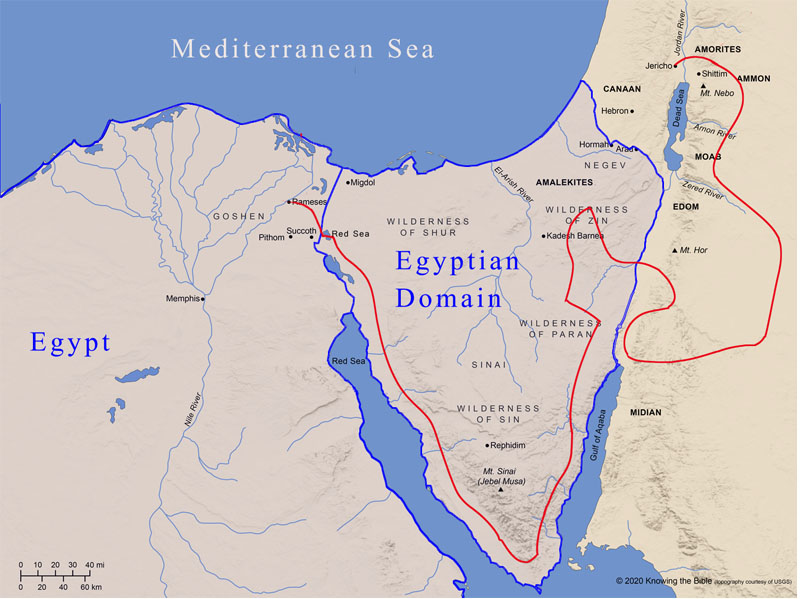
Israelite Journeys Rameses
|
Punishments for Unlawful Sexual Immorality Leviticus 18:1 Then the LORD said to Moses, "Speak to the Israelites and tell them: I am the LORD your God. You must not follow the practices of the land of Egypt, where you used to live, and you must not follow the practices of the land of Canaan, into which I am bringing you. You must not walk in their customs. Israel was positioned between Egypt, their past home, and Canaan, their future destination, both of which were notorious for sexual depravity. Consequently, God's laws were designed to distinguish His people and protect them from the immoral behaviors prevalent in both lands. Leviticus 18:4 You are to practice My judgments and keep My statutes by walking in them. I am the LORD your God. Keep My statutes and My judgments, for the man who does these things will live by them. I am the LORD. God establishes His identity to emphasize that Israel belongs solely to Him. Consequently, they are commanded to live by His standards. They must follow His laws and strictly avoid the immoral, pagan customs common among surrounding nations. Leviticus 18:6 None of you are to approach any close relative to have sexual relations. I am the LORD. In the beginning, sibling intermarriage was necessary to populate the earth. The laws against incestuous relations were not recognized until about 2,500 years after creation, long after Abraham. Early humans had less corrupted genetic codes, making close intermarriage safer initially, but once the human race expanded and, due to sin, the human genetic code grew more corrupt, God commanded against the marriage of close relatives. Leviticus 18:7-20 and Leviticus 20:1-21 outline strict prohibitions against incest, adultery, and various forms of sexual immorality, forbidding relations with close relatives (parents, siblings, in-laws, grandchildren), a neighbor's wife, or a woman during menstruation. These laws aimed to set Israel apart from Canaanite practices, emphasizing that such acts bring shame, dishonor, and impurity upon individuals and their families. "Exposing the nakedness" is not typically about casual nudity but rather a violation of moral and sexual boundaries. Leviticus 18:7 You must not expose the nakedness of your father by having sexual relations with your mother. She is your mother; you must not have sexual relations with her. Leviticus 18:8 You must not have sexual relations with your father's wife; it would dishonor your father.
Leviticus 18:9 You must not have sexual relations with your sister, either your father's daughter or your mother's daughter, whether she was born in the same home or elsewhere.
Leviticus 18:10 You must not have sexual relations with your son's daughter or your daughter's daughter, for that would shame your family. Leviticus 18:11 You must not have sexual relations with the daughter of your father's wife, born to your father; she is your sister. Leviticus 18:12 You must not have sexual relations with your father's sister; she is your father's close relative. Leviticus 18:13 You must not have sexual relations with your mother's sister, for she is your mother's close relative.
Leviticus 18:14 You must not dishonor your father's brother by approaching his wife to have sexual relations with her; she is your aunt.
Leviticus 18:15 You must not have sexual relations with your daughter-in-law. She is your son's wife; you are not to have sexual relations with her.
Leviticus 18:16 You must not have sexual relations with your brother's wife; that would shame your brother.
Leviticus 18:17 You must not have sexual relations with both a woman and her daughter. You are not to marry her son's daughter or her daughter's daughter and have sexual relations with her. They are close relatives; it is depraved.
Leviticus 18:18 You must not take your wife's sister as a rival wife and have sexual relations with her while your wife is still alive. Leviticus 18:19 You must not approach a woman to have sexual relations with her during her menstrual period.
Leviticus 18:20 You must not lie carnally with your neighbor's wife and thus defile yourself with her.
Leviticus 18:21 You must not give any of your children to be sacrificed to Molech, for you must not profane the name of your God. I am the LORD.
Molech was a Canaanite deity, likely representing a king, known primarily for rituals involving child sacrifice. Worship was associated with extreme fertility rites, often performed during times of severe drought or famine to appease the deity. It was a brass and hollow image, bull-headed, with arms stretched out like a human being who opens his hands to receive something from his neighbor. A fire was kindled in Molech till its arms became red hot; the child was then put into its hands, and drums were beaten to produce tremendous noises so as to prevent the shrieks of the child reaching the father's ears, lest he should be moved with pity towards his offspring. This idolatrous worship was detestable to God, punished by communal stoning, the most severe mode of capital punishment among the Hebrews.
If a community ignores, disregards, overlooks the crime and fails to carry out justice, God declares He will "set His face against" the offender and those who ignored the sin. This includes the removal of God's protection and a deliberate, personal involvement in their punishment. Leviticus 18:22 You must not lie with a man as with a woman; that is an abomination. Homosexuality is the sin commonly known as "sodomy" which originates from the biblical story of Sodom. Christian authorities began to label and condemn acts of sodomy as the worst of all sexual sins, and one of the worst crimes in general.
Leviticus 18:23 You must not lie carnally with any animal, thus defiling yourself with it; a woman must not stand before an animal to mate with it; that is a perversion. This degrading practice actually formed a part of the religious worship of the Egyptians in connection with the goat deities. Sexual contact between humans and animals carries severe risks, including physical injury, transmission of diseases, psychological harm, and legal consequences. The practice can be dangerous for both the human and the animal involved. Leviticus 20:15 If a man lies carnally with an animal, he must be put to death. And you are also to kill the animal.
Leviticus 18:24 Do not defile yourselves by any of these practices, for by all these things the nations I am driving out before you have defiled themselves. Even the land has become defiled, so I am punishing it for its sin, and the land will vomit out its inhabitants. The reason the Canaanites were being cast out is because they became thoroughly corrupted by their immoral sexual practices and spiritual defilement. The land is not mere property but a holy entity that cannot tolerate the inhabitants' sin. Sin has environmental and communal consequences, not just individual ones. Holiness is necessary to remain in the land. Leviticus 18:26 But you are to keep My statutes and ordinances, and you must not commit any of these abominations—neither your native-born nor the foreigner who lives among you. For the men who were in the land before you committed all these abominations, and the land has become defiled. So if you defile the land, it will vomit you out as it spewed out the nations before you. History shows that when cultures advocate these behaviors, they eventually collapse. The Canaanite nations were driven out of their land by God because of detestable practices, including child sacrifice to Molech, incest, bestiality, and sexual immorality. The Israelites were warned not to adopt the practices of the Canaanites. When they did, they were conquered and exiled by the Assyrians. Jerusalem and the Temple were destroyed, and the people were exiled to Babylon because the land was defiled by "innocent blood" shed and injustice. The Roman Destruction of Jerusalem occurred as a direct consequence of rejecting the Messiah and the new covenant. The Ming Dynasty was plagued by weak emperors, oppressive taxation, and political paralysis, leading to its downfall. The Roman Empire faced corruption, inefficient leadership, and a rapid turnover of emperors who often gained power through violence which caused it's collapse. Leviticus 18:29 Therefore anyone who commits any of these abominations must be cut off from among his people. You must keep My charge not to practice any of the abominable customs that were practiced before you, so that you do not defile yourselves by them. I am the LORD your God." Being "cut off" implies a severe form of punishment, which could mean excommunication, banishment, or even death, depending on the context and the specific transgression. The danger of these atrocities lies in their power to turn the whole community away from its holy path. The presence of sin could bring judgment upon the entire nation. Separation from sin is necessary for holiness among God's people. Commandments for Holiness Leviticus 19:1 Then the LORD said to Moses, "Speak to the whole congregation of Israel and tell them: Be holy because I, the LORD your God, am holy. The following verses contain explanations of the ten commandments. God wanted the Israelites to strive for holiness and godliness. He wanted His people to have a unique identity separate from the rest of the world. They were chosen to be a "kingdom of priests," demonstrating God's power and character to the rest of the world. That meant carrying higher responsibilities, stricter accountability, and the obligation to be a holy example. Moses is to deliver the summary of the laws to all the people. Eight of the ten commandments are not arranged in order because the chapter acts as a "Holiness Code" applying the Commandments to daily life, rather than reciting them as a formal, legal covenant. The phrase "I am the Lord your God occurs more than twenty times in Leviticus. God proclaims His authority to express His commitment to His promises. Repeating this phrase creates a sense of security and safety. Leviticus 19:3 Each of you must respect his mother and father, and you must keep My Sabbaths. I am the LORD your God. This verse begins with the fifth commandment. In ancient Israel, the family was the primary unit of society, and honoring parents was seen as honoring God Himself. This respect extends beyond mere obedience to include care and provision, especially as parents age. Next is the forth commandment, Observing the Sabbath, was a way for the Israelites to rest and worship, reflecting God's rest on the seventh day of creation. The spirituality of the nation depended upon the proper observance of the sabbaths. Leviticus 19:4 Do not turn to idols or make for yourselves molten gods. I am the LORD your God. This command is a direct prohibition against idolatry In the ancient Near East, idol worship was common. The Israelites were to remain distinct from the Canaanites and other neighboring cultures, who often worshiped multiple gods. The phrase "molten gods" refers to idols made by melting metal and casting it into a form, often representing deities. Leviticus 19:5 When you sacrifice a peace offering to the LORD, you shall offer it for your acceptance. It shall be eaten on the day you sacrifice it, or on the next day; but what remains on the third day must be burned up. If any of it is eaten on the third day, it is tainted and will not be accepted. Whoever eats it will bear his iniquity, for he has profaned what is holy to the LORD. That person must be cut off from his people. The peace offering, also known as the fellowship offering, symbolized peace and fellowship with God. A peace offering must be offered in the prescribed manner or it will be rejected. Violating sacred laws signified a total removal from God's favor and separation from the community of Israel. Love Your Neighbor This phrase is heavily emphasized by Jesus as the second greatest commandment after loving God. This command fulfills the essence of all moral laws regarding human relationships. Leviticus 19:9 When you reap the harvest of your land, you are not to reap to the very edges of your field or gather the gleanings of your harvest. You must not strip your vineyard bare or gather its fallen grapes. Leave them for the poor and the foreigner. I am the LORD your God. Farming was a primary occupation of the Israelites and vineyards were a common source of livelihood. Gleanings refer to the leftover crops that fall during the harvest. This law was to take effect once they established themselves in the Promised Land. These instructions highlight the responsibility of the community to care for those less fortunate. Leviticus 19:11 You must not steal. You must not lie or deceive one another. Truthfulness is a reflection of God's character. Therefore He cannot endorse falsehood among His people. Because He is truthful, faithful, and just, His people are called to reflect His holiness and truthfulness in actions and words. Love for neighbor means no stealing, lying, or deceiving. Leviticus 19:12 You must not swear falsely by My name and so profane the name of your God. I am the LORD. In the cultural context of the Israelites, a name was more than just a label; it represented the essence and reputation of the person. God's name, therefore, was to be held in the highest regard, reflecting His holiness in their words. Leviticus 19:13 You must not defraud your neighbor or rob him. You must not withhold until morning the wages due a hired hand. The Hebrew word for "defraud" implies deceit or trickery. In the ancient Near Eastern context, where community and familial ties were strong, defrauding a neighbor would have been a serious breach of trust and a deliberate breaking of God's commands. Day laborers were often poor and relied on daily wages for survival. Withholding wages would have violated the principle of justice and, rejecting God's authority, crossing a set moral boundary. Leviticus 19:14 You must not curse the deaf or place a stumbling block before the blind, but you shall fear your God. I am the LORD. While this is a literal command not to endanger the blind, it also carries a metaphorical weight, urging believers to avoid causing others to fall into sin or difficulty. Leviticus 19:15 You must not pervert justice; you must not show partiality to the poor or favoritism to the rich; you are to judge your neighbor fairly. Maintaining integrity and fairness in legal matters is not just a legal obligation but a moral one. The common human tendency to favor the wealthy or to show priority to the poor are both condemned. Justice must remain pure and unaltered, reflecting the impartiality of God, who judges all people equally. Leviticus 19:16 You must not go about spreading slander among your people. You must not endanger the life of your neighbor. I am the LORD. The Hebrew word for "slander" can also mean "to go about as a talebearer," indicating the destructive nature of gossip. The warning against the dangers of gossip, highlights its potential to ruin relationships and reputations. Believers are instructed not to speak evil against one another. Actions that might put others at risk, whether through negligence, malice, or indifference can result in severe personal injury or death. God desires His people to live in truth and love, fostering unity and peace. Leviticus 19:17 You must not harbor hatred against your brother in your heart. Directly rebuke your neighbor, so that you will not incur guilt on account of him. Do not seek revenge or bear a grudge against any of your people, but love your neighbor as yourself. I am the LORD. Harboring secret resentment is considered a breach of duty and a form of hidden hatred. Directly confront a neighbor about their sin in humility and compassion, aiming to bring the person to repentance and restoration. True love sometimes requires the difficult task of pointing out error. Refusing to speak out or act against immoral acts makes one guilty of allowing them to continue. The term "neighbor" extends beyond immediate kin to include all members of the community. Keep My Statutes Obedience to God's laws underscores the covenantal relationship between God and His people. Leviticus 19:19 You are to keep My statutes. You shall not crossbreed two different kinds of livestock; you shall not sow your fields with two kinds of seed; and you shall not wear clothing made of two kinds of material. God did not want His people imitating the superstitious practices of the idolatrous nations surrounding them. The laws against improper mixtures could have been to remind the Israelites of their responsibility to be separate and holy. The Mosaic Law required purity to extend to all that God's people touched. Leviticus 19:20 If a man lies carnally with a slave girl promised to another man but who has not been redeemed or given her freedom, there must be due punishment. But they are not to be put to death, because she had not been freed. The man, however, must bring a ram to the entrance to the Tent of Meeting as his guilt offering to the LORD. The priest shall make atonement on his behalf before the LORD with the ram of the guilt offering for the sin he has committed, and he will be forgiven the sin he has committed. Slavery was a part of the social structure in ancient Israel. Laws were given to regulate and protect those in servitude. In this case, a slave girl is engaged to another man, but is still serving as a slave and is under the ownership of another person. If a man has sex with her, the law demands accountability and justice. However, unlike adultery, which is punishable by death, the consequences were less severe. The man was required to bring a guilt offering for restitution and sacrifice. Leviticus 19:23 When you enter the land and plant any kind of tree for food, you shall regard the fruit as forbidden. For three years it will be forbidden to you and must not be eaten. In the fourth year all its fruit must be consecrated as a praise offering to the LORD. But in the fifth year you may eat its fruit; thus your harvest will be increased. I am the LORD your God. The trees planted by the inhabitants of Canaan before the Israelites took possession of it, were exempt from this law. It only applies to fruit-trees intended for food, such as citron-trees, olive-trees, fig-trees, vines, etc. In the first three years fruit-trees bear only a little tasteless fruit. Blossoms or fruit are broken off to that it will thrive better and bear more abundantly afterwards. The fruits must not be sold, but must either be burnt, or buried in the ground. God requires the first-fruits, so they must be of the best. Leviticus 19:26 You must not eat anything with blood still in it. You must not practice divination or sorcery. Blood represents the sacredness of life, and is meant for atonement rather than sustenance. When an animal is slaughtered for food, the blood must be drained out. Some have suggested God may have given this command for health reasons; eating uncooked meat can lead to disease or sickness. Divination and sorcery were common practices among Israel's neighboring cultures, such as the Canaanites and Egyptians, who relied on omens, astrology, and necromancy. Such practices are considered abominations because they divert trust and dependence away from God and towards false spiritual powers. Leviticus 19:27 You must not cut off the hair at the sides of your head or clip off the edges of your beard. Hair was often associated with one's identity and status and so to distinguish the Israelites from surrounding pagan cultures, they were to avoid adopting the customs of other nations which practiced specific hair-cutting rituals as part of idol worship or mourning rites. In a broader biblical context, the beard is sometimes seen as a symbol of maturity and wisdom Leviticus 19:28 You must not make any cuts in your bodies for the dead or put tattoo marks on yourselves. I am the LORD. Pagans would cut themselves as a mourning ritual to honor or appease the dead. Israelites ware reminded that they are children of God and should not adopt pagan mourning practices. Tattoos marked allegiance to a deity as part of pagan rituals. The body is a temple of the Holy Spirit and should not be defiled, permanently altered, or marked to align with worldly, occult, or rebellious symbols. Leviticus 19:29 You must not defile your daughter by making her a prostitute, or the land will be prostituted and filled with depravity. Temple prostitution was sometimes practiced as part of pagan worship. God calls for ethical and moral conduct for His people. The concept of the land being "prostituted" suggests that moral corruption and wickedness defile not just individuals but the entire community and the land itself. Leviticus 19:30 You must keep My Sabbaths and have reverence for My sanctuary. I am the LORD. These commands were central to the worship and community life of the Israelites. Observing the Sabbath was an act of trust and obedience, acknowledging God as the provider of all their needs. God called His people to treat the tabernacle/Temple space with great respect, recognizing it as holy ground set apart for worship. Leviticus 19:31 You must not turn to mediums or spiritists; do not seek them out, or you will be defiled by them. I am the LORD your God. Mediums" (those who contact the dead) and "familiar spirits" (often associated with demonic influence) refer to supernatural consultation forbidden by God. Seeking these sources spiritually contaminates the person, rendering them unsuitable for fellowship with a holy God.
The same punishment will be carried out for those who that turned to familiar spirits and necromantists. Such practices being are always closely connected with idolatry. Leviticus 19:32 You are to rise in the presence of the elderly, honor the aged, and fear your God. I am the LORD. Showing respect to the elderly were often leaders within the community. Rising in their presence was a physical demonstration of respect and acknowledgment of their status. Fearing God involves recognizing His authority and holiness. Leviticus 19:33 When a foreigner resides with you in your land, you must not oppress him. You must treat the foreigner living among you as native-born and love him as yourself, for you were foreigners in the land of Egypt. I am the LORD your God. The term "foreigner" refers to those who were not native-born Israelites but chose to live within the community. Outsiders often had no legal rights or protection. Israelites were reminded that they were once oppressed and were to have empathy for them. Leviticus 19:35 You must not use dishonest measures of length, weight, or volume. You shall maintain honest scales and weights, an honest ephah, and an honest hin. I am the LORD your God, who brought you out of the land of Egypt. Honesty in measurements reflects God's character of truth and justice. Those who act dishonestly are detestable to the Lord. An honest ephah is a biblical standard for fair, accurate dry measure (roughly 22 liters or 5.8 gallons). Leviticus 19:37 You must keep all My statutes and all My ordinances and follow them. I am the LORD."
The statutes and ordinances refer to the various laws, decrees, and commandments that God provided through Moses.
Respect for parents was seen as respect for God's ordained order. Cursing, in this context, implies a severe form of disrespect or rebellion, not merely using foul language but invoking harm or wishing evil upon one's parents. The cursing of parents was a capital crime. Such severe penalties were not uncommon for actions that threatened the social fabric. |