Leviticus - Making a Vow
Timeline: 1451 BC
(Leviticus 27:1–34; Deuteronomy 30:1-2, 10)
|
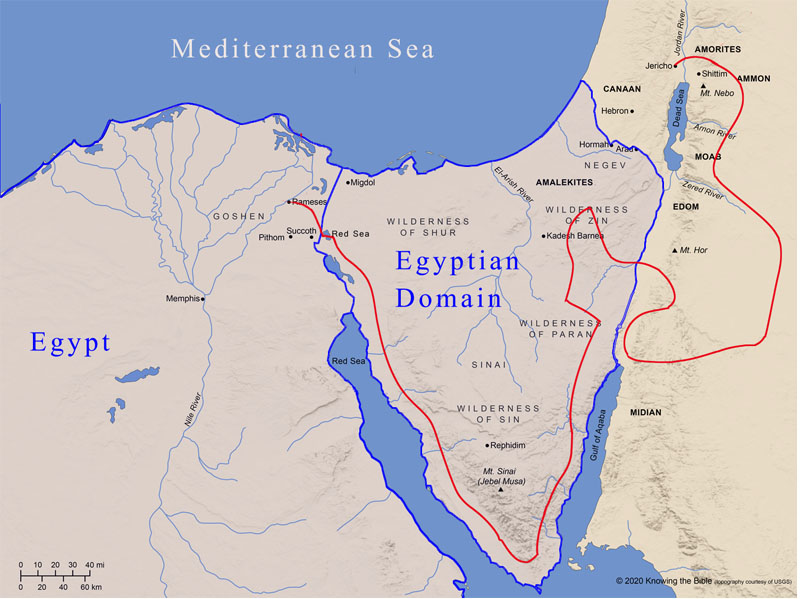
Israelite Journeys Rameses
|
In the time of illness, danger, distress or out of gratitude, one might make a rare type of vow that involves dedicating something or someone to the Lord. This is not a requirement but a promise freely given by the person. However, vows were serious and binding commitments to God that needed to be honored. Sometimes, people made rash vows then came to regret them. God provided a way to get out of the extraordinary vow without loss of the item vowed. Laws were set up to help prevent people from making an impulsive promise which would potentially have negative long-term consequences. A person who had made a vow to God was allowed to "buy back" a dedicated person or object by paying its valuation plus a premium (usually 20%). This system allowed for the support of the sanctuary and its priests through the payments made for redemption. Leviticus 27:1 Then the LORD said to Moses, "Speak to the Israelites and say to them, 'When someone makes a special vow to the LORD involving the value of persons, if the valuation concerns a male from twenty to sixty years of age, then your valuation shall be fifty shekels of silver, according to the sanctuary shekel. Or if it is a female, then your valuation shall be thirty shekels. And if the person is from five to twenty years of age, then your valuation for the male shall be twenty shekels, and for the female ten shekels. In biblical times, an individual's worth was determined by the volume of work they could perform. The greater the amount of strenuous labor a person could undertake, the higher their financial value. Males aged 20 to 60 were deemed more valuable in agricultural settings compared to females. This was due to their physical strength, which made them more suited for arduous tasks, toil, and labor-intensive work than women. Women were often seen as having limited capacity to generate income or possess wealth in a farming community. Their lower monetary value was not a reflection of their worth but rather a means to alleviate financial strain on themselves or their families. Childbearing was a primary responsibility, alongside cooking, cleaning, sewing, and caring for family livestock. Women also played a vital role as midwives, essential during childbirth, which could be a perilous experience. The Old Testament generally underscores the importance of honoring and protecting women. In contrast, men's responsibilities included being heads of households, providers, protectors, and leaders within their families and communities, often taking on roles as farmers, artisans, or warriors through various occupations such as agriculture, craftsmanship, or military service. Leviticus 27:6 Now if the person is from one month to five years of age, then your valuation for the male shall be five shekels of silver, and for the female three shekels of silver. And if the person is sixty years of age or older, then your valuation shall be fifteen shekels for the male and ten shekels for the female. But if the one making the vow is too poor to pay the valuation, he is to present the person before the priest, who shall set the value according to what the one making the vow can afford. The average wage of a worker at this point was about one shekel per month. So if a person did not wish to pay the redemption price, a 20 to 60 year old would be obligated for 50 months while a person from 5 to 10 years old was committed for 20 months. The requirement for a female was only 10 months. The Levitical clan was tasked with the establishment and maintenance of the Tabernacle. A person who was not a Levi could not perform service of the tabernacle, because he was not a priestly family. Therefore a payment was made in lieu of their service for the upkeep of the tabernacle/temple. Leviticus 27:9 If he vows an animal that may be brought as an offering to the LORD, any such animal given to the LORD shall be holy. He must not replace it or exchange it, either good for bad or bad for good. But if he does substitute one animal for another, both that animal and its substitute will be holy. If the animal was brought as a sacrifice, it had to be a clean animal and was dedicated or consecrated to God. It was only to be used for that purpose and could not be redeemed. However, if it was not fit for sacrifice because of blemish, and the person who vowed it made a substitution, both the blemished animal and the sacrificial animal would be considered holy and set apart and not returned to common uses. Leviticus 27:11 But if the vow involves any of the unclean animals that may not be brought as an offering to the LORD, the animal must be presented before the priest. The priest shall set its value, whether high or low; as the priest values it, the price will be set. If, however, the owner decides to redeem the animal, he must add a fifth to its value. A person could bring an unclean animal to fulfill a vow but could not be used as a sacrifice. The priest determines the value of the animal according to it's condition. If the owner does not redeem the animal, It could be used by the priest or sold and the proceeds could be used for the maintenance of the tabernacle/temple. However, if the owner wants to keep the animal, he must pay the value plus 20 percent. Leviticus 27:14 Now if a man consecrates his house as holy to the LORD, then the priest shall value it either as good or bad. The price will stand just as the priest values it. But if he who consecrated his house redeems it, he must add a fifth to the assessed value, and it will belong to him. Houses that were located inside walled cities could be sold permanently and was not bound by the law of Jubilee. The house that was given to honor a vow would be assigned a price by the priest, and if it was not redeemed, it may be sold, and the proceeds used for other purposed related to reparations or expenses of the sanctuary, or it could serve as accommodation for the priest. If the house was redeemed, the owner would pay the assessed value plus 20 percent and the money would go to the tabernacle treasury. Leviticus 27:16 If a man consecrates to the LORD a parcel of his land, then your valuation shall be proportional to the seed required for it—fifty shekels of silver for every homer of barley seed. If he consecrates his field during the Year of Jubilee, the price will stand according to your valuation. A person was not allowed to vow his entire estate, only a parcel of it. If he dedicates part of his inherited land to God, it was up to the priests to value that land based on the amount seed needed to sow it for forty-nine years, from one Jubilee year to another. Fifty shekels is approximately 1.26 pounds of silver. A homer is a dry measure of approximately 6.24 bushels of barley seed. If the field was consecrated during the year of Jubilee, the land is given to the priests for their use during that time. Leviticus 27:18 But if he consecrates his field after the Jubilee, the priest is to calculate the price in proportion to the years left until the next Year of Jubilee, so that your valuation will be reduced. And if the one who consecrated the field decides to redeem it, he must add a fifth to the assessed value, and it shall belong to him. If it consecrated after the Jubilee, the price is calculated on the number of years remaining until the next year of Jubilee. If a farmer had 100 bushels of grain set aside what was consecrated and wanted to keep it, the original owner or a family member would have to pay the cash equivalent of 100 bushels, plus 20 percent of that value. As long as the land was redeemed sometime before Jubilee, the owner did not lose ownership of the land. Leviticus 27:20 If, however, he does not redeem the field, or if he has sold it to another man, it may no longer be redeemed. When the field is released in the Jubilee, it will become holy, like a field devoted to the LORD; it becomes the property of the priests. If the one who dedicated the land does not redeem it by paying its assessed value plus a 20 percent increase before the Jubilee, it becomes forfeited and permanently belongs to the priests, consecrated forever to the Lord. If he sold the land to someone else, the purchaser was essentially leasing the land. The Law of restoration during Jubilee was overridden in this case, so if the owner did not redeem it, the land would become holy and belong to the priests. Leviticus 27:22 Now if a man consecrates to the LORD a field he has purchased, which is not a part of his own property, then the priest shall calculate for him the value up to the Year of Jubilee, and the man shall pay the assessed value on that day as a sacred offering to the LORD. In the Year of Jubilee the field shall return to the one from whom it was bought—the original owner of the land. Every valuation will be according to the sanctuary shekel, twenty gerahs to the shekel. Twenty gerahs is equivalent to one shekel (approximately 0.4 ounces). If a person purchased the land from a fellow-Israelite and then consecrates it, the value of the land was to be paid when the vow was made. The reason is that the land would revert back to the original owner free and clear during the year of Jubilee. Leviticus 27:26 But no one may consecrate a firstborn of the livestock, because a firstborn belongs to the LORD. Whether it is an ox or a sheep, it is the LORD's. But if it is among the unclean animals, then he may redeem it according to your valuation and add a fifth of its value. If it is not redeemed, then it shall be sold according to your valuation. Exodus 13:2 commands the Israelites to consecrate to God every firstborn male of both humans and animals. Firstborn male animals, such as oxen or sheep, were considered suitable for sacrifice. An unclean animal such as a donkey which was part of a vow, had to be redeemed at the price plus 20 percent valued by the priest. Otherwise the animal was sold and the money was given to the tabernacle treasury. Leviticus 27:28 Nothing that a man sets apart to the LORD from all he owns—whether a man, an animal, or his inherited land—can be sold or redeemed; everything so devoted is most holy to the LORD. Exodus 22:29-30 states that the first born of man and animals belong to the Lord. Leviticus 25:23 declares that the land belongs to God and the people of Israel are temporary stewards. Therefore they were not allowed to dedicate anything that already belonged to the Lord. Leviticus 27:29 No person set apart for destruction may be ransomed; he must surely be put to death. If a person was convicted and sentenced to death for capital crimes, he could not be redeemed. Leviticus 27:30 Thus any tithe from the land, whether from the seed of the land or the fruit of the trees, belongs to the LORD; it is holy to the LORD. If a man wishes to redeem part of his tithe, he must add a fifth to its value. Verses 1, 2 and 10 in Deuteronomy 26 explains the tithes: When you enter the land that the LORD your God is giving you as an inheritance, and you take possession of it and settle in it, you are to take some of the firstfruits of all your produce from the soil of the land that the LORD your God is giving you and put them in a basket. When you have finished laying aside a tenth of all your produce in the third year, the year of the tithe, you are to give it to the Levite, the foreigner, the fatherless, and the widow, that they may eat and be filled within your gates. Tithes could also be bought back from the LORD. For example, instead of tithing seed from his field, a farmer could pay the value of the seed plus 20%. Leviticus 27:32 Every tenth animal from the herd or flock that passes under the shepherd's rod will be holy to the LORD. He must not inspect whether it is good or bad, and he shall not make any substitution. But if he does make a substitution, both the animal and its substitute shall become holy; they cannot be redeemed.'" The owner was not allowed to choose the best or worst animals. The animals were counted as they passed single file under the staff of the herdsman. Every tenth animal was marked with a red colored stick, to show that it had been chosen for the tithe. This method prevented owners from selecting animals, regardless of its quality. Leviticus 27:34 These are the commandments that the LORD gave to Moses for the Israelites on Mount Sinai. This is the conclusion of Leviticus. This verse emphasizes that these regulations on sacrifices, purity, holiness, and the tithe were given for the benefit of the Israelites and were intended to guide their life and worship. |
Cassie, Matt, Joe |
|