Leviticus – Introduction
Timeline: 1451 BC
|
Resources
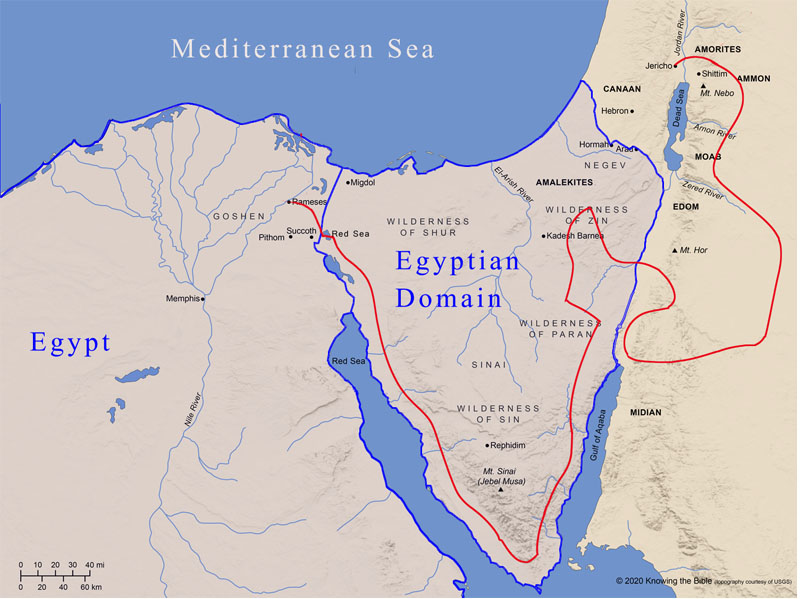
Israelite's Journey Rameses
|
The book of Leviticus, Numbers and Deuteronomy make up three-fifths of the Pentateuch. They are primarily focused on detailing God's law for his chosen nation of Israel. God's Law is generally seen as consisting of three types of laws - the moral law, the ceremonial law, and the civil law. Chaos had to be turned into organization. A disorderly mob of former slaves left Egypt. In order to turn them into God's chosen nation, civil laws were given. Learning about health to keep them from suffering all manner of sickness, they were given the health laws. The people were used to worshiping the gods of Egypt which led to brokenness, bondage, and separation from God. Ceremonial laws were instituted to set Israel apart as God's holy people. These people were to teach the world, by word and by example, what the universe is supposed to be like. So the moral Laws were instituted. This study will focus on three important aspects of the Law of Moses: the sacrificial offerings, the priesthood and the feasts. Using Leviticus as a base, parallel verses will be extracted from Numbers and Deuteronomy to provide a deeper understanding of the Israelite laws. Leviticus contains important theological themes like God's holiness, the need for purity, and the concept of sacrifice. It is quoted over 100 times in the New Testament. Although we are not subject to the rituals as such, we can learn about God's character from understanding them. Leviticus enables us to see Christ and his work on our behalf in a deeper and richer light. God truly does desire to dwell with, meet with, and dine with his sinful people in a world of death. Leviticus derives its name from Levi, the tribe of Israel who were designated to serve as priests. They were given the responsibility of caring for the furnishings and all the things that made up the tabernacle complex; to strip it down and pack it, to move it to its new location and then to put it together when they arrived at their new location. The role of high priest was only open to direct descendants of Aaron's family. Eventually all of the caretakers of the tabernacle, and then later on the temple, came from other families but were from the tribe of Levi. Instruction to Moses The book of Leviticus through the 10th chapter of Numbers covers 50 days which intervened between the setting up of the tabernacle and the departure of from the neighborhood of Mount Sinai. During this time, God gave instructions for the priest to perform sacrifices and ceremonies in the tabernacle to make them understand His Holiness and to teach the people what was required to be holy. He didn't choose them because they were holy; He chose them in order to make them a holy people of God. Being holy meant that they were set apart from the other nations. They were separated in order to be exclusively used by God for His purposes. They were to be a kingdom of priests and a holy nation. While the book of Leviticus seams repetitive, it becomes easier to understand when one considers the intent. The first sets of instructions were given for the Israelite who comes to the tabernacle to make an offering. Where the offerings are repeated described the sacrifice instruction for the priest and how he was to deal with this offering. The entire sacrificial system pointed to Jesus Christ as the final sacrifice for sins. The sacrificial system was meant to purify the temple and the community, but it was limited in application and had to be repeated annually. Christ's sacrifice was so complete that it secured eternal redemption for all sins. The sacrificial system ceased because His death relaced animal sacrifices. |
| Cassie, Matt, Joe, Noah, Sue, Steve | |