Leviticus - Grain and Drink Offerings
Timeline: 1451 BC
(Leviticus 2:1-16; 6:14-23; 7:9-10; Numbers 15:1-10; Numbers 28:1-8)
|
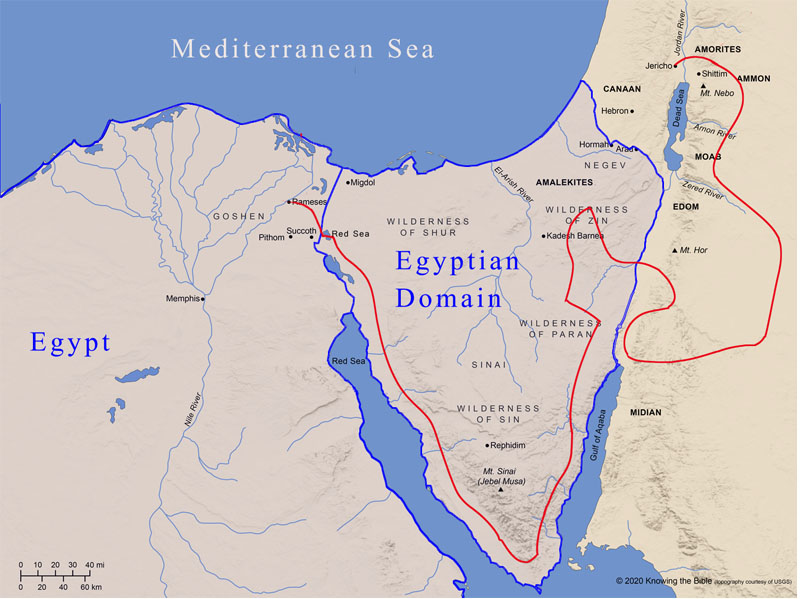
Israelite Journeys Rameses
|
In the Old Testament, there is a lot of repetition, especially in the offering chapters of Leviticus. The repetition is used to facilitate memorization and to emphasize important points. It's important to look at these repetitive sections for the new information being added in each new repetition. In the KJV, the grain offering is called a "meat offering" which is a Hebrew word "minchah" meaning to apportion, specifically a sacrificial offering (usually bloodless and voluntary). Grain and drink offerings expressed gratitude and thanksgiving and was required whenever a burnt offering or a peace offering was offered. The burnt offering signifies a man giving his life to God, while the meal offering signifies his labor of the fruit of the ground. One is incomplete without the other. The grain offering was different from the burnt offering in the following ways:
Leviticus 2:1-3 'When anyone offers a grain offering to the Lord, his offering shall be of fine flour. And he shall pour oil on it, and put frankincense on it. He shall bring it to Aaron's sons, the priests, one of whom shall take from it his handful of fine flour and oil with all the frankincense. And the priest shall burn it as a memorial on the altar, an offering made by fire, a sweet aroma to the Lord. The rest of the grain offering shall be Aaron's and his sons'. It is most holy of the offerings to the Lord made by fire. A grain offering would have most likely been one of wheat or barley, depending on what was available. It was pounded, ground, and sifted repeatedly In order to make it into fine flour. The oil and frankincense used were made from recipes in Exodus 30. The priest would scoop up the flour with three fingers and put it into his hand. Then it was placed on the fire. The memorial portion is a reminder of God's covenant.
Priests are to live on the offerings and other sacrifices given to the Lord. The people were to provide for them and to give help for their support in order that they could minister to them. Their share is the privilege of being the Lord's priests, as the Lord has promised. The kinds of offering depended on the wealth of the offeror. The wealthiest would offer fine flour. Next would be the cakes baked in an oven. Not many people had ovens so it was brought by the less wealthy. The wafers required less flour and was fried in a pan. All of these required oil, salt and frankincense and no leavening or honey. Leviticus 2:4-6 'And if you bring as an offering a grain offering baked in the oven, it shall be unleavened cakes of fine flour mixed with oil, or unleavened wafers anointed with oil. But if your offering is a grain offering baked in a pan, it shall be of fine flour, unleavened, mixed with oil. You shall break it in pieces and pour oil on it; it is a grain offering. Bread baked into cakes was made with fine flour and oil without leaven. If fried in a pan, it would have been flat and dense like a tortilla or other flatbread. No matter what form it was in, the grain offering had to be prepared at home. How the bread itself was cooked doesn't matter. It was the ingredients that were significant. They would sprinkle frankincense on it and then the priest would tear it into pieces. Leviticus 2:7-10 'If your offering is a grain offering baked in a covered pan, it shall be made of fine flour with oil. You shall bring the grain offering that is made of these things to the Lord. And when it is presented to the priest, he shall bring it to the altar. Then the priest shall take from the grain offering a memorial portion, and burn it on the altar. It is an offering made by fire, a sweet aroma to the Lord. And what is left of the grain offering shall be Aaron's and his sons'. It is most holy of the offerings to the Lord made by fire. Some scholars suggest that baking grain in a covered pan is similar to the way we cook in a deep fat fryer. They would look more like a doughnut. Others suggest that they may be boiled like dumplings.
After the portion was burnt on the altar, the remainder was given to the Aaron and his sons. A grain offering must never be treated like common bread. "Most holy portion" simply means: the part reserved for only the priests and only for sacred space. (Remember that Holy means "set apart"). It is to be eaten only by the males and only in the tabernacle.
Each son shall receive equal portions from the grain offering. Leviticus 2:11-13 'No grain offering which you bring to the Lord shall be made with leaven, for you shall burn no leaven nor any honey in any offering to the Lord made by fire. As for the offering of the firstfruits, you shall offer them to the Lord, but they shall not be burned on the altar for a sweet aroma. And every offering of your grain offering you shall season with salt; you shall not allow the salt of the covenant of your God to be lacking from your grain offering. With all your offerings you shall offer salt. Leaven (yeast) is a symbol of sin. It is contagious and infects everything it touches. The source of sin is pride. The first sin ever committed was an act of pride when Satan refused to recognize God as his Lord. At the end of Passover, every household in Israel begins with new leaven starting a new cycle. The word "honey" was a generic term for "sweetener." It could be juice from dates, grapes, and other fruit. It could also refer to the honey from bees. When burned, honey could ferment and create an unpleasant smell signifying that it was not considered an appropriate offering to God. Therefore, the prohibition was due to the process of burning, not necessarily the consumption of honey with bread in general. Some scholars speculate that honey might have been associated with pagan practices, further contributing to its exclusion from certain offerings. Every offering must have salt. The salt of covenant symbolizes the enduring, eternal nature of the agreement of God's promises. According to ancient custom, a bond of friendship was established through the eating of salt. It was said that once you had eaten a man's salt, you were his friend for life. God wanted every sacrifice to be a reminder of the relationship between the children of Israel and Himself. Leviticus 2:14-16 'If you offer a grain offering of your firstfruits to the Lord, you shall offer for the grain offering of your firstfruits green heads of grain roasted on the fire, grain beaten from full heads. And you shall put oil on it, and lay frankincense on it. It is a grain offering. Then the priest shall burn the memorial portion: part of its beaten grain and part of its oil, with all the frankincense, as an offering made by fire to the Lord. Firstfruits are freshly harvested grain that would have too much moisture to be made into fine flour. In such cases, the grain was made suitable for offering by crushing the grain's kernels, roasting them, and then presenting the mash to the priests in the same manner that bread would be presented. The priests would take the first portion; add frankincense and then burn it as a memorial on the altar representing prayer.
These were commands to be fulfilled once they were in the Promised Land. God's discipline is intended to strengthen the covenant relationship. Israel still needed to show gratitude to God for His goodness to them. God will bless them so abundantly that they will in turn bring countless sacrifices and offerings with which to honor and worship him. The prescribed amount of fine flour depended on the size of animal that was brought. For each lamb or a kid, about five pints of flour mingled with five cups of oil, and the drink-offering must be the same quantity of wine. If it was a ram, the meat-offering was doubled, ten pints of flour, ten cups of oil and ten cups of wine for a drink-offering. Triple that if it is a bullock. The intent of this law is to direct the proportions of the meat-offering and drink-offering to cover sin and to express gratitude. God gave specific details for offerings because they were intended to symbolize the seriousness of approaching God and to demonstrate the concept of holiness. The detailed instructions were not about the literal food, but rather about the spiritual meaning behind the act of offering.
Israel needed to be continually reminded to focus on God and their relationship with Him. All of these sacrifices were a shadow pointing to the ultimate sacrifice of the Lamb of God who takes away the sins of the world.
Israel was commanded to bring a male lamb to the Lord every morning and every evening as a burnt offering. The grain and drink offering was to accompany the offerings offered to God by fire. The KJV states the drink offering should be "strong" wine. The Hebrew word used here is shekar. It signifies intensely alcoholic liquor. It was to be the strongest, best, and choicest that they had. The "drink offering" was "poured out" upon the altar and was not drunk by the people. The lamb of the burnt offering, with its meal and drink offerings, foreshadowed the ultimate sacrifice of Jesus Christ, the Lamb of God. |
Cassie, Matt, Joe |
|