Leviticus - Clean and Unclean Animals
Timeline: 1451 BC
(Leviticus 11:1-47; 20:22-26 — Deuteronomy 14:3-21)
|
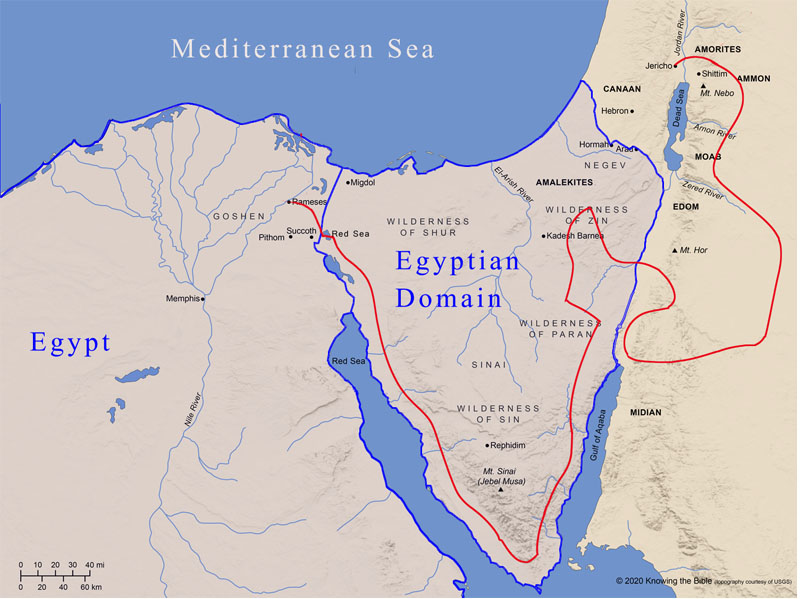
Israelite Journeys Rameses
|
Clean and Unclean Animals God created all the animals, clean and unclean, before He created Adam and Eve. The original diet for all creatures, man and animals was plant-based. (Genesis 1:29-30) After the Fall, He clothed them in animal skins and undoubtedly instructed them which animals were clean and suitable for sacrifice. This knowledge was passed down through the generations. Noah was instructed to bring two of each unclean animal, seven pairs of each clean animal, and seven pairs of birds, to keep their species alive. (Genesis 7:1-3) The phrase "two of each kind" suggests that there were far more than just fourteen clean animals and birds. Upon leaving the ark, Noah's first act was to build an altar and offer sacrifices from the clean animals and birds, using only a small number of them. God told Noah that he and his family could consume "everything that lives and moves," suggesting that all types of animals are included. (Genesis 9:3) The only restriction was that they must not eat meat that has not been drained of its blood. God specifically designated blood for use on the altar to atone for sins, making it sacred and unsuitable for consumption. Leviticus 11:46 This is the law regarding animals, birds, all living creatures that move in the water, and all creatures that crawl along the ground. You must distinguish between the unclean and the clean, between animals that may be eaten and those that may not.'" When the Israelites were established as a nation, dietary laws, including prohibitions against "unclean" animals, were given to the Israelites. Part of the reason behind them were spiritual and the other is physical. Spiritually, the focus is on holiness, being set apart, and obedience. Jews were chosen for a specific role, seen as a kingdom of priests, and the lineage of Jesus. They were expected to follow God's laws (Torah), live a holy and moral life, and demonstrate God's existence and faithfulness. This included eating meat in a manner befitting God, consuming animals suitable for sacrifice. In addition, pagan nations often used certain unclean animals in their idol worship and sacrificial rituals. Avoiding these foods prevented Israelites from participating in or resembling those forbidden practices. Physically, almost all of the creatures on the unclean list are scavengers. Their primary food source is the dead and decaying matter of our environment. They eat anything and everything not suitable for food. Animals described as clean never eat dead animals or animal byproducts, and therefore good for food. Nutritionists have noted that the listings of clean and unclean foods actually provide a guideline for a healthy diet. In a time period lacking modern food safety techniques, a diet consisting of only clean animals would have protected people against many health problems. Animals Carnivores, as beasts of prey, are crucial for managing the populations of other animals. For instance, wolves and mountain lions, which feed on herds of deer, not only control numbers, but simultaneously enhance the herd's overall health by eliminating sick, old, or infirm members. This role in consuming potentially diseased animals is one rationale for avoiding the consumption of carnivores, as it could pose a risk of disease transmission to humans. Leviticus 11:1 The LORD spoke again to Moses and Aaron, telling them, "Say to the Israelites, 'Of all the beasts of the earth, these ones you may eat: You may eat any animal that has a split hoof completely divided and that chews the cud. A split hoof is divided into two distinct toes, each covered by a hard outer wall. Animals with cloven hooves digest food differently than other animals. Clean animals possess a unique four-chambered stomach which helps them digest plant material. These animals all "chew the cud," slowly chewing their partly-digested food over and over again in their mouth before finally swallowing it.
While some animals have split hooves, they do not chew the cud. Others chew the cud but lack fully split hooves. These are considered detestable and are not to be consumed by the Israelites. The term kosher means "clean, fit or proper". A food is kosher if it follows Jewish dietary laws based on biblical food prohibitions. Rules about permitted meat also include how it is prepared. The slaughter of animals for consumption may be performed by a trained Jewish ritual slaughterer. The meat must also be thoroughly checked and prepared to remove any blood or specific forbidden fats and nerves. Leviticus 11:4 But of those that only chew the cud or only have a divided hoof, you are not to eat the following: The camel, though it chews the cud, does not have a divided hoof; it is unclean for you. The rock badger, though it chews the cud, does not have a divided hoof; it is unclean for you. The rabbit, though it chews the cud, does not have a divided hoof; it is unclean for you. And the pig, though it has a split hoof completely divided, does not chew the cud; it is unclean for you. You must not eat their meat or touch their carcasses; they are unclean for you.
While the camel's feet are divided into two parts, they don't have hard, solid hooves. Their weight is distributed on their soft pads rather than their nails, thus differentiating them from true hoofed animals like cows. Rabbits don't technically "chew the cud" like cows. They are also known to constantly move their mouths, in a motion that looks extremely similar to the chewing motion of cows and other ruminants. In addition, since they do not have a split hoof, they are unclean. Rock badgers, aka rock rabbits, are small creatures about the size of a hare but has short, rounded ears, short legs, and virtually no tail. Like rabbits, these creatures made peculiar chewing and swallowing movements. Although the rock badger has broad nails, they do not cover the entire foot, nor do thy have a single division in the middle. God deemed pigs unclean since, although they have split hooves, they don't chew the cud. Pigs back then were essentially wild boars, roaming freely. They ate whatever they could find, including animal and human corpses. The Canaanites, Greeks, Romans, and Egyptians, kept swine and sacrificed them to idols with the meat consumed in ritual feasts. Leviticus 11:26 Every animal with hooves not completely divided or that does not chew the cud is unclean for you. Whoever touches any of them will be unclean. Contact with animal carcasses poses significant health risks, potentially leading to serious and even fatal diseases. Some animals and rodents, for instance, can transmit tularemia (also known as rabbit fever, deerfly fever, or tick fever) to humans through contact with their meat or fluids. Bats and monkeys have been linked to the Ebola virus, which has had devastating consequences in Africa, where these primates and bats are sometimes consumed as "bush meat." Pigs and other animals considered unclean can transmit trichinosis, a disease caused by a parasitic roundworm that infects muscle tissue. Many meat-eating and omnivorous animals carry the *Trichinella spiralis* parasite, and people can contract it by eating the meat of animals like squirrels, rats, cats, dogs, rabbits, foxes, panthers, lions, and horses. Fish Leviticus 11:9 Of all the creatures that live in the water, whether in the seas or in the streams, you may eat anything with fins and scales. But the following among all the teeming life and creatures in the water are detestable to you: everything in the seas or streams that does not have fins and scales. They shall be an abomination to you; you must not eat their meat, and you must detest their carcasses. Everything in the water that does not have fins and scales shall be detestable to you.
Fish that are considered clean must have both scales and fins. They always live in the highest, cleanest waters, where they obtain their growth from the air that enters such waters. Free-swimming fish are less likely to harbor parasites and bacteria. Their scales act as a barrier, protecting the flesh from contaminants. In contrast, Most unclean fish are either bottom-dwellers or predatory scavengers. Scaleless fish and shellfish are often found in murky waters consuming decaying matter and dead organisms, essentially eating what should not be consumed by humans. Their diet makes them carriers for bacteria, parasites, and viruses, which can cause severe foodborne illnesses (like typhoid fever). Other sea creatures are noted for producing venomous substances in their bodies. Birds Leviticus 11:13 Additionally, you are to detest the following birds, and they must not be eaten because they are detestable: the eagle, the bearded vulture, the black vulture, the kite, any kind of falcon, any kind of raven, the ostrich, the screech owl, the gull, any kind of hawk, the little owl, the cormorant, the great owl, the white owl, the desert owl, the osprey, the stork, any kind of heron, the hoopoe, and the bat.
Unclean birds are unclean feeders. Their diets consist of flesh and blood of their prey and often feeding on carcasses of dead animals. This makes these birds potential agents for transmitting disease. They tend to accumulate high levels of toxic chemicals in their bodies.
Clean birds (like doves, pigeons) are considered clean. They eat grain. They often feed on grains, seeds, or insects. They don't hunt other birds or animals. Common clean birds include Chicken, Turkey, Goose, Pigeon/Dove, Quail, Partridge, and Duck (though some traditions debate ducks). The egg of a clean animal is clean, but the egg of an unclean bird is forbidden. Naturally, eggs from a bird suffering from a visible sickness is forbidden. A drop of blood found on the yolk of an egg is considered an indication that the process of hatching has already begun, and the egg is therefore forbidden. If both ends of the egg are sharp or round, or if the yolk is outside and the white inside, it is of an unclean bird. A key sign of a clean bird's egg is that it has one pointed end and one rounded end, with the white surrounding the yolk. Flying Insects
Many flying insects are significant carriers of diseases often picked up from contaminated sources and transferring them to humans and animals, potentially causing illnesses like food poisoning, malaria, Lyme disease, and other pathogens. Leviticus 11:20 All flying insects that walk on all fours are detestable to you. However, you may eat the following kinds of flying insects that walk on all fours: those having jointed legs above their feet for hopping on the ground. Of these you may eat any kind of locust, katydid, cricket, or grasshopper. All other flying insects that have four legs are detestable to you. Insects typically have six legs, but the phrase "on all fours" may refer to the primary legs used for walking. The forelegs perform tasting/cleaning functions. Locus, katydid, crickets and grasshoppers are low in chitin allergens (which causes inflammation and allergy) and high in protein. Their digestive tract is cleaner than those that feed on dead and decomposing organic matter. Leviticus 11:24 These creatures will make you unclean. Whoever touches their carcasses will be unclean until evening, and whoever picks up one of their carcasses must wash his clothes, and he will be unclean until evening. Anyone who touches a dead body, whether it is an insect or an animal is considered unclean until evening. Days end at sunset in the Hebrew calendar. The purification process involves washing clothes, bathing, and waiting for sunset to complete the cleansing cycle. While unclean, a person could not participate in holy activities, like entering the Tabernacle or Temple. Four Footed Animals Leviticus 11:27 All the four-footed animals that walk on their paws are unclean for you; whoever touches their carcasses will be unclean until evening, and anyone who picks up a carcass must wash his clothes, and he will be unclean until evening. They are unclean for you. Animals which have paws, such as dogs, cats, bears, lions and other similar creatures were forbidden. Most four-footed animals have claws that are generally used for stalking and catching prey. Leviticus 11:29 The following creatures that move along the ground are unclean for you: the mole, the mouse, any kind of great lizard, the gecko, the monitor lizard, the common lizard, the skink, and the chameleon. Rodents and reptiles are also among the animals listed as unfit for human food. Each unclean animal illustrates a facet of impurity: darkness, destruction, or decay. Crawling Creatures Crawling things were were symbols of pagan idolatry, representing spiritual corruption and forbidden worship. Israel was repeatedly warned against adopting such practices as they marked a turning away from the one true God, leading to spiritual unfaithfulness and eventual destruction. Leviticus 11:31 These animals are unclean for you among all the crawling creatures. Whoever touches them when they are dead shall be unclean until evening. When one of them dies and falls on something, that article becomes unclean; any article of wood, clothing, leather, sackcloth, or any implement used for work must be rinsed with water and will remain unclean until evening; then it will be clean. If any of them falls into a clay pot, everything in it will be unclean; you must break the pot. Any food coming into contact with water from that pot will be unclean, and any drink in such a container will be unclean. Venomous reptiles and rodents are often found in living quarters, contaminating the articles they touch. They must be removed immediately to prevent disease. The water that came into contact with the any of these objects is contaminated and must be discarded and not used for any purpose.
Wood, clothing, leather, sackcloth, or any implement used for work such as copper or metal pots were were allowed to be adequately cleaned to remove impurity. Clay pots, however, were porous, allowing liquids and substances to soak into it, therefore had to be destroyed. The distinction between the different items emphasizes the different methods required to maintain ritual purity. Leviticus 11:41 Every creature that moves along the ground is detestable; it must not be eaten. Do not eat any creature that moves along the ground, whether it crawls on its belly or walks on four or more feet; for such creatures are detestable. Creatures that crawl on their belly refers to snakes, worms and maggots. Other creatures such as centipedes, caterpillars, spiders, etc. are also considered in this classification. In Jewish dietary law, insects that have always been contained within fruit or vegetables (and never left them) are technically considered permitted, as they are viewed as part of the produce itself. Leviticus 11:43 Do not defile yourselves by any crawling creature; do not become unclean or defiled by them. For I am the LORD your God; consecrate yourselves, therefore, and be holy, because I am holy. You must not defile yourselves by any creature that crawls along the ground. For I am the LORD, who brought you up out of the land of Egypt so that I would be your God; therefore be holy, because I am holy. These laws were specifically given to the children of Israel who were set apart as holy, distinct from other nations, and to teach them about ritual purity and obedience to God. Today, many of the same laws are practiced by Orthodox Jews. During the Black Death pandemic in the mid-14th century, European populations falsely accused Jews of poisoning wells to spread the plague because Jewish communities, who observed religious laws regarding diet, hygiene, and ritual cleanliness, often experienced lower mortality rates. The dietary and ceremonial restrictions in Leviticus 11 and Deuteronomy 14 were were part of the covenant with Israel, intended specifically to shape national culture and set the Jewish people apart and to be sanctified. The New Testament signifies a new covenant where Christ fulfills these laws, making all foods "clean" for believers and emphasizing internal, moral purity for Gentiles. In Matthew 15:11 Jesus said, "A man is not defiled by what enters his mouth, but by what comes out of it." In Acts 10 God gave Peter a vision and showed him that he should not call any man impure or unclean by virtue of his diet. Romans 14:17 states "For the kingdom of God is not a matter of eating and drinking, but of righteousness, peace, and joy in the Holy Spirit." Rules to abstain from food sacrificed to idols, blood, and strangled animals (prevented the blood from draining out) focusing on idolatry and bloodshed, continued in the New Testament.Carcasses Leviticus 11:39 If an animal that you may eat dies, anyone who touches the carcass will be unclean until evening. Whoever eats from the carcass must wash his clothes and will be unclean until evening, and anyone who picks up the carcass must wash his clothes and will be unclean until evening. Touching a dead animal makes a person ritually unclean, not morally guilty of sin. This impurity is a matter of sanitation and ceremonial separation from death. No sin offering is needed, just a washing and a waiting period until sundown, when purity is restored. Leviticus 11:35 Anything upon which one of their carcasses falls will be unclean. If it is an oven or cooking pot, it must be smashed; it is unclean and will remain unclean for you. Nevertheless, a spring or cistern containing water will remain clean, but one who touches a carcass in it will be unclean. If a carcass falls on any seed for sowing, the seed is clean; but if water has been put on the seed and a carcass falls on it, it is unclean for you. A spring or cistern was connected directly to a natural source of water, such as a spring. The constant change of water, counteracts the effects of the polluting carcass and is constantly filtered out as the water is replenished. The person who removes it from the water is unclean and must follow cleanliness rules. On the other hand, if there was stagnant water on a seed, and unclean material fell on the seed, the seed would become unclean because bacteria thrives on water that is stagnate.
Foreigners, or "sojourners, (non-Jewish people who resided among the Israelites)" were not bound by the same dietary laws as Israelites. The rules and restrictions were intended to raise the Israelites above the common level while still showing kindness and provision for those living among them. The exception is that even Gentiles should not eat food sacrificed to idols, blood or meat of strangled animals. In addition they are to abstain from sexual immorality.
Pagans practiced a superstitious ritual where they would boil a young goat in its mother's milk and sprinkle the trees, fields and gardens with the broth in order to make them more fruitful the following year. Some say that the goat was alive when it was boiled. The Rabbinic law forbids consuming of dairy and meat together because of this. In Israel, meat is never eaten in the same meal where dairy products are eaten. This is part of the kosher kitchen. Leviticus 20:22 You are therefore to keep all My statutes and ordinances, so that the land where I am bringing you to live will not vomit you out. You must not follow the statutes of the nations I am driving out before you. Because they did all these things, I abhorred them. Leviticus 20:24 But I have told you that you will inherit their land, since I will give it to you as an inheritance—a land flowing with milk and honey. I am the LORD your God, who has set you apart from the peoples. God was about to give the Israelites possession the fruitful land, whose inhabitants He had driven out because of their abominations. He warned them that they could also receive the same punishment. Leviticus 20:25 You are therefore to distinguish between clean and unclean animals and birds. Do not become contaminated by any animal or bird, or by anything that crawls on the ground; I have set these apart as unclean for you. You are to be holy to Me because I, the LORD, am holy, and I have set you apart from the nations to be My own. |
| Matt, Cassie | |