Leviticus - Burnt Offerings
Timeline: 1451 BC
(Leviticus 1:3-17; 6:8-13; 17:7-9; 22:17-20; 22:24--28; Numbers 15:13-16)
|
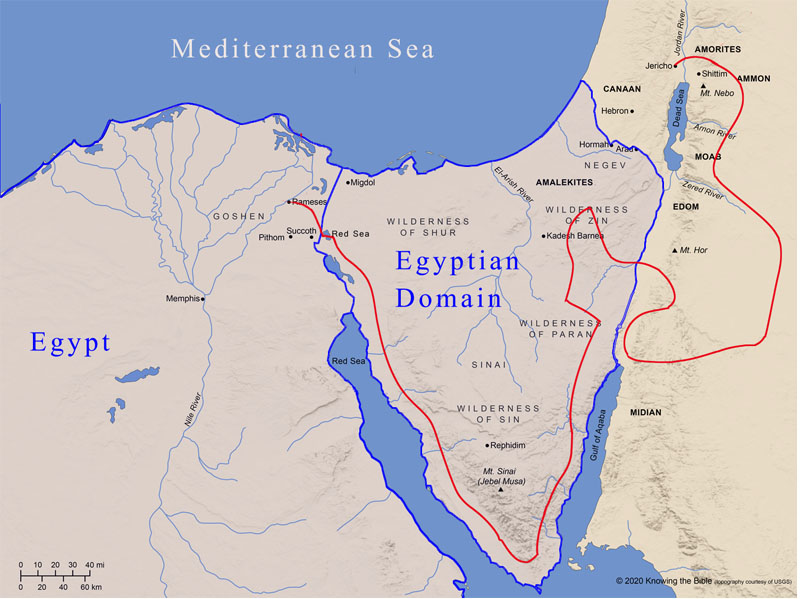
Israelite Journeys Rameses
|
The first sacrifice in the Bible was used as a payment for sin when God sacrificed an animal to provide clothing for Adam and Eve. The Bible tells the story of Cain and Abel who evidently had an idea of what kinds of offerings God expected. The patriarchs built altars or pillars and offer animals and oil to God. So from the beginning, God laid down a tradition of shedding innocent blood to cover up sins. The book of Leviticus provides instruction and laws to guide the priests in their work as they ministered to the nation. A burnt offering symbolized a complete surrender to God, where the entire animal was consumed by fire. This was considered as a sweet "savor" (fragrance) unto the lord. A burnt offering was the most common of all sacrifices in Israel. It was often offered in conjunction with another sacrifice. Among these were the guilt offering, the sin offering, the votive or freewill offering, the sheaf offering, and the new grain offering. The burnt offering:
Leviticus 1:3-9 'If his offering is a burnt sacrifice of the herd, let him offer a male without blemish; he shall offer it of his own free will at the door of the tabernacle of meeting before the Lord. Then he shall put his hand on the head of the burnt offering, and it will be accepted on his behalf to make atonement for him. He shall kill the bull before the Lord; and the priests, Aaron's sons, shall bring the blood and sprinkle the blood all around on the altar that is by the door of the tabernacle of meeting. And he shall skin the burnt offering and cut it into its pieces. The sons of Aaron the priest shall put fire on the altar, and lay the wood in order on the fire. Then the priests, Aaron's sons, shall lay the parts, the head, and the fat in order on the wood that is on the fire upon the altar; but he shall wash its entrails and its legs with water. And the priest shall burn all on the altar as a burnt sacrifice, an offering made by fire, a sweet aroma to the Lord. This is the procedure for offering a bull as a burnt offering. The only accepted animals were those who were domesticated and from their flock or herd. Animals of prey and carnivorous animals that live by the death of others were excluded. Any animal that was killed for a sacrifice must be brought to the door of the tabernacle or it would not be accepted. The sacrificial animal was a symbol of Jesus. It had to be a male, it had to be flawless, it had to be valuable to the worshipper, and it was given freely given, just as Jesus was valuable to His father, blameless in every way and freely gave His life to make atonement for us. The worshipper laid his hands on the animal's head asking that the animal be an acceptable cover. He confessed that he deserved to die and that the animal died in his place. Animal sacrifices could did not remove sins; they only cover them. The sacrifices were essentially like a bandage, only acting as a covering for sin. They pointed forward in time to Jesus who shed His precious blood to accomplish that purpose. The sinner kills the animal himself and then the priests sprinkle the blood around the altar to cleanse and purify the altar from all contamination: sin, death, impurity. There is no covenant meal or sacrificial meal going on here. The entire offering is for God alone. Killing an animal for sacrifice or for eating must be done in a humane way. The only pain was the cut that drained the blood and soon rendered the animal unconscious. The divine intention was to reduce suffering to a minimum, thus showing God's concern for animals. Later Jewish traditions required that the knife used be sharp and smooth to avoid inflicting unnecessary pain to the victim. The entrails and legs had to be washed. Entrails are contaminated by excrement. The washing of the inwards, represented their inner thoughts, symbolizing they were cleansed. The act of washing the legs illustrated their spiritual cleansing just as Jesus washed His disciples feet. Leviticus 1:10-13 'If his offering is of the flocks—of the sheep or of the goats—as a burnt sacrifice, he shall bring a male without blemish. He shall kill it on the north side of the altar before the Lord; and the priests, Aaron's sons, shall sprinkle its blood all around on the altar. And he shall cut it into its pieces, with its head and its fat; and the priest shall lay them in order on the wood that is on the fire upon the altar; but he shall wash the entrails and the legs with water. Then the priest shall bring it all and burn it on the altar; it is a burnt sacrifice, an offering made by fire, a sweet aroma to the Lord. Those of the middle rank, that could not well afford to offer a bullock, would bring a sheep or a goat. The burnt sacrifice is slaughtered on the north side of the altar. The North symbolizes God's sovereign judgment, His means to chastise His wayward people, draw them back to Him, and restore righteousness. The Bible also implies that salvation comes from the north. Jesus was crucified outside of Jerusalem on a hill called Golgotha, which was north of the city's northern wall. The fat is located on the kidneys and loins. The head and fat are placed together, partly because they are both separated from the flesh when animals are slaughtered, and partly also to point out distinctly that the whole of the animal was to be burned upon the altar. They were burnt apart from the other pieces, emphasizing orderliness and respect for the life of the animal.
"Bruised, crushed, torn or cut" are, four ways in which animal were castrated. This practice was absolutely forbidden to the Jews and was not to be sacrificed, nor in fact to be kept in the land at all. Animals that were mutilated and sold to the Israelites by the hands of foreigners were rejected. God forbade the receiving of any offering, whether blemished or perfect, from the hands of a stranger remaining in heathenism.
A "man of the house of Israel" represents any of the Jews. A stranger, in this case, was one who desired to show respect to the God of Israel. When people made sacrifices, they were to have sympathy for the innocent animals that lost their lives. The Sacrifices Must Be without Blemish. An animal with a fault would not be acceptable. This law was abused in the days of Jesus, where priests sometimes disqualified an animal for an insignificant reason. Then, the corrupt priest might require the purchase of an approved sacrificial animal at a dishonest high price. Leviticus 1:14-17 And if the burnt sacrifice of his offering to the Lord is of birds, then he shall bring his offering of turtledoves or young pigeons. The priest shall bring it to the altar, wring off its head, and burn it on the altar; its blood shall be drained out at the side of the altar. And he shall remove its crop with its feathers and cast it beside the altar on the east side, into the place for ashes. Then he shall split it at its wings, but shall not divide it completely; and the priest shall burn it on the altar, on the wood that is on the fire. It is a burnt sacrifice, an offering made by fire, a sweet aroma to the Lord. Not every Israelite was wealthy enough to offer God a bull or a ram and so a substitute would be sufficient. Instead of the sacrificial knife that was used with the herd or the flock, the priest would use his fingernail and hands to tear or cleave the bird, but not completely in two. The priests killed birds instead of the offeror because the priest was responsible for the proper execution of the sacrifice. Placing the ashes and feathers on the east side is symbolic of turning away from Eden/a sign of walking farther away from God. A sweet aroma unto the Lord - It wasn't that the smell of "burning flesh or grain" pleased God, but rather that it signifies the sacrifice and heart posture of obedience and love. Mark 12:33 And to love Him with all the heart, with all the understanding, with all the soul, and with all the strength, and to love one's neighbor as oneself, is more than all the whole burnt offerings and sacrifices.
Under seven days the animal is extremely weak, dependent on its mother, and unfit for human food, and hence must not be offered as the food of God. This was unnecessary cruelty to a newborn animal, and the practice was probably performed in pagan sacrifices to idols. To sacrifice a newborn or young animal and the mother of the animal on the same day was to imitate a Canaanite fertility ritual. This was strictly forbidden to Israel.
Having instructed the people concerning the sacrifices to be brought by them, Moses now proceeds, at God's command, to direct the priests respecting several parts of their official services. The first fire upon the altar had been kindled from heaven at the consecration of the tabernacle. Then the priests would lay piece after piece on the altar and maintain the fire constantly. The Hebrew, the burnt offering was called "a sacrifice, which went up in smoke." It was burnt entirely except for the hide which was given to the priests. The specific mention of the linen breeches is to signify the covering of the priest's private parts. The linen garments for the priests are described in (See Exodus Chapter 27). Ritual nakedness was a prominent part of the worship of ancient pagan priests where they would dance before the goddess in the pagan temple. The priestly garments were worn only at the altar and in the tabernacle. Every morning, he would put on his linen garment and trousers and shovel the ashes from the altar. He placed them in a heap on the east side of the altar until it was time to take them outside the camp. Then he put on "street clothes" to take the ashes outside the camp. Great care was taken that the place to which the ashes were removed was well sheltered, so that the wind should not blow them about. The priest had to deposit them gently in a place where no dead carcasses, dung, or filth of any kind was laid for the ashes were holy. The sacred fire endured throughout the 40 years in the desert and likely beyond that, as tabernacle worship continued until the time of King Solomon and the building of the Jewish temple. When the temple was dedicated, God once again lit the fire on the altar.
The Hebrew word rendered demons signifies goats, because goats were eminently worshipped by the Egyptians. This idolatrous worship involved licentious and obscene ceremonies. This was a violation of the covenant because faith toward God is broken.
After the tabernacle was built, the rites of religion could be acceptably performed only at the appointed place of worship. This restriction was necessary to prevent idolatry; it prohibited the Israelites, when at a distance, from returning to the altars of the heathen, which were commonly in groves or fields. Once the second temple was destroyed in Jerusalem in 70 CE, sacrifices ceased to be practiced in Judaism. Instead, prayer, study, and acts of kindness became central to Jewish worship. They believe that prayer became the new way to sacrifice to God. Traditional Jews believe that the reading and studying of the scriptures, especially on Yom Kippur, is a substitute for the sacrifices. Christians believe that Jesus' crucifixion and resurrection is the substitute for the animal offering. All scripture has principles that apply to our lives today. |
| Matt, Cassie, Joe | |