Leviticus 24 - The Law Regarding the Tabernacle and the Penalty for Blasphemy
Timeline: 1451 BC
(Leviticus 24:1-23)
|
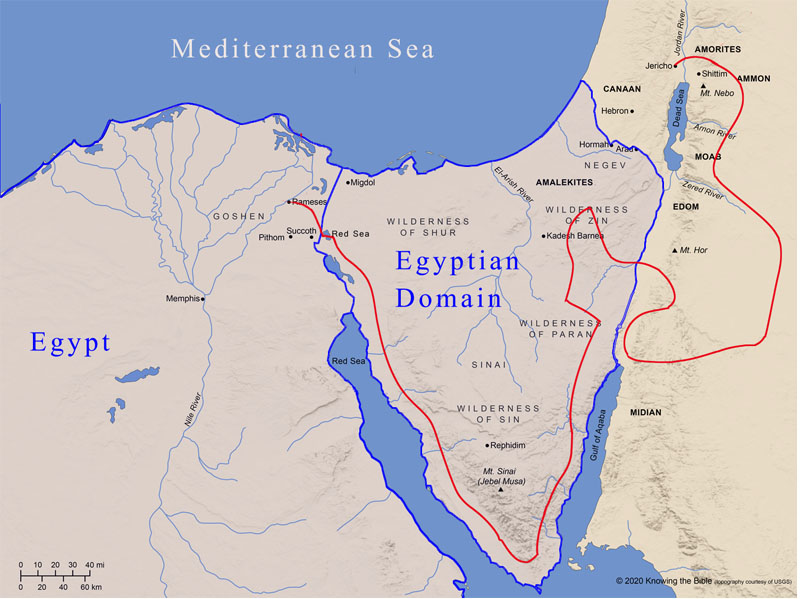
Israelite Journeys Rameses
|
1 Then the LORD said to Moses, "Command the Israelites to bring you pure oil of pressed olives for the light, to keep the lamps burning continually. The lampstand (also known as the menorah) was positioned in the Holy Place directly across from the table of the showbread. It was hammered out of one solid lump of gold. The central trunk was formed with three branches on each side, equaling seven branches in all. Each branch held a lamp containing oil for burning. The people were told to provide pure oil for the lamps from beaten olives so that the light may be kept burning all day and night, whether anyone was present or not. 3 Outside the veil of the Testimony in the Tent of Meeting, Aaron is to tend the lamps continually before the LORD from evening until morning. This is to be a permanent statute for the generations to come. He shall tend the lamps on the pure gold lampstand before the LORD continually. These lamps constantly lit up the glory of the Holy Place symbolizing God's eternal presence and guidance. The lampstand holds symbolic significance within some of the feasts mentioned in the Bible, particularly the Feast of Tabernacles and Hanukkah. The Feast of Hanukkah, specifically known as the Feast of Dedication, commemorates rededication of the Second Temple. The Jews wanted to light the Menorah as a symbolic and religious act, representing the triumph of their faith, the restoration of their sacred space, and the enduring presence of God. However, they only found a small amount of ritual oil. Miraculously, this small amount of oil burned for eight days, until new oil could be prepared. In the celebration of Hanukkah today, a menorah contains nine candles, one for each of the eight days and new candle used to light the others. 5 You are also to take fine flour and bake twelve loaves, using two-tenths of an ephah for each loaf, and set them in two rows—six per row—on the table of pure gold before the LORD. and you are to place pure frankincense near each row, so that it may serve as a memorial portion for the bread, a food offering to the LORD. During Jewish festivals, food offerings were presented to God as a way to express gratitude, devotion, and to commemorate specific events. The presence of the showbread in the Tabernacle/Temple, the central place of worship, would have been a constant part of the Israelites' religious life, including during the observance of the feasts. The twelve cakes of bread spoke of the relationship and fellowship the people had with their God. The frankincense was burnt upon the altar, as God's portion of the food offering. 8 Every Sabbath day the bread is to be set out before the LORD on behalf of the Israelites as a permanent covenant. It belongs to Aaron and his sons, who are to eat it in a holy place; for it is to him a most holy part of the food offerings to the LORD—his portion forever." Each Sabbath, hot loaves were placed on the altar and the stale ones removed to be eaten by Aaron and his sons and by future priests, in a holy place as a sacred part of the offerings. This was a symbolic gesture that was carried out in perpetuity to show the people's thanksgiving to God and their commitment to him as their Covenant Lord. 10 Now the son of an Israelite mother and an Egyptian father went out among the Israelites, and a fight broke out in the camp between him and an Israelite. The son of the Israelite woman blasphemed the Name with a curse. So they brought him to Moses. (His mother's name was Shelomith daughter of Dibri, of the tribe of Dan.) Rashi, the famous Jewish commentator, explains how the event took place, adding further details to the story. Exodus 2:11-15 describes an Egyptian taskmaster beating a Hebrew. Rashi contends that Shelomith either willingly lay with the Egyptian taskmaster while her husband was at his labors and conceived a son or that this sexual coupling was forced upon her while her husband was away. Her husband, from the tribe of Dan, found out what had happened and was beaten by the Egyptian. Moses witnessed the incident and said, "Was it not enough that this wicked man raped his wife, he should not return and beat him?" And so Moses Killed the taskmaster and buried his body in the sand. Egyptians who came out with the Israelites had their own section, not specifically mentioned in the scriptures, but implied by the fact that the camps were divided into 12 distinct tribes. Those who camped were descendants of the 12 children of Israel. An Egyptian was not allowed to set up his tent among these camps. According to one tradition the son considered himself a Danite because of his mother and wanted to pitch his tent within the encampment of Dan with his tribe. They told him that the Scripture said that each was to pitch his tent with those of his "father's" house, not his mother's house. He got into a quarrel with an Israelite, and blasphemed the Name of the Lord. 12 They placed him in custody until the will of the LORD should be made clear to them. The name of the lord was so sacred in Israel that they felt it was sinful to even pronounce it. Even today, you will see writings which use G_d because scholars revere the Name of the Lord in such high esteem that they don't even write it. They knew that the penalty for a jew to do that was death, but they weren't sure how to handle this situation since thee one whw was half Egyptian blasphemed and cursed God. They consulted the Lord and He made the law clear. 13 Then the LORD said to Moses, "Take the blasphemer outside the camp, and have all who heard him lay their hands on his head; then have the whole assembly stone him. The witnesses and judges made a formal, public declaration that their testimony was true by laying their hands on the blasphemer's head. This was done in cases where capital punishment was the consequence. This act was intended to deter false accusations since the witnesses knew they would be participating in the execution. 15 And you are to tell the Israelites, 'If anyone curses his God, he shall bear the consequences of his sin. Whoever blasphemes the name of the LORD must surely be put to death; the whole assembly must surely stone him, whether he is a foreign resident or native; if he blasphemes the Name, he must be put to death.
In the Old Testament, sacrifices were often offered for unintentional sins, but for intentional sins, especially those against God's name, there was no sacrifice for such sins. This law emphasizes that those who rebels against God, whether Israelite or Egyptian, faced severe consequences. Such sin was not to be tolerated. 17 And if a man takes the life of anyone else, he must surely be put to death. Whoever kills an animal must make restitution—life for life. If anyone injures his neighbor, whatever he has done must be done to him: fracture for fracture, eye for eye, tooth for tooth. Just as he injured the other person, the same must be inflicted on him. God was telling the congregation that what they were about to do, stoning the son of Shelomith, was to be taken seriously. It emphasized that this was a righteous judgment, an execution of a guilty party. The next verses provide specific examples of how the principle of justice previously introduced should be applied in various situations, particularly those involving violence or harm to others. The main purpose of "an eye for an eye", was to limit retribution and ensure fair and measured punishments. The punishment for a crime should be proportional to the harm inflicted, aiming to prevent excessive vengeance. A death sentence was not permissible except in cases of blasphemy or intentional murder by bringing the case to judges in formal legal processes and not by the hand of private parties. 21 Whoever kills an animal must make restitution, but whoever kills a man must be put to death. You are to have the same standard of law for the foreign resident and the native; for I am the LORD your God.'" Animals were crucial assets in ancient Israelite households. The death or disappearance of an animal carried significant ramifications. If someone kills an animal, they must replace it with a living animal of equal value. While the importance of restitution when an animal is killed is important, the sacredness of human life is far above the value of any property or animal. A human life cannot be replaced. While some other cultures may have had laws regarding murder, God's commandment emphasized the belief that humans are created in God's image which set the Israelite society apart. Both native-born Israelites and foreigners who lived among them were expected to adhere to the same laws and face the same consequences for violations, emphasizing the principle of equal justice under God's law. 23 Then Moses spoke to the Israelites, and they took the blasphemer outside the camp and stoned him. So the Israelites did as the LORD had commanded Moses. Adam Clarke, an Irish biblical scholar, stated, "The Jews themselves tell us that their manner of stoning was this: they brought the condemned person without the camp, because his crime had rendered him unclean, and whatever was unclean must be put without the camp. When they came within four cubits of the place of execution, they stripped the criminal, if a man, leaving him nothing but a cloth about the waist. The place on which he was to be executed was elevated, and the witnesses went up with him to it, and laid their hands upon him. Then one of the witnesses struck him with a stone upon the loins; if he was not killed with that blow, then the witnesses took up a great stone, as much as two men could lift, and threw it upon his breast." The execution of Shelomith's son became the established punishment in all cases of blasphemy. |
| Cassie, Matt, Joe | |