Genesis 8 – The Flood Subsides
Timeline: Before 2500 BC
|
Resources |
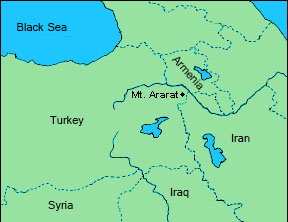
The global Flood of Noah’s Day changed the world. The Garden of Eden was washed away. It is probable that the former configuration of the surface was not exactly restored. Extensive volcanic activity and warm oceans created the necessary conditions to cause the Ice Age, which began within a short time following the flood. During a period of several hundred years, global temperatures cooled and glaciers covered one-third of Earth’s surface. This would have caused the geological landscape to reshape the earth. 1 Then God remembered Noah, and every living thing, and all the animals that were with him in the ark. And God made a wind to pass over the earth, and the waters subsided. The fountains of the deep and the windows of heaven were also stopped, and the rain from heaven was restrained. And the waters receded continually from the earth. At the end of the hundred and fifty days the waters decreased. Then the ark rested in the seventh month, the seventeenth day of the month, on the mountains of Ararat. And the waters decreased continually until the tenth month. In the tenth month, on the first day of the month, the tops of the mountains were seen. God did not suddenly "remember" that Noah was in the ark, floating through the storm. It means that God took specific action to on Noah's behalf and made the waters subside. God's "remembering" was a manifestation of Himself, to indicate His Divine compassion as well as grace. The word for wind in Hebrew is Ruach and it's exactly the same word and it's exactly the same word in Genesis 1:2 "And the Spirit of God was hovering over the face of the waters". A vast disturbance of the atmosphere must have caused violent currents, which still existed up to the end of the one hundred and fiftieth day. As the earth was not drowned in a day, so it was not dried in a day. It was probably the heat of the sun combined with a hot wind that rapidly caused evaporation of a portion of the waters into the atmosphere and the other would be gradually drained off by outlets beneath. By breathing 100 percent oxygen at elevated pressure, 20 times more oxygen travels through the body's bloodstream to injured organs and tissue. This causes accelerated healing and other beneficial effects. The oxygen pressure was much lower after the flood.The firmament which caused a greenhouse effect that created a universal climate was greatly reduced. The Atmospheric pressure was reduced by 50% and lifespan is decreased partly due to the radiation. 6 So it came to pass, at the end of forty days, that Noah opened the window of the ark which he had made. Then he sent out a raven, which kept going to and fro until the waters had dried up from the earth. He also sent out from himself a dove, to see if the waters had receded from the face of the ground. But the dove found no resting place for the sole of her foot, and she returned into the ark to him, for the waters were on the face of the whole earth. So he put out his hand and took her, and drew her into the ark to himself. And he waited yet another seven days, and again he sent the dove out from the ark. Then the dove came to him in the evening, and behold, a freshly plucked olive leaf was in her mouth; and Noah knew that the waters had receded from the earth. So he waited yet another seven days and sent out the dove, which did not return again to him anymore. Noah sent two birds to search for dry land. The raven was first chosen as one strong of flight, and also, perhaps, because anciently regarded as prophetic of the weather. In addition, the raven is a common land sighting bird, meaning it will fly towards land even if it can’t see any, and was used in navigation before compasses. It is possible that it rested on the ark, but did not enter into it. A dove will only settle upon such places and objects as are dry and clean. Though the ground might not be perfectly dry, the olive-tree will put out leaves even under water. When the dove did not return the third time it was a sign that the waters had completely receded from the earth. Genesis 1 and 7-8 are mirrors of each other in many ways, framing the flood story as a re-creation story. God separates the waters, skies, and land, and by the end of Genesis 7, the earth is very much like Genesis 1:2, wild and waste and covered in water. The dove is reminiscent of the Spirit hovering over the face of the deep. Then God begins population the Earth with a pair of families. Perhaps this is meant to further emphasize the connection between the pre-creation world and the post flood world. It is meant to signal hope and a new beginning. 13 And it came to pass in the six hundred and first year, in the first month, the first day of the month, that the waters were dried up from the earth; and Noah removed the covering of the ark and looked, and indeed the surface of the ground was dry. And in the second month, on the twenty-seventh day of the month, the earth was dried. Noah was now six hundred and one years old. If this was our calendar today, it would be January 1, New Year's Day. The flood began on the seventeenth day of the second month of the former year, it lasted, upon the whole, a complete solar year.The surface of the ground was dry, but yet soft and muddy so in the twenty-seventh day of the second month, it was finally fit for Noah's habitation. 15 Then God spoke to Noah, saying, “Go out of the ark, you and your wife, and your sons and your sons’ wives with you. Bring out with you every living thing of all flesh that is with you: birds and cattle and every creeping thing that creeps on the earth, so that they may abound on the earth, and be fruitful and multiply on the earth.” So Noah went out, and his sons and his wife and his sons’ wives with him. Every animal, every creeping thing, every bird, and whatever creeps on the earth, according to their families, went out of the ark. Noah waited until God told him to come out. The world had a new lease on life. They looked around at a creation cleansed of wickedness, and Noah was the head of the new world order, the leader of God’s remnant. Once again, man and animals were told to be fruitful and multiply to repopulate the earth. 20 Then Noah built an altar to the Lord, and took of every clean animal and of every clean bird, and offered burnt offerings on the altar. And the Lord smelled a soothing aroma. Then the Lord said in His heart, “I will never again curse the ground for man’s sake, although the imagination of man’s heart is evil from his youth; nor will I again destroy every living thing as I have done. “While the earth remains, Seedtime and harvest, Cold and heat, Winter and summer, And day and night Shall not cease.” Noah probably used one of each of the clean animals and birds for the offering. The Hebrew word for “burnt offering” actually means to “ascend,“ literally to “go up in smoke.” A burnt offering was the complete destruction of the animal (except for the hide) in an effort to renew the relationship between Holy God and sinful man. It’s entirely possible that Abel’s offering in Genesis 4:4 was a burnt offering. This is the first covenant God made with man known as the "Noahic Covenant". He promised that He would never destroy every living thing in spite of the fact that man's heart is evil from the time he is young. Prophecy tells us that the next time he destroys the earth will not be by water but by fire.
1. How did God make the water recede?
2. On what mount did Noah's ark come to rest?
3. On which day was the top of the mountains seen?
4. Which animal did Noah first send to check whether the water had abated? 5. When Noah sent a bird the second time, it returned with which leaf?
6. Which of the following was NOT one of Noah's sons?
7. At the time the waters dried, Noah was how many years old??
8. Where did Noah find the courage to go out of the ark?
9. What was the first significant thing Noah did after coming out of the ark?
10. And the LORD smelled a sweet savour; and the LORD said ........................., I will not again curse the ground any more for man's sake;
|