Genesis 48 – Jacob's Illness
Timeline: 1705 BC
Resources |
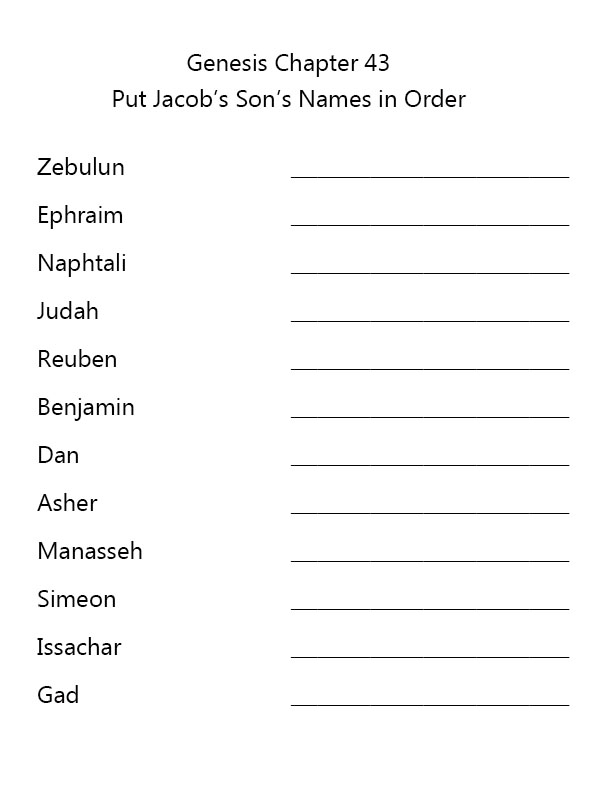
Some little time after Jacob had sent for Joseph, and conversed with him about his burial in the land of Canaan, and took an oath to bury him there, the time drew nigh that he must die. Jacob had been with Joseph for about fourteen years and the famine had been over. His family is prospering and he is weakening. 1 Now it came to pass after these things that Joseph was told, “Indeed your father is sick”; and he took with him his two sons, Manasseh and Ephraim. And Jacob was told, “Look, your son Joseph is coming to you”; and Israel strengthened himself and sat up on the bed. Joseph had two sons, the oldest being Manasseh who were in their early twenties when they heard of Jacob's condition. In one sentence, Jacob's name is used and is also referred to as Israel. He is referred to Jacob here in speaking of his sickness, but used Israel in relating his work as the patriarchal head of the Chosen Nation. Israel was used because Jacob's actions were directly related to the destinies of the covenant people. 3 Then Jacob said to Joseph: “God Almighty appeared to me at Luz in the land of Canaan and blessed me, and said to me, ‘Behold, I will make you fruitful and multiply you, and I will make of you a multitude of people, and give this land to your descendants after you as an everlasting possession.’ Jacob recounted the promise God made to him at Luz which he renamed "Bethel" - meaning the "House of God". There are three parts to this promise. First, the promise was that he would be fruitful and multiply. When he first got to Egypt, his family had more than seventy people. That number will increase exponentially. Secondly, he was promised that his descendants will be made a multiple of people. In Genesis 35:9, God states that "a nation and a company of nations shall proceed" from Israel referring to the tribes, named after each one of Jacob's sons. The third part of the promise is that the nation of Israel will possess the Promised Land. 5 And now your two sons, Ephraim and Manasseh, who were born to you in the land of Egypt before I came to you in Egypt, are mine; as Reuben and Simeon, they shall be mine.Your offspring whom you beget after them shall be yours; they will be called by the name of their brothers in their inheritance. Notice Jacob referred to Joseph's sons as Ephraim and Manasseh. Names are generally listed by age order. When this order is changed, it means that the blessing will not go to the oldest but to whom the one who is listed first. Remember that Jacob was younger than Esau and he received the birthright. Issac was also younger than Ishmael and he was given the birthright. God, in his infinate wisdom, chooses the one who will be most worthy. Because Rueben and Simeon forfeited their birthright through misbehavior, Jacob elevated Joseph to be the one who received the birthright. Jacob legally adopted Ephraim as his firstborn, and Manasseh as his second son and then split Joseph's birthright between them. He elevated them to the status of a patriarch. Any sons Joseph had afterwards were not included in his inheritance. Jacob had twelve sons and their descendants were known as the twelve tribes of Israel. The twelve tribes will include Ephriam, Manasseh, Reuben, Simeon, Judah, Dan, Naphtali, Gad, Asher, Issachar, Zubulun, and Benjamin. Notice that Joseph and Levi are not included but Ephriam and Manasseh are listed. When Jacob adopted Ephriam and Manasseh, he split Joseph's double portion birthright between them. The only time the tribe of Joseph is mentioned is in Revelation 7. To qualify as a nation, one must have a homeland. Each of these twelve inherited land in Israel. The tribe of Levi became priests and did not inherit land. Instead, God gave them all the tithes from the entire land of Israel as their allotment. They belong to God. Notice the similarity...Jesus had twelve disciples and He was a priest. Israel has twelve tribes plus the Levites. The twelve tribes of Israel are significant which will become evident as we continue studing the Bible. 7 But as for me, when I came from Padan, Rachel died beside me in the land of Canaan on the way, when there was but a little distance to go to Ephrath; and I buried her there on the way to Ephrath (that is, Bethlehem).” Just north of modern-day Bethlehem, Rachel's tomb is considered to be the third holiest site in all of Judiasm. 8 Then Israel saw Joseph’s sons, and said, “Who are these?” 9 Joseph said to his father, “They are my sons, whom God has given me in this place.” And he said, “Please bring them to me, and I will bless them.” Now the eyes of Israel were dim with age, so that he could not see. Then Joseph brought them near him, and he kissed them and embraced them. And Israel said to Joseph, “I had not thought to see your face; but in fact, God has also shown me your offspring!” In Genesis 27:1, Isaac was about to give the blessing to Esau: "Now it came to pass, when Isaac was old and his eyes were so dim that he could not see ..." Jacob's eyes were also failing. Jacob wanted to confirm that these are Joseph's sons. 12 So Joseph brought them from beside his knees, and he bowed down with his face to the earth. And Joseph took them both, Ephraim with his right hand toward Israel’s left hand, and Manasseh with his left hand toward Israel’s right hand, and brought them near him. Then Israel stretched out his right hand and laid it on Ephraim’s head, who was the younger, and his left hand on Manasseh’s head, guiding his hands knowingly, for Manasseh was the firstborn. Although Joseph was legally Jacob's superior, he humbled himself in respect to his father. Expecting the oldest would receive the first-born blessing, Joseph positioned them in order of age but Jacob crossed his hands. Blessing may be done by either hand; but when each is laid on a different object, it denotes that the higher blessing is conveyed by the right hand. The term "blessing" has to do with pulling down the goodness of Heaven upon someone. Essentially, Jacob was asking God to look favorably upon Joseph. And again, it is Israel rather than Jacob who is giving the blessing. 15 And he blessed Joseph, and said: God, before whom my fathers Abraham and Isaac walked, The God who has fed me all my life long to this day, The Angel who has redeemed me from all evil, Bless the lads; Let my name be named upon them, And the name of my fathers Abraham and Isaac; And let them grow into a multitude in the midst of the earth.” Jacob here is passing the Promise that was given to Abraham, Isaac and himself on to Joseph. Their descendants will become a great nation, the nation of Israel. "And let them grow into a multitude in the midst of the earth." This term in Hebrew refers to a multitude of fish. So when Jesus called his disciples "Fisher's of Men", they knew what He meant because they had studied the scriptures. 17 Now when Joseph saw that his father laid his right hand on the head of Ephraim, it displeased him; so he took hold of his father’s hand to remove it from Ephraim’s head to Manasseh’s head. And Joseph said to his father, “Not so, my father, for this one is the firstborn; put your right hand on his head.” 19 But his father refused and said, “I know, my son, I know. He also shall become a people, and he also shall be great; but truly his younger brother shall be greater than he, and his descendants shall become a multitude of nations.” Jacob was nearly blind so Joseph thought he was confused. Jacob was given the gift of prophecy. His blessings are more a prediction of what is to become of each of Joseph's sons. He knew that Ephriam would become the one of the most powerful and most prestigious tribes which would become the leader of all the other tribes. The majority of Israel's leaders came from the tribe of Ephriam such as Joshua, Samuel, Jeroboam, Ahab and others. When the kingdoms divided, the northern kingdom is referred to as Israel and sometimes as the Kingdom of Ephriam, which consisted of the Tribe of Ephriam, Rueben, Simeon, Issachar, Zebulun, Dan, Asher, Gad, Naphtali and Manasseh. The Southern Kingdom included Judah and Benjamin and is referred to as Judah. Among the most illustrious members of the tribe of Manasseh was Gideon, a fearless warrior who served as a judge for 40 years. In the end of times, all the tribes will come together as the Jews. 20 So he blessed them that day, saying, “By you Israel will bless, saying, ‘May God make you as Ephraim and as Manasseh!’ ” And thus he set Ephraim before Manasseh. God's will prevails over man's laws. The law of preeminence supersedes the law of the firstborn. God elevated certain people to the firstborn position. Jacob knew God's intention and therefore obeyed Him. 21 Then Israel said to Joseph, “Behold, I am dying, but God will be with you and bring you back to the land of your fathers. Moreover I have given to you one portion above your brothers, which I took from the hand of the Amorite with my sword and my bow.” The portion Jacob promises to Joseph refers to Shechem in which Joseph’s bones were to be buried. Genesis 33:19 tells us that Jacob purchased this property from Hamor, the prince of the country, however the part about the Amorites is not mentioned in the Bible. Other historical sources such as the Book of Jubilees, states that Jacob fought against several Amorite kings who had plundered their herds. Jacob won the battle and afterwards made peace with them.
1. At the time Joseph came to visit Jacob with his sons, Jacob was...
2. According to Jacob, where did God appeared to him and blessed him?
3. What did God say He would do to bless Jacob?
4. What did Jacob mean when he said 'And now thy two sons, Ephraim and Manasseh, are mine?
5. What is the place called Ephrath also known as?
6. Where was Jacob's wife, Rachel burried?
7. Which of the following happened to Jacob when he grew old?
8. When Jacob was blessing Joseph, whom did he place his right hand on?
9. When Jacob was blessing Joseph, whom did he place his left hand on?
10. Where did Jacob say God would bring Joseph to after he died?
|
| Cassie, Matt, Mary, Sue, Kelly | |