Genesis 43 – The Return with Benjamin
Timeline: 1706 BC
|
Resources |
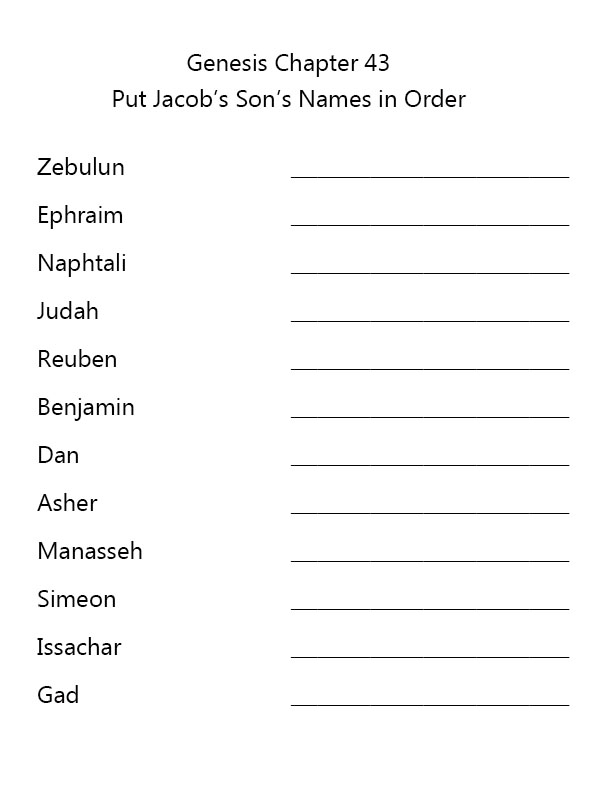
Simeon was incarcerated when his brothers left Egypt. Evidently, they took the first trip during the first year of the Famine and now it was a year later. They had no way of knowing that the famine was going to last for seven years so they probably didn't ration the grain. 1 Now the famine was severe in the land. And it came to pass, when they had eaten up the grain which they had brought from Egypt, that their father said to them, "Go back, buy us a little food." The drought continued and the grain was spent. Figuring that the famine could not last much longer, Jacob told his sons to buy a little more. Jacob was so afraid of losing Benjamin, that he refused to send them back to Egypt, until the threat of hunger forced the issue. 3 But Judah spoke to him, saying, "The man solemnly warned us, saying, 'You shall not see my face unless your brother is with you.' If you send our brother with us, we will go down and buy you food. But if you will not send him, we will not go down; for the man said to us, ‘You shall not see my face unless your brother is with you.' " Reuben slept with Bilhah, his father' concubine, Levi and Simeon murdered the Shechemites and Judah had twins with his daughter-in-law. No wonder Jacob was reluctant to send Benjamin with them! However, it was Judah who suggested selling Joseph rather than putting him to death. The transformation of Judah and his rise to leadership amongst his brothers became apparent when comparing the way Reuben and Judah negotiated with his father regarding Joseph's demand. Judah accepted full responsibility for the price of his brother's life and was willing to sacrifice his relationship with his father, so that Jacob would never see him again. In those days, this was significant. 6 And Israel said, "Why did you deal so wrongfully with me as to tell the man whether you had still another brother?" Jacob is now being referred to as Israel. Jacob relies upon himself, but Israel depends on God. He realized that he had to make the decision to let Benjamin go but the decision was not an easy one. Joseph didn't make direct inquiries about their father and their brother. They offered that information in their feeble attempt to prove that they were not spies. However he did take that opportunity to inquire about his father and brother. 7 But they said, "The man asked us pointedly about ourselves and our family, saying, 'Is your father still alive? Have you another brother?' And we told him according to these words. Could we possibly have known that he would say, ‘Bring your brother down'?" Then Judah said to Israel his father, "Send the lad with me, and we will arise and go, that we may live and not die, both we and you and also our little ones. I myself will be surety for him; from my hand you shall require him. If I do not bring him back to you and set him before you, then let me bear the blame forever. For if we had not lingered, surely by now we would have returned this second time." Judah makes his point. His self-sacrifice convinced Jacob to send Benjamin with them. He took full responsibility for his safety. At this time Benjamin would have been around 25 - 30 years old yet he was not the one who decided whether he should go or not. 11 And their father Israel said to them, "If it must be so, then do this: Take some of the best fruits of the land in your vessels and carry down a present for the man—a little balm and a little honey, spices and myrrh, pistachio nuts and almonds. Take double money in your hand, and take back in your hand the money that was returned in the mouth of your sacks; perhaps it was an oversight. Take your brother also, and arise, go back to the man. And may God Almighty give you mercy before the man, that he may release your other brother and Benjamin. If I am bereaved, I am bereaved!" For the first time, Jacob seems to realize that Benjamin must go with them, or they will not go. It slowly dawns upon him that he must accept the conditions. Just as he sent gifts to Esau when he met him after many years, he also sent gifts to "the man" who had Simeon. His hope was that his sons would gain favor in the eyes of Joseph. The items he sent were scarce in Egypt making them very valuable. And so he finally depends on God Almighty (El Shaddai - The One who is sufficient). El Shaddai, God Almighty, has been named only four times so far in Genesis. The first was when He spoke to Abraham in chapter 17 at the time of the covenant of circumcision. Then in chapter 28 when Isaac blessed Jacob before he went away, he blessed him using the name El Shaddai. After that in Genesis 35, El Shaddai appeared to Jacob at Bethel. In each of those accounts, a blessing for fruitfulness and a multitude of descendants is promised or pronounced. Now, as a hope that those blessings include Simeon and Benjamin, Jacob invokes the name once again. There was a scarcity even of the fruits and almonds, which do not grow well in Egypt. Probably the trade in them had ceased due to the famine, and therefore even a moderate quantity would be welcome. The double money was to give back the money for the first purchased grain and then enough for the grain they intend to purchase during this trip. 15 So the men took that present and Benjamin, and they took double money in their hand, and arose and went down to Egypt; and they stood before Joseph. When Joseph saw Benjamin with them, he said to the steward of his house, "Take these men to my home, and slaughter an animal and make ready; for these men will dine with me at noon." Then the man did as Joseph ordered, and the man brought the men into Joseph's house. In ancient Middle East culture, being invited into a house was very significant. It meant that you were under their complete protection. If you were a guest and were attacked, the men of the household would fight to their death to protect you. You became part of the family. Jesus said in Revelation 3:20 "Behold, I stand at the door and knock. If anyone hears My voice and opens the door, I will come in to him and dine with him, and he with Me." It means that if you invite him in, you will become one of his and He will give you complete protection. In the heat of the day, when the sun is the strongest, the people would break and go indoors to have a meal. 18 Now the men were afraid because they were brought into Joseph's house; and they said, "It is because of the money, which was returned in our sacks the first time, that we are brought in, so that he may make a case against us and seize us, to take us as slaves with our donkeys." They assumed that they were being framed. A guilty conscience needs no accuser, so the judgment of God weighed on their consciences. They feared that they would become slaves just as they had sold Joseph to slavery. They had no idea that Joseph was working out working out a plan in hopes of reconciliation with his brothers. 19 When they drew near to the steward of Joseph's house, they talked with him at the door of the house, and said, "O sir, we indeed came down the first time to buy food; but it happened, when we came to the encampment, that we opened our sacks, and there, each man's money was in the mouth of his sack, our money in full weight; so we have brought it back in our hand. And we have brought down other money in our hands to buy food. We do not know who put our money in our sacks." The steward of the house was intrusted with the management of the house and quite often a mediator for Joseph so they began to make their case to him. Their honesty was being tested, though they didn't know it yet. 23 But he said, "Peace be with you, do not be afraid. Your God and the God of your father has given you treasure in your sacks; I had your money." Then he brought Simeon out to them. Joseph had taught the steward both the customs of the Hebrews and to fear the true God. The words he used were given as a note of encouragement. He acknowledged that he received the money from the brothers but that the money that was in their sacks was from God. 24 So the man brought the men into Joseph's house and gave them water, and they washed their feet; and he gave their donkeys feed. Then they made the present ready for Joseph's coming at noon, for they heard that they would eat bread there. The brothers are encouraged by the steward and having Simeon with them again was tangible evidence that everything would be ok. The washing of their feet is equivalent to us taking someone's hat and coat and telling them to relax. 26 And when Joseph came home, they brought him the present which was in their hand into the house, and bowed down before him to the earth. Then he asked them about 'their' well-being, and said, "Is your father well, the old man of whom you spoke? Is he still alive?" And they answered, "Your servant our father is in good health; he is still alive." And they bowed their heads down and prostrated themselves. The first thing the brothers did was to present the gifts to Joseph. They bowed down for the second time and this is the fulfillment of the first dream that Joseph had more than 20 years earlier. However he has been given two dreams. The second one included his father also bowing so he is concerned and asked about him. As they bowed down to Joseph, they did not realize that what they hated and refused to believe, had come to fruition. 29 Then he lifted his eyes and saw his brother Benjamin, his mother's son, and said, "Is this your younger brother of whom you spoke to me?" And he said, "God be gracious to you, my son." Now his heart yearned for his brother; so Joseph made haste and sought somewhere to weep. And he went into his chamber and wept there. Then he washed his face and came out; and he restrained himself, and said, "Serve the bread." Joseph’s question was one of surprise. Can this young man, who is nearly thirty years old, be the little Benjamin, who was but a child of eight or nine when he last saw him! It was overwhelming for him so he left the room to weep since he was not yet ready to reveal himself. Remember that he is still speaking through an interpreter. 32 So they set him a place by himself, and them by themselves, and the Egyptians who ate with him by themselves; because the Egyptians could not eat food with the Hebrews, for that is an abomination to the Egyptians. And they sat before him, the firstborn according to his birthright and the youngest according to his youth; and the men looked in astonishment at one another. Then he took servings to them from before him, but Benjamin's serving was five times as much as any of theirs. So they drank and were merry with him. Prior to Joseph there was a group of nomadic shepherds called the Hyskos dynasty that fought against Egypt and conqured them. They ruled for a number of years. They savagely burnt the cities, destroyed the temples of the gods, and treated the whole native population with the utmost cruelty, massacring some, and carrying off the wives and children of others into slavery. The Egyptians rebelled and took their land back and so they despised Hebrews, who were mostly shepherds and therefore refused to eat with them. In the dining hall, there are at least three separate tables. These distinctions were common in ancient times, and still exist in India. Though Joseph is himself a foreigner by birth, his position dictated that the customs be upheld. Joseph is set by himself as a sign of his position and authority. Joseph's brothers were very close in age. With the exception of Benjamin, there is only a six year difference between them. The probability of being able to seat the brothers in the correct order was about 40 million to one. So when they were seated in order, they were astonished. The brothers passed the first test of honesty. Next, Joseph subjected his brothers to another test. He wanted to see whether they would envy Benjamin and hate him on account of this distinction. Joseph must have been pleased with their reaction. Their cares and fears were now over. The brothers feared Benjamin was in danger, however the presence of Simeon, and the attention paid to their brother assured them that they were in good terms with the lord of the land. Bible Study Questions 1. Jacob and his household had run out of food. What was hindering the son of Jacob from going to Egypt to buy food again?
2. Who voluntarily took responsibility for Benjamin's safe return to their father?
3. Which of these were part of the present that Jacob advised his children to take to the ruler of Egypt?
4. What moved the ruler of Egypt to treat the sons of Jacob kindly when they came to Egypt the second time?
5. The sons of Jacob were ................... when they were brought to the house of the ruler of Egypt.
6. On the day the sons of Jacob were brought to Joseph's house, Joseph returned home ........................
7. Joseph, the ruler of Egypt, had .................... with Reuben and his brothers in his house.
8. Why did Joseph hurry away to weep in his chamber?
9. It was an abomination for .......................................
10. Benjamin received .......................... the food his elder brothers received.
|
| Joe, Cassie, Matt, Mary, Noah, Sue, Kelly | |