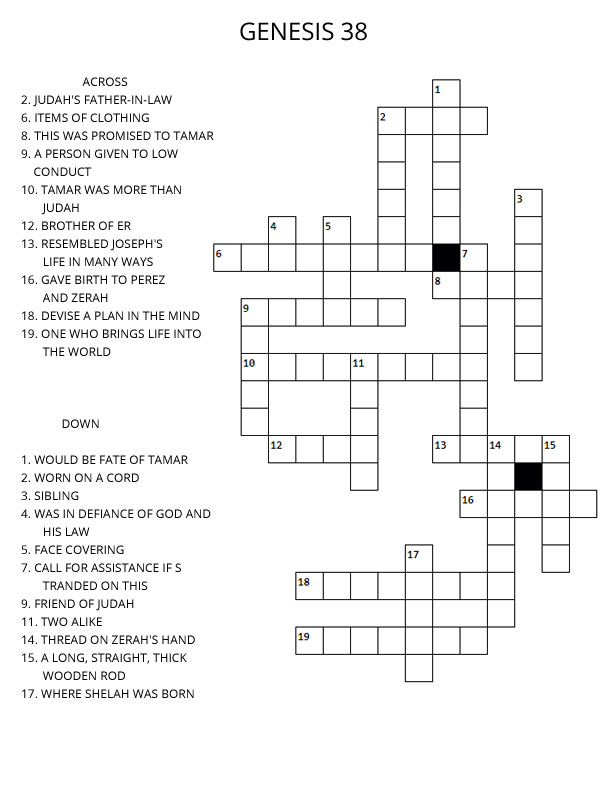
Genesis 38 – Tamar Deceives Judah
Timeline: 1898 BC
|
Resources |
Joseph's life resembled Jesus' life in so many ways. However, Jesus is a descendant of Judah through David. Judah is the tribe of the first-born - by assignment. Rueben would have had that privilege if he had not forfeited it through misconduct. Simeon and Levi also lost out since they attacked Shechem. The events recorded here probably began soon after his father's arrival at the tower of Eder, about fifteen or sixteen miles west by north from Hebron the country of the Philistines. While Joseph is in Egypt for about 20 years the events of this chapter takes place. 1 At that time, Judah left his brothers and went down to stay with a man of Adullam named Hirah. There Judah met the daughter of a Canaanite man named Shua. He married her and made love to her; she became pregnant and gave birth to a son, who was named Er. She conceived again and gave birth to a son and named him Onan. She gave birth to still another son and named him Shelah. It was at Kezib that she gave birth to him. Judah's choice to marry a Canaanite threatened the very survival of the nation of Israel. Judah was the tribe carrying the seed promise God delivered to Abraham. By marrying a Canaanite woman, which was forbbiden by his ancestors, Abraham and Isaac, Judah's sons would carry the Canaanite curse. The town of Adullam, was near the cave where David escaped to when he was pursued by Saul. 6 Then Judah took a wife for Er his firstborn, and her name was Tamar. But Er, Judah's firstborn, was wicked in the sight of the Lord, and the Lord killed him. Judah arranged his oldest son's marriage to Tamar, a Jewish woman. Er was half Canaanite. To prevent the the line to Jesus being corrupted by the cursed gene, Er died an untimely death.. 8 And Judah said to Onan, "Go in to your brother’s wife and marry her, and raise up an heir to your brother." But Onan knew that the heir would not be his; and it came to pass, when he went in to his brother’s wife, that he emitted on the ground, lest he should give an heir to his brother. And the thing which he did displeased the Lord; therefore He killed him also. In the ancient time of the Hebrew people, if a husband dies and leaves no offspring, it is the duty of the next in line, if he is not married, to marry the widow so she can bear her son to perserve her dead husbands line. This practice is codified in Deuteronomy 25 as law called the levirate marriage law which literally means "a marriage with a brother-in-law. This was a common practice in Asia and Africa but it originated in Mesopotamia In this case the male child would received the first-born inheritance. Onan was Judah's second son. So if he would have impregnated Tamar, her son would assume all the rights of his brother, not his. He took advantage of the social custom to satisfy his lust but to prevent her from taking his birth-right, he used ancient birth control to keep her from having children. God's displeasure was not about the relationship between Onan and Tamar. It was about protecting Judah's line which is ultimately the line through which Jesus comes. 11 Then Judah said to Tamar his daughter-in-law, "Remain a widow in your father’s house till my son Shelah is grown." For he said, "Lest he also die like his brothers." And Tamar went and dwelt in her father’s house. Judah looked at Tamar as a "black-widow" and feared that once she married his last son, Shua, that he too would die. So he sent her home and promised that when Shua was old enough, he would bring her back. Obviously, he was not about to keep that promise. 12 Now in the process of time the daughter of Shua, Judah’s wife, died; and Judah was comforted, and went up to his sheepshearers at Timnah, he and his friend Hirah the Adullamite. And it was told Tamar, saying, "Look, your father-in-law is going up to Timnah to shear his sheep." So she took off her widow’s garments, covered herself with a veil and wrapped herself, and sat in an open place which was on the way to Timnah; for she saw that Shelah was grown, and she was not given to him as a wife. Judah mourned awhile for the death of his wife, according to the custom of the country and of those times. It was usual to have a feast furing this time of the year, so he took Hirah along with him for a companion, and to partake of the entertainment. The idol worshippers in that land engaged in immoral sex to cause the gods to join together, ensuring good harvests. This practice became the basis for religious prostitution. Judah's family had knowledge of the Messiah being to be born of Jacob's line and therefore what Tamar did was in order to fulfill the will of God. She wanted to keep the lineage of the family. 15 When Judah saw her, he thought she was a harlot, because she had covered her face. Then he turned to her by the way, and said, "Please let me come in to you"; for he did not know that she was his daughter-in-law. God miraculously caused him to not know her by her voice. 17 And he said, "I will send a young goat from the flock." So she said, "Will you give me a pledge till you send it?" Then he said, "What pledge shall I give you?" So she said, "Your signet and cord, and your staff that is in your hand." Then he gave them to her, and went in to her, and she conceived by him. The Jewish commentators all agree that this was not the custom of harlots to cover their face. Judah probably thought that she was performing worship to the fertility gods. Hence the hire was a young goat to be sacrificed to the goddess. Each man of distinction had his emblem, Judah’s was a lion. The cord by which the signet ring was suspended round his neck and his staff were both objects of value, and were regarded as ornaments in the East. The immediate conception indicates that although this was a deceiptful act, it happened in order to fulfil the continuation of the lineage to Jesus. 19 So she arose and went away, and laid aside her veil and put on the garments of her widowhood. Think about how Rachel deceived Isaac. If she had not, then Esau would have received the birth-right instead of Jacob to whom God had intended. This was a one-time event so after her encounter with Judah. Afterwards, she immediately arose and went away, to her father's house and resumed her role as a widow. 20 And Judah sent the young goat by the hand of his friend the Adullamite, to receive his pledge from the woman’s hand, but he did not find her. Then he asked the men of that place, saying, "Where is the harlot who was openly by the roadside?" And they said, "There was no harlot in this place." He sent his friend, rather than the servants, to retrieve his signet, cord and staff to pay the "harlet" the goat he promised. Now, of course, she wasn't there. She was only there for Judah. 22 So he returned to Judah and said, "I cannot find her. Also, the men of the place said there was no harlot in this place."
Judah resolved to leave his pledges with the girl, that he might not expose himself to the ridicule of the people by any further inquiries. He was either afraid his sin would become known publicly or that he whould be laughed at for being a fool for trusting a harlet with his signet and staff. So he forbade his friend to make any further inquiry. The pledges were unquestionably of more value than a young male goat. 24 And it came to pass, about three months after, that Judah was told, saying, "Tamar your daughter-in-law has played the harlot; furthermore she is with child by harlotry." So Judah said, "Bring her out and let her be burned!" Judah, as the head of the family, acts as judge having power of life and death. Stoning was the normal mode of punishment for such a crime, however, death by burning was the penalty of a priest’s daughter only in cases of excessive criminality. 25 When she was brought out, she sent to her father-in-law, saying, "By the man to whom these belong, I am with child." And she said, "Please determine whose these are—the signet and cord, and staff." Tamar had the first DNA test performed. She had proof that Judah was the father. Tamar's act of obedience demonstrated her commitment to her husband. She carried on the redemption of his name. Because of her act, the lineage of Messiah continued so Jesus could be born. 26 So Judah acknowledged them and said, "She has been more righteous than I, because I did not give her to Shelah my son." And he never knew her again. It is evident from the whole account, that she was not driven to her sin by lust, but by the innate desire for children. Because Judah had confessed that he had broken his word with Tamar when he witheld Shelah from her, he humbled himself and God gave him grace, and not only exalted him to be the chief of the house of Israel, but blessed the children that were begotten in sin. 27 Now it came to pass, at the time for giving birth, that behold, twins were in her womb. And so it was, when she was giving birth, that the one put out his hand; and the midwife took a scarlet thread and bound it on his hand, saying, "This one came out first." Then it happened, as he drew back his hand, that his brother came out unexpectedly; and she said, "How did you break through? This breach be upon you!" Therefore his name was called Perez. Afterward his brother came out who had the scarlet thread on his hand. And his name was called Zerah. Like Jacob and Esau, the children struggled for the birthright. It was important to know who was born first since the birthright includes a double portion and a title of stature. The second-born son Zerah had the red thread on his wrist, which would have made him the first-born but the second-born son, Perez, would be found in the Messianic line. So far we have seen over and over again how Satan has tried to end the line of Jesus. But God stepped in and twarted his plans. Judah was twenty-eight when Perez and Zerah, his grandsons were born and Joseph was twenty-four. So this story takes place during the time that Joseph was in Potiphar's house. Bible Study Questions 1. Who was Judah's first wife?
2. Who was Judah's firstborn?
3. How old was Judah when Perez and Zerah born?
4. Who was the first to marry Tamar? 5. Why did God kill Er, son of Judah?
6. Why did God kill Onan, son of Judah?
7. Judah was going to see his sheepshearers in
8. Who was Judah's Adullamite friend?
8. What did Judah agree to pay the supposed harlot with?
10. What did Judah give as a pledge to pay for service?
|
| Joe, Cassie, Matt, Noah, Sue, Mary | |