Genesis 36 – Descendants of Esau
Timeline: 1906 BC
| ||||
Genesis 36 – Descendants of Esau
Timeline: 1906 BC
Resources
Let's begin this chapter with a bit of history. When Rebekah was pregnant, God told her she had two nations in her womb who were in conflict with each other. Therefore He promised Rebekah Esau would become a nation. Later, Esau despised his birthright and sold it to Jacob for bowl of red stew. Esau was thereafter called Edom, which means hairy or red and Jacob became Israel, thus the two nations. When Esau was forty years old, he married Judith the daughter of Beeri the Hittite, and Basemath the daughter of Elon the Hittite. Intermarrying was at this time prohibited by the sons of Abraham, especially one who was eligible for the covenant. Esau dismissed this completely. By marrying Canaanitish women, Esau also forfeited the birthright since he married outside the clan. Therefore his children could not inherit the Promised Land. When he saw that his parents were upset by his decision, he married Ishmael's daughter in addition to the wives he already had. (Ishmael is Isaac's brother, Esau's uncle.) So when Jacob left home, Esau had at least three wives.
Esau wanted earthly blessings: children, wealth, land, status, influence, and that is exactly what God gave him. Esau had little regard for spiritual things. He was hated and rejected by God so he did not inherit the covenant made to Abraham.
It is noteworthy to mention that there some of the names listed here different from the ones listed in chapter 28. Several commentaries had opinions as to why this is so:
1. Assuming Esau had only three wives, each of them had two names which is not unusual in Oriental countries:
Bashemath is the same as Mahalath
Adah is the same as Judith,
Aholibamah is the same as Bathsemath2. The first name was the generic term for the race and the second was the specific designation of the tribe and if there were a thrird, it was the particular name for the inhabitants of the district to which they belongs.
3. There were four wives and Judith died either died or did not have children so therefore was not listed in this chapter.
4. There may have been a transcription error in Genesis 36:2 somewhere along the way from the original text to the surviving copies available today.
There may be other explanations as well.
The first account is the history of Esau when he was still living in Canaan, the land of promise.
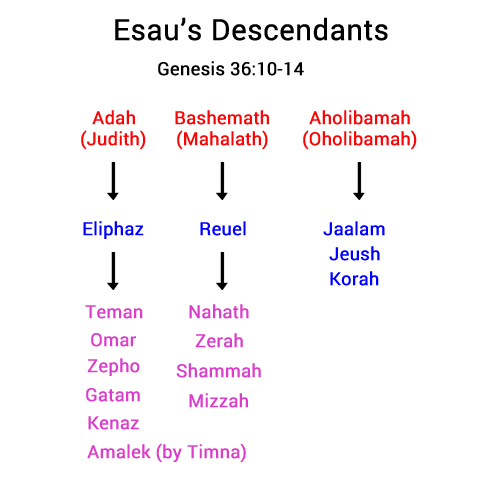
1 Now this is the genealogy of Esau, who is Edom. Esau took his wives from the daughters of Canaan: Adah the daughter of Elon the Hittite; Aholibamah the daughter of Anah, the daughter of Zibeon the Hivite; and Basemath, Ishmael's daughter, sister of Nebajoth. Now Adah bore Eliphaz to Esau, and Basemath bore Reuel. And Aholibamah bore Jeush, Jaalam, and Korah. These were the sons of Esau who were born to him in the land of Canaan.
Esau had five sons: By Adah: Eliphaz. By Aholibamah: Jeush, Jaalam, Korah. By Basemath: Reuel He had also daughters, though their names be not here mentioned.
In Job, Eliphaz was one of Job's friends was of the same name. He was a Temanite. The Septuagint says Zepho was also one of Job's friends. Reuel is also called Jethro, the father of the father-in-law of Moses and priest of Midian of the Kenite clan. Korah was the name of a family of Levites and singers in the time of David to whom ten of the psalms are ascribed.
6 Then Esau took his wives, his sons, his daughters, and all the persons of his household, his cattle and all his animals, and all his goods which he had gained in the land of Canaan, and went to a country away from the presence of his brother Jacob. For their possessions were too great for them to dwell together, and the land where they were strangers could not support them because of their livestock.So Esau dwelt in Mount Seir. Esau is Edom.
After Isaac's death, Jacob inherited a double portion of his fathers wealth and Esau received a third which added to what he had in addition to the flocks he received from his brother. Esau's settled in Edom and Jacob's settled in Haran. Abraham and Lot separated the same for the same reason as Jacob and Esau, too much stuff; so little room.
This next genealogy set introduces Esau's history after he moved to Seir (Edom).
9 And this is the genealogy of Esau the father of the Edomites in Mount Seir. These were the names of Esau’s sons: Eliphaz the son of Adah the wife of Esau, and Reuel the son of Basemath the wife of Esau. And the sons of Eliphaz were Teman, Omar, Zepho, Gatam, and Kenaz.
Not all of Esau's descendants settled within the limits of Edom. Teman is the father of the Temanites who went westward into Arabia. Kenaz also may have led his family and followers to a distance from Mount Seir and may indicate some affinity of Edom with the Kenizzites , though these were an older tribe. Omar, Zepho, and Gatam, and Kenaz are not mentioned as towns or cities, or any part of the land of Edom.
These were the sons of Reuel: Nahath, Zerah, Shammah, and Mizzah. These were the sons of Basemath, Esau's wife.
Nahath is an ancestor of Samuel. Zerah is mentioned in the genealogy of Jesus in Matthew and is also listed as the ancestor of Achan, who was stoned to death as recounted in the Book of Joshua.
These were the sons of Aholibamah, Esau's wife, the daughter of Anah, the daughter of Zibeon. And she bore to Esau: Jeush, Jaalam and Korah.
Jeush was a ancestor of King Saul. The sons and grandsons of Esau are called Chiefs because they were military commanders, that had soldiers under them; for Esau and his family lived by the sword.
These were the chiefs of the sons of Esau. The sons of Eliphaz, the firstborn son of Esau, were Chief Teman, Chief Omar, Chief Zepho, Chief Kenaz, Chief Korah, Chief Gatam, and Chief Amalek. These were the chiefs of Eliphaz in the land of Edom. They were the sons of Adah.
Probably they were military commanders, that had soldiers under them; for Esau and his family lived by the sword
Among the sons of Eliphaz we find Amalek who was a nation described in the Hebrew Bible as a staunch enemy of the Israelites. Balaam describes Amalek as "the beginning of nations". He settled in the desert between Egypt and Palestine. The Amalekites attacked the Israelites at Horeb as they came out of Egypt under Moses. The Kenezites, under Caleb, were fused into the tribe of Judah.
13 These were the sons of Reuel, Esau's son: Chief Nahath, Chief Zerah, Chief Shammah, and Chief Mizzah. These were the chiefs of Reuel in the land of Edom. These were the sons of Basemath, Esau's wife.
The Hebrew word for chiefs means "the ruler or commander of a thousand men". The Edomites, like the Israelites, were divided into tribes, which took their names from his sons. The head of each tribe was called a Chief.
And these were the sons of Aholibamah, Esau's wife: Chief Jeush, Chief Jaalam, and Chief Korah. These were the chiefs who descended from Aholibamah, Esau's wife, the daughter of Anah. These were the sons of Esau, who is Edom, and these were their chiefs.
It is significant that these "chiefs" were, except for the three sons of Aholibamah, "grandsons", not "sons" of Esau. The reason of this is probably that she belonged to the dominant family of Seir, and her sons took the command of districts and tribes of the Horite people in her right.
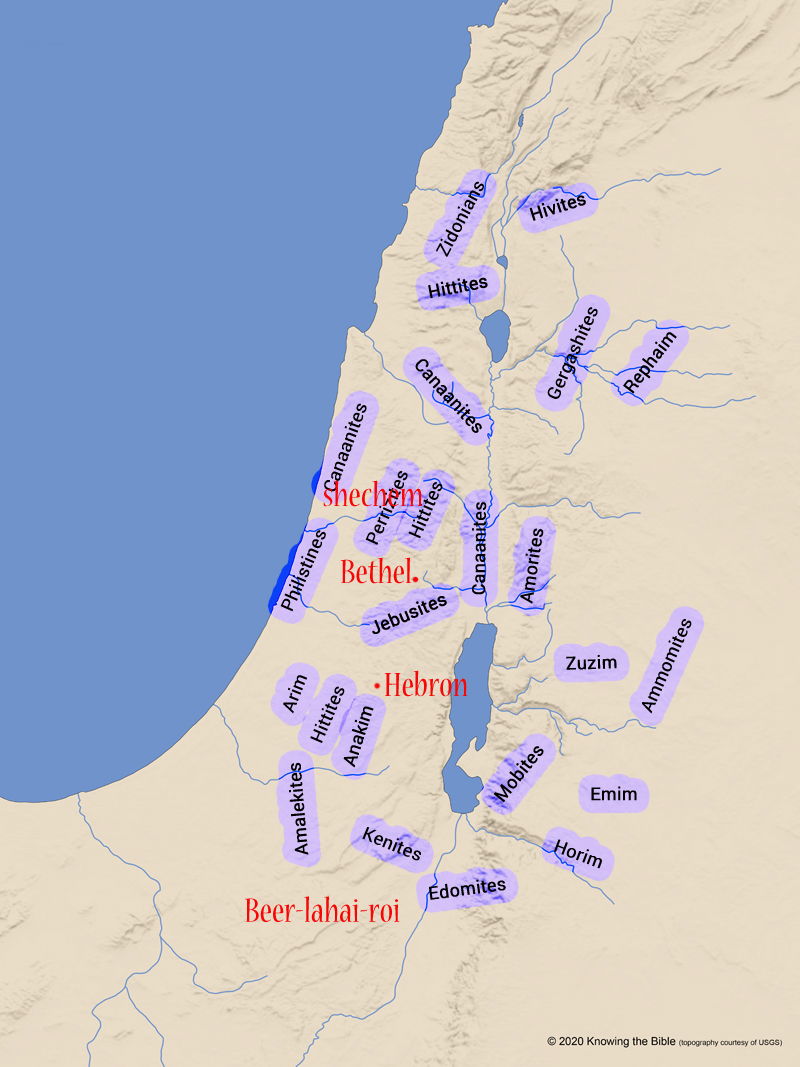
20 These were the sons of Seir the Horite who inhabited the land: Lotan, Shobal, Zibeon, Anah, Dishon, Ezer, and Dishan. These were the chiefs of the Horites, the sons of Seir, in the land of Edom.
Seir was first occupied by the Horites, and fell into possession of Esau and his posterity. Hence Seir and Edom are sometimes spoken of as identical. Ezer is used consistently in military context. The Ezer is a warrior.
And the sons of Lotan were Hori and Hemam. Lotan’s sister was Timna. These were the sons of Shobal: Alvan, Manahath, Ebal, Shepho, and Onam.
The Rabbis relate that Timna sought to convert and join Abraham's household. She went to Abraham, Isaac, and Jacob, but since they would not accept her, she went and became the concubine of Eliphaz. Manahath was a place to which certain Benjamites, victims, apparently, of intra-tribal jealousy, were carried captive.
These were the sons of Zibeon: both Ajah and Anah. This was the Anah who found the water in the wilderness as he pastured the donkeys of his father Zibeon. These were the children of Anah: Dishon and Aholibamah the daughter of Anah.
These were the sons of Dishon: Hemdan, Eshban, Ithran, and Cheran. These were the sons of Ezer: Bilhan, Zaavan, and Akan. These were the sons of Dishan: Uz and Aran.
These were the chiefs of the Horites: Chief Lotan, Chief Shobal, Chief Zibeon, Chief Anah, Chief Dishon, Chief Ezer, and Chief Dishan. These were the chiefs of the Horites, according to their chiefs in the land of Seir.
Esau took over the country, but the pagan culture of Seir took over the Edomites.
31 Now these were the kings who reigned in the land of Edom before any king reigned over the children of Israel: Bela the son of Beor reigned in Edom, and the name of his city was Dinhabah. And when Bela died, Jobab the son of Zerah of Bozrah reigned in his place. When Jobab died, Husham of the land of the Temanites reigned in his place. And when Husham died, Hadad the son of Bedad, who attacked Midian in the field of Moab, reigned in his place. And the name of his city was Avith. When Hadad died, Samlah of Masrekah reigned in his place. And when Samlah died, Saul of Rehoboth-by-the-River reigned in his place. When Saul died, Baal-Hanan the son of Achbor reigned in his place. And when Baal-Hanan the son of Achbor died, Hadar reigned in his place; and the name of his city was Pau. His wife’s name was Mehetabel, the daughter of Matred, the daughter of Mezahab.
Before any king reigned over the children of Israel, they were ruled by judges, the first one being Othniel and the last being Samuel. When Israel had reached the borders of their land, Edom then had a king which seemed to have come to the throne by election, and not by lineal descent, after the death of Esau. However no king succeeds his father. They were petty monarchs and during a long period of civil war, the Horites completed conquered by Saul and Solomon.
Before Israel had kings, they were governs by judges. Othniel son of Caleb's younger brother Kenaz became the first judge of Israel Samuel was the last judge before the first King which was Saul. Caleb was Joshua’s assistant who had gone with him to spy out the land of Canaan.
The Chiefs of Esau
40 And these were the names of the chiefs of Esau, according to their families and their places, by their names: Chief Timnah, Chief Alvah, Chief Jetheth, Chief Aholibamah, Chief Elah, Chief Pinon, Chief Kenaz, Chief Teman, Chief Mibzar, Chief Magdiel, and Chief Iram. These were the chiefs of Edom, according to their dwelling places in the land of their possession. Esau was the father of the Edomites.
The kings co-existed with the chiefs, who are again enumerated at the close of the list, and are mentioned in the song of Moses. There is a Jewish tradition stemming from the Talmud, that the descendants of Esau would eventually become the Romans, and to a larger extent, all Europeans.
Bible Study Questions
1. This chapter is a listing of the generations of...
a. Jacob
b. Esau
c. Abraham
d. Ezra2. The descendants of Esau would eventually become ...
a. the Romans.
b. the Israelis.
c. the Talmud.
d. all the above.3. Why did Esau move away from his brother?
a. He feared him
b. His brother ordered him to move
c. They had so much riches the land could not bear them
d. The people of that place forced him out4. Many of Esau's descendants were called...
a. Jacob
b. Chiefs
c. Lords
d. Prophets5. Esau is called the father of...
a. Many nations
b. The Edomites
c. Princes
d. Valor6. The Edomites were a tribe who dwelled in ...
a. Mount Seir
b. Hamon
c. Shechem
d. Canaan7. By marrying Canaanitish women, Esau...
a. inherited Canaan.
b. made his family proud.
c. was eligible for the covenant.
d. forfeited the birthright.8. Esau's sons and grandsons are called Chiefs because...
a. they were military commanders.
b. they had soldiers under them.
c. Esau and his family lived by the sword.
d. All the above.9. Why didn't Esau get the birthright?
a. He moved away.
b. He displeased his father
c. He killed his brother.
d. None of the above.10. Esau was the father of the ...
a. Hittites
b. Horivites
c. Edomites
d. HoritesJoe, Cassie, Matt, Kelly, Sue, Mary