Genesis 35 – Jacob Returns to Bethel
Timeline: 1906 - 1903 BC
|
Resources |
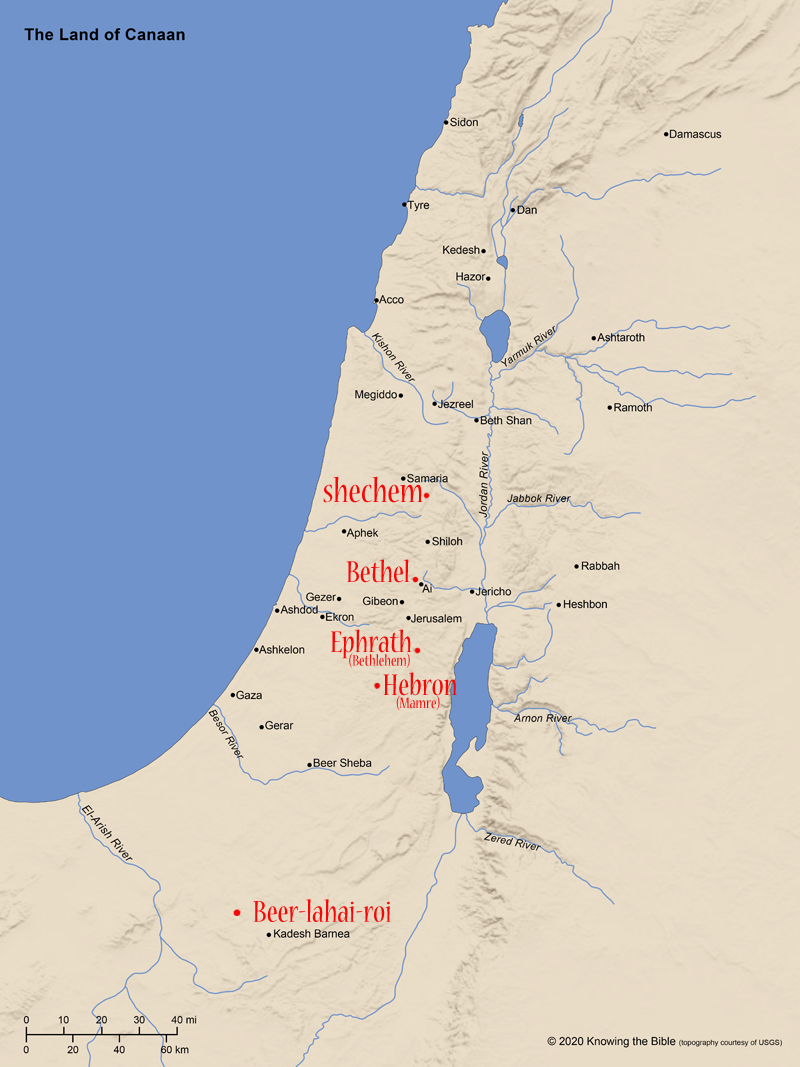
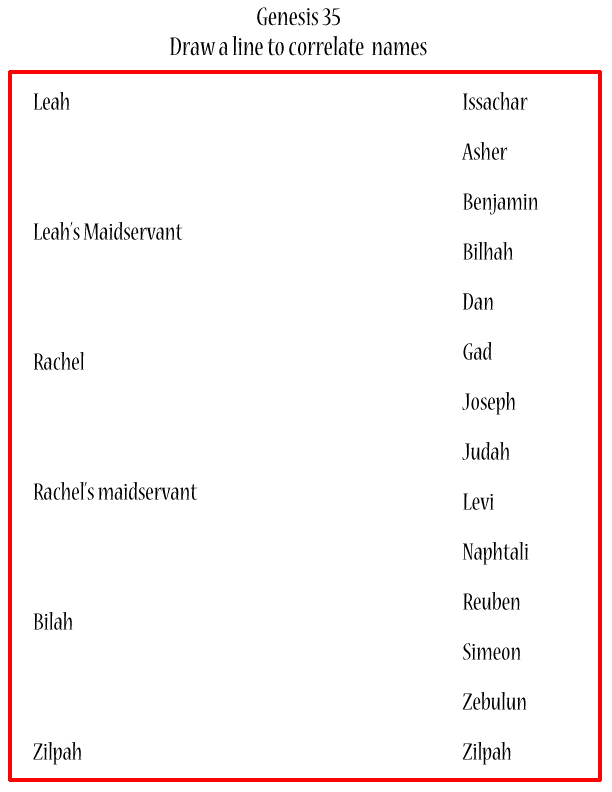
Jacob found good pasture and plenty of room for his cattle at Shechem, so he remained there for awhile; before going first to Bethel, and then finally to Hebron. Although the Canaanites were very angry against the sons of Jacob for what they did to the Shechemites, the inhabitants of Canaan were afraid of Jacob and his clan, and were kept back by Divine power. However, they might retaliate if they had time to learn how few Jacob's clan really was. 1 Then God said to Jacob, "Arise, go up to Bethel and dwell there; and make an altar there to God, who appeared to you when you fled from the face of Esau your brother." Many years had passed since Jacob' vow, but he did not abandon his purpose. So God spoke to him for his comfort and direction to continue on his journey. Bethel was about thirty miles south of Shechem. God reminded him of His former appearance to him at that place, and directed him to erect an altar there. 2 And Jacob said to his household and to all who were with him, "Put away the foreign gods that are among you, purify yourselves, and change your garments. Then let us arise and go up to Bethel; and I will make an altar there to God, who answered me in the day of my distress and has been with me in the way which I have gone." Rachel was still in possession of the teraphim idol she stole from her father. In addition, the women whom they had taken captive undoubtedly had their own idols. I have to wonder here about the changing of the clothes. Could it be that the garments warn by the captives had influenced Jacob's family and servants? Clothes often signify who or what a person is. As a person changes clothes, it changes who he is at the moment or what he does. They had to purify themselves to go back to righteousness. 4 So they gave Jacob all the foreign gods which were in their hands, and the earrings which were in their ears; and Jacob hid them under the terebinth tree which was by Shechem. Earrings, which were formed the likeness of their idols, seem to have been worn not so much for ornament as symbols of heathen deities. It is noteworthy that the "terebinth" is the same tree mentioned in several other places in the Bible. It is probably the very tree under which Abraham once pitched his tent (Genesis 12:6), and which was regarded as a sacred place in Joshua's time (Joshua 24:26). 5 And they journeyed, and the terror of God was upon the cities that were all around them, and they did not pursue the sons of Jacob. So Jacob came to Luz (that is, Bethel), which is in the land of Canaan, he and all the people who were with him. And he built an altar there and called the place Bethel, because there God appeared to him when he fled from the face of his brother. When the people in the cities surrounding Shechem heard about the masscure by only two men they must have been terrified of Jacob and his God so they let him go without reprisal. Jacob obeyed the command of God, as he went on his journey to Bethel where he had made the memorial pillar at this place. He sacrificed livestock on the altar to fulfill his promise to give God ten percent of everything he owned twenty-six years before this time. 8 Now Deborah, Rebekah' nurse, died, and she was buried below Bethel under the terebinth tree. So the name of it was called Allon Bachuth. Rebekah had a nurse named Deborah from the time she was born. She must have been nearly one hundred and sixty years of age. Perhaps Deborah came to Jacob at some time to tell him of his mother's passing and then died and was burried in Bethel. Allon Bachuth means weeping. 9 Then God appeared to Jacob again, when he came from Padan Aram, and blessed him. And God said to him, "Your name is Jacob; your name shall not be called Jacob anymore, but Israel shall be your name." So He called his name Israel. Also God said to him: "I am God Almighty. Be fruitful and multiply; a nation and a company of nations shall proceed from you, and kings shall come from your body. The land which I gave Abraham and Isaac I give to you; and to your descendants after you I give this land." God reaffirmed, as emphasis, the name change from Jacob to Israel, and clarified the blessings to his descendants. However in chapters both his names were used at different times. Jacob had two missions in life. The Jacob role was to be internally righteous, to become more spiritual, and to develop a relationship with God. However, he would also be Israel, the world leader, assuming the mission his brother, Esau, refused to shoulder. So when he is doing something personal, he's Jacob, but when he's doing an action that will change the course of Jewish history he is Israel. The word "inherit" is related to Jerusalem. The people of Judah were given a parcel of land that included the place that would become Jerusalem. To Israel, Jerusalem was more than just a city. It was a symbol of something eternal—the seat of God’s kingdom on earth. 13 Then God went up from him in the place where He talked with him. So Jacob set up a pillar in the place where He talked with him, a pillar of stone; and he poured a drink offering on it, and he poured oil on it. And Jacob called the name of the place where God spoke with him, Bethel. It seems that there was a visible appearance of the glory of the Lord, as the Son of God in an human form (Christophany), who either appeared just above him, or on the same spot with him, conversing with him and when He had finished, He ascended in a visible manner from him, till he disappeared. Jacob transmitted to his descendants by erecting a memorial stone, which he not only anointed with oil like the former one in Genesis 28:17, but consecrated by a drink-offering and by the renewal of the name Bethel. 16 Then they journeyed from Bethel. And when there was but a little distance to go to Ephrath, Rachel labored in childbirth, and she had hard labor. Now it came to pass, when she was in hard labor, that the midwife said to her, "Do not fear; you will have this son also." And so it was, as her soul was departing (for she died), that she called his name Ben-Oni; but his father called him Benjamin. So Rachel died and was buried on the way to Ephrath (that is, Bethlehem). And Jacob set a pillar on her grave, which is the pillar of Rachel' grave to this day. The Hebrew word signifies as much ground as one can cover from resting point to resting point, which is taken for half a days journey. Jewish interpreters generally think that "a little distance" meant a mile, because Rachel’s traditional tomb was about that distance from Bethlehem. Ben-Oni means the son of my sorrow. Jacob, because he would not renew the sorrowful remembrance of the mother's death every time he called his son, changed his name to Benjamin, the son of my right hand. Unto the time when Moses wrote this book. The grave was still known in Samuel's time (1 Samuel 10:2) and was mentioned again by pilgrims in a.d. 333. You can read about Rachel's Tomby. 21 Then Israel journeyed and pitched his tent beyond the tower of Eder. And it happened, when Israel dwelt in that land, that Reuben went and lay with Bilhah his father' concubine; and Israel heard about it. The tower of Eder (the tower of the flock) may have been only a tower and no town between Bethlehem and Hebron. Reuben slept with Bilhah (Rachel's servant) in order to make sure that she didn't assume his mother's position as Jacob's chief wife. So now Jacob cannot sleep with Bilhah because she is now defiled. Also, by sleeping with Bilhah, was trying to lay claim to his inheritance as the first born, however since Jacob was still alive, he forfeited the birthright and blessing. 23 Now the sons of Jacob were twelve: the sons of Leah were Reuben, Jacob' firstborn, and Simeon, Levi, Judah, Issachar, and Zebulun; the sons of Rachel were Joseph and Benjamin; the sons of Bilhah, Rachel' maidservant, were Dan and Naphtali; and the sons of Zilpah, Leah' maidservant, were Gad and Asher. These were the sons of Jacob who were born to him in Padan Aram. Jacob's family is listed because it now completes his family, who become the twelve tribes of Israel, as the heir of the promise made to Jacob.The number 12 represents the people of God. 27 Then Jacob came to his father Isaac at Mamre, or Kirjath Arba (that is, Hebron), where Abraham and Isaac had dwelt. Now the days of Isaac were one hundred and eighty years. So Isaac breathed his last and died, and was gathered to his people, being old and full of days. And his sons Esau and Jacob buried him. Isaac was over 120 when Jacob returned from Haran. Mamre is the word for a plain which is located in Hebron. He would have been alive when Joseph was sold and about 10 years before Jacob took his family to Egypt. The number 18 signifies life. Isaac lived a full and got to see God's promise come true. Esau very probably was sent for upon his father's death, or a little before it. This shows that there was a reconciliation between Jacob and Esau, it continued, and that Jacob did not decline the visit of him at Seir, nor that he took his journey secretively, and thus did not avoid taking him up on his invitation. Bible Study Questions 1. Where did God tell Jacob to go to make an alter?
2. Who pursued Jacob and his household?
3. Who was Deborah?
4. What was the cause of Rachel's death?
5. How many sons did Jacob have?
6. How old was Isaac when he died?
7. What was Jacob's new name God gave him?
8. What did Jacob name Rachel's son?
9. Where did Jacob's father dewll?
10. Who buried Isaac?
|