Genesis 33 – Jacob Meets Esau
Timeline: 1906 BC
|
Resources |
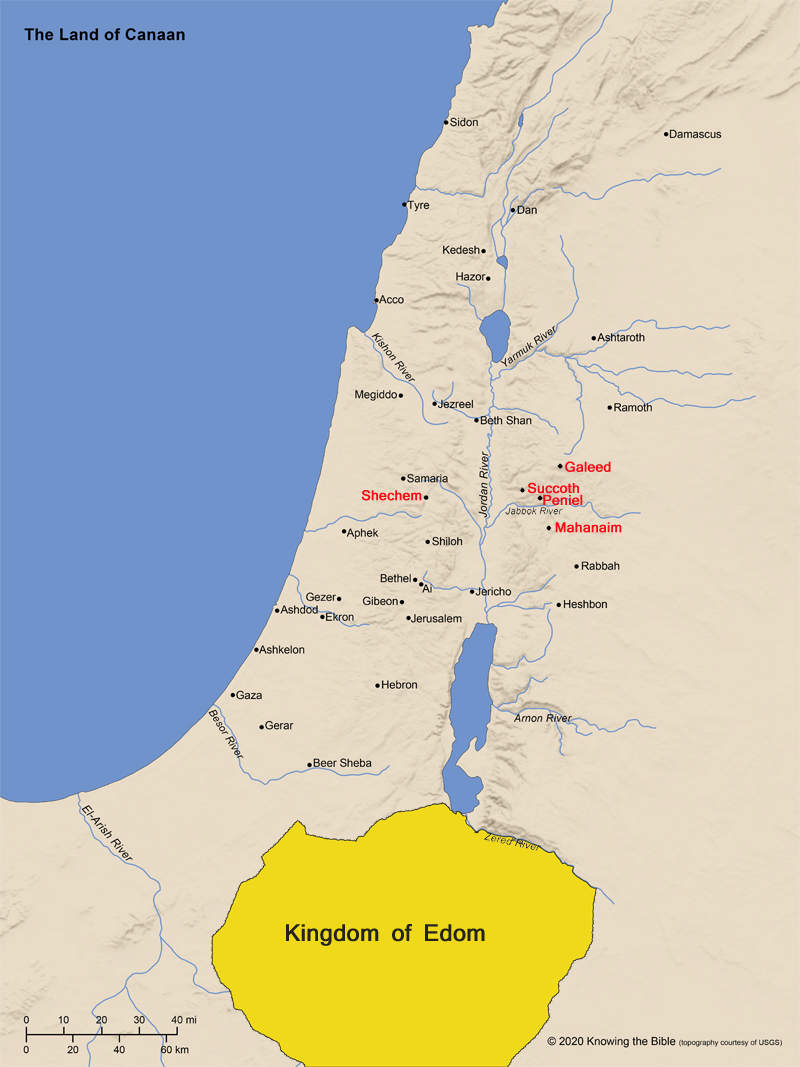
For twenty years Jacob had anticipated with fear of a meeting with his brother. So he turned to God in prayer. When that time came, it proved to be one of the happiest things that ever happened to him in all his life. 1 Now Jacob lifted his eyes and looked, and there, Esau was coming, and with him were four hundred men. So he divided the children among Leah, Rachel, and the two maidservants. And he put the maidservants and their children in front, Leah and her children behind, and Rachel and Joseph last. Then he crossed over before them and bowed himself to the ground seven times, until he came near to his brother. Jacob lined up his servants first with their sons: Bilhah and her sons Dan and Naphtali, Zilpah and her sons Gad and Ashur. Next was Leah and her children Reuben, Simeon, Levi, Judah, Issachar, Zebulun and her daughter, Dinah. And finally, Rachel and Joseph. In those times, whenever you met a dignitary, it was customary to formally introduce your wives and children especially if the dignitary asked about them. There was actually a formal presentation and Jacob considered Esau to be a dignitary. Also, as a king approached, you were required to bow seven times before him. Therefore, Jacob recognized that his brother was the ruler of that region. Esau lived in Sier which means "hairy" and later became know as Edom which means "red". These names describe Esau and in the last days, Edom will be judged (See Edom's Judgement). 4 But Esau ran to meet him, and embraced him, and fell on his neck and kissed him, and they wept. And he lifted his eyes and saw the women and children, and said, "Who are these with you?" So he said, "The children whom God has graciously given your servant." Then the maidservants came near, they and their children, and bowed down. And Leah also came near with her children, and they bowed down. Afterward Joseph and Rachel came near, and they bowed down. Esau receives Jacob as a brother, and much tenderness passes between them. Imagine the relief that Jacob felt that his fear was needless. Jacob's family was not very far away at this point. As they were introduced, they humbled themselves before Esau, again showing respect. 8 Then Esau said, "What do you mean by all this company which I met?" The servants told Esau that the droves were intended for him, but he wanted Jacob's confirmation. Jacob wanted Esau to know that even though he received the birthright and the blessing to serve God and to fulfill His promise, he never intended to dominate Esau. 9 But Esau said, "I have enough, my brother; keep what you have for yourself." It was common courtesy in that culture, and even today, that you graciously decline a gift at first even if you intend to accept it. To refuse a gift would be a mark of hostility. 10 And Jacob said, "No, please, if I have now found favor in your sight, then receive my present from my hand, inasmuch as I have seen your face as though I had seen the face of God, and you were pleased with me. Please, take my blessing that is brought to you, because God has dealt graciously with me, and because I have enough." So he urged him, and he took it. The phrase "I have seen your face as though I had seen the face of God" is an elaborate compliment, such as is found in 1 Samuel 29:9, where David is compared to an angel of God. With this, Esau knew that Jacob meant to reconcile with him by giving him this gift, as a blessing which came from God. 12 Then Esau said, "Let us take our journey; let us go, and I will go before you." But Jacob said to him, "My lord knows that the children are weak, and the flocks and herds which are nursing are with me. And if the men should drive them hard one day, all the flock will die. Please let my lord go on ahead before his servant. I will lead on slowly at a pace which the livestock that go before me, and the children, are able to endure, until I come to my lord in Seir." Custom dictated that Esau be hospitable and part of being hospitable was inviting people to your home. Esau was expected to bring Jacob back home to Seir but God told Jacob to go back to Canaan. So Jacob gave Esau a polite excuse and then turned to head to the Jordan Valley. What Jacob told Esau was meant to show good intentions but it was not to be taken literally. 15 And Esau said, "Now let me leave with you some of the people who are with me."
Jacob does not want Esau's influence on his family so he graciously declines Esau's offer to send his men with him. Once he arrived in Succoth he stayed there for about for about 18 months. The next time Esau is mentioned in Genesis is in chapter 35 when Isaac dies and Jacob and Esau bury him. The fate of Edom, Esau's descendants, is described described in the very short book of Obadiah. 18 Then Jacob came safely to the city of Shechem, which is in the land of Canaan, when he came from Padan Aram; and he pitched his tent before the city. And he bought the parcel of land, where he had pitched his tent, from the children of Hamor, Shechem’s father, for one hundred pieces of money. Then he erected an altar there and called it El Elohe Israel. Israel, the new name of Jacob, now owns another piece of property in the land God has promised to them. It was the burial-place of the bones of Joseph and became an inheritance of his descendants. According to tradition, the plain stretches out at the south-eastern opening of the valley of Shechem, where Jacob's well is still pointed out. "Children of Hamor, Shechem's father" apparently means the people of the tribe of Hamor; and Hamor was the founder, or chieftain, of the city of Shechem for whom he named after his son. Jacob set up an altar and called it "The God of Israel". It was the very spot where Abraham, about one hundred and eighty-five years before this time, built the first altar he erected in the promised land. Understanding the relationship between Jacob (Israel) and Esau (Edom) explains much about the events that follow throughout the Bible and even to today. Bible Study Questions 1. How many men were with Esau?
2. How did Jacob order the children?
3. How many times did Jacob bow to the ground?
4. Why did Jacob give Esau all the gifts?
5. Jacob didn't accept the offer to go with Esau. Why?
6. When they departed, Esau went to
7. When they departed, Jacob first went to
8. When Jacob arrived in the city in question 7, what did he do?
9. Where did Jacob go after he left Succoth?
10. What does El Elohe Israel mean?
|