Genesis 32 – Jacob Wrestles with God
Timeline: 1906 BC
|
Resources |
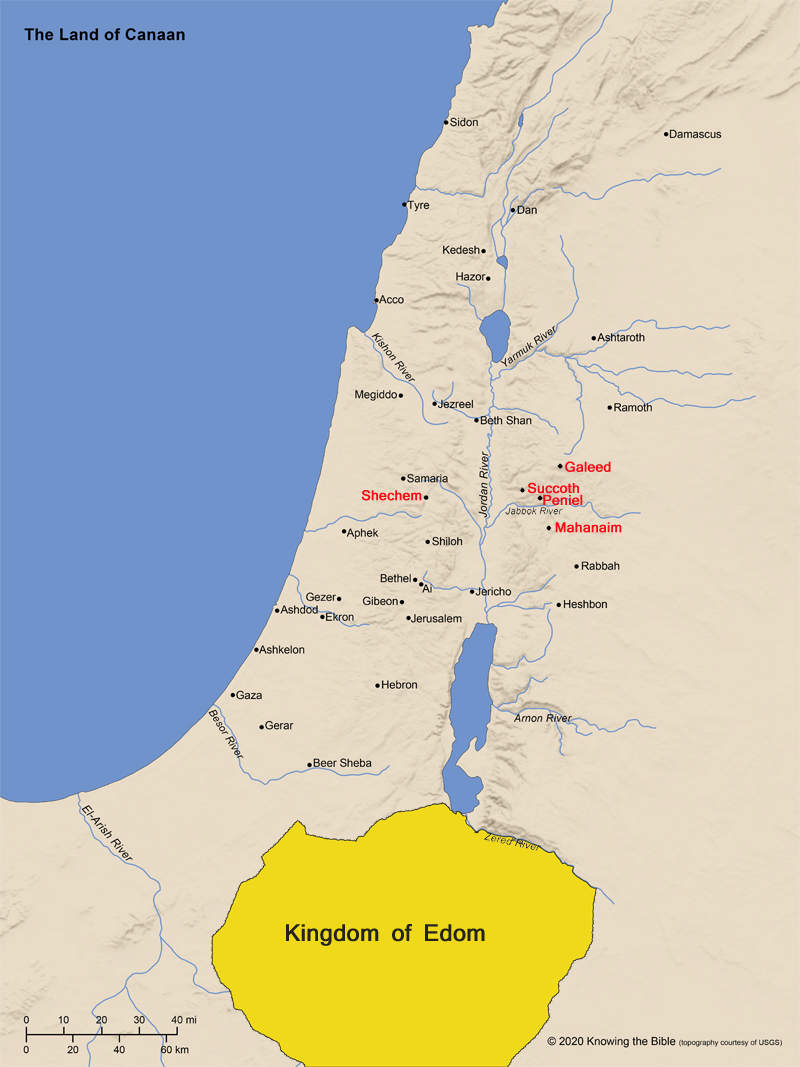
Eisegesis: "reading things into the bible that really aren't there because of preconceived ideas." In the time of Constantine around 335 AD, the church became very anti-semitic. So the western Christian took a different perspective on Bible stories in the Old Testament than the Jews. The reason we are taking so much time with our Bible study is to carefully examine God's Word. As we slowly read through the chapters verse by verse, and pray for discernment, we gain more perspective and understanding of how we should handle difficult situations in our own lives. 1 So Jacob went on his way, and the angels of God met him. When Jacob saw them, he said, "This is God's camp." And he called the name of that place Mahanaim. Laban left Jacob to go back to Haran and Jacob continues his travels back to his homeland. Remember in chapter 28 when he left home, he arrived at Bethel where he had a dream and God promised to take care of him. On Jacob's return to Canaan, he prepares to meet his brother, Esau. After about a week's journey southward, he has a vision of "angels of God." He recognizes them as God's camp, to assure him of protection. He called that place ‘Mahanaim,’ two camps. One camp was his and the other was the camp of the Angels. Mahanaim was afterwards a distinguished city, which is frequently mentioned and the name and remains are still preserved in the place called Mahneh. 3 Then Jacob sent messengers before him to Esau his brother in the land of Seir, the country of Edom. And he commanded them, saying, "Speak thus to my lord Esau, 'Thus your servant Jacob says: "I have dwelt with Laban and stayed there until now. I have oxen, donkeys, flocks, and male and female servants; and I have sent to tell my lord, that I may find favor in your sight." Seir was originally occupied by the Horites but later became the seat of Esau and his descendants although he still lived in Canaan at this time. Jacob sent messengers to tell him of his wealth, to indicate that he did not expect anything from Esau. He called himself a servant as a term of humility and loyalty. He let his brother know that he was with Laban these past years but now he was seeking reconciliation. 6 Then the messengers returned to Jacob, saying, "We came to your brother Esau, and he also is coming to meet you, and four hundred men are with him." So Jacob was greatly afraid and distressed; and he divided the people that were with him, and the flocks and herds and camels, into two companies. And he said, "If Esau comes to the one company and attacks it, then the other company which is left will escape." Jacob felt that Esau was ready to attack him since he threatened to kill him the last time they were together. After all, he had four hundred men with him! Perhaps Esau was prepared to defend himself since they have not spoken since Jacob's departure. Jacob takes defense in the only way he could. He did not have fighters with him. He would not be able to defend himself against Esau's army. 9 Then Jacob said, "O God of my father Abraham and God of my father Isaac, the Lord who said to me, 'Return to your country and to your family, and I will deal well with you': I am not worthy of the least of all the mercies and of all the truth which You have shown Your servant; for I crossed over this Jordan with my staff, and now I have become two companies. Deliver me, I pray, from the hand of my brother, from the hand of Esau; for I fear him, lest he come and attack me and the mother with the children. For You said, 'I will surely treat you well, and make your descendants as the sand of the sea, which cannot be numbered for multitude.' " Jacob's prayer was the first recorded in the Bible and the perfect pattern for true prayer. Jacob first addresses God as his Lord, who has been the father of his father and his grandfather. Next is a reminder of His promise. He humbly acknowledged unworthiness of the mercies he received. Then he asked for protection and for the fulfilment of the covenant promise. It was the prayer of a kind husband, an affectionate father, a firm believer in the promises. 13 So he lodged there that same night, and took what came to his hand as a present for Esau his brother: two hundred female goats and twenty male goats, two hundred ewes and twenty rams, thirty milk camels with their colts, forty cows and ten bulls, twenty female donkeys and ten foals. Then he delivered them to the hand of his servants, every drove by itself, and said to his servants, "Pass over before me, and put some distance between successive droves." And he commanded the first one, saying, "When Esau my brother meets you and asks you, saying, 'To whom do you belong, and where are you going? Whose are these in front of you?' then you shall say, 'They are your servant Jacob's. It is a present sent to my lord Esau; and behold, he also is behind us.' " So he commanded the second, the third, and all who followed the droves, saying, "In this manner you shall speak to Esau when you find him; and also say, 'Behold, your servant Jacob is behind us.' " For he said, "I will appease him with the present that goes before me, and afterward I will see his face; perhaps he will accept me." So the present went on over before him, but he himself lodged that night in the camp. Superiors are always approached with presents, and the respect expressed is estimated by the quality and amount of the gift. The present of Jacob consisted of five hundred eighty head of cattle, of different kinds, such as would be most prized by Esau. The repetition of the announcement of the gift, and of Jacob himself being at hand, was calculated to appease Esau, and persuade him that Jacob was approaching him in all brotherly confidence and affection. The camels alone were of immense value; for the she camels form the principal part of Arab wealth; their milk is a chief article of diet; and in many other respects they are of the greatest use. 21 So the present went on over before him, but he himself lodged that night in the camp. And he arose that night and took his two wives, his two female servants, and his eleven sons, and crossed over the ford of Jabbok. He took them, sent them over the brook, and sent over what he had. After Jacob sent the gifts, he took his family and herds over the ford which has a width of four to six miles. Then he crossed back over to the camp where he spent the night alone. He began to pray and during that time, Jesus, as a Christophany, appears to him. 24 Then Jacob was left alone; and a Man wrestled with him until the breaking of day. Now when He saw that He did not prevail against him, He touched the socket of his hip; and the socket of Jacob's hip was out of joint as He wrestled with him. And He said, "Let Me go, for the day breaks."
In Hosea 12:3-51 there are three references to" the Man". Hosea describes the Man as God, the angel and the LORD God of Heaven's Armies. These descriptions can only be Jesus who appeared as a Christophany. If you see God the father, you will not live so this has to be God the Son, Jesus. Jacob means to "follow after or to pursue". This describes his personality. He doesn't give up easily. He spent twenty years with Laban because he refused to give up just as he did here. Jacob refused to surrender. God put into his heart a desire to serve God to bring about a covenant so he is holding out for God to bless him. In 2 Kings2, Elisha asked to be blessed with a double portion of Elijah's spirit who had the same desire as Jacob, that is to be blessed by God. God could have ended Jacob at anytime during this encounter but instead, He tested him. Jacob demonstrated that he was willing to let God prevail in his life. In response, God changed Jacob’s name to Israel, meaning ‘let God prevail.’ God has many names.3 Perhaps Jacob wanted to learn God's nature. But instead of telling him his name, God gave him all the blessings that had been given to Abraham. In prayer, Jacob pravailed with God and with men. He will sometimes be called by Jacob and sometimes by Israel, as the occasion may serve. Both names have a spiritual significance for two different aspects of the child of God. Jacob's new name was transmitted to his descendants as the covenant nation. 30 So Jacob called the name of the place Peniel: "For I have seen God face to face, and my life is preserved." Just as he crossed over Penuel the sun rose on him, and he limped on his hip. Therefore to this day the children of Israel do not eat the muscle that shrank, which is on the hip socket, because He touched the socket of Jacob's hip in the muscle that shrank. There was afterwards a city built here, called by the same name. It is said to be four miles from Mahanaim. As soon as the angel left him he proceeded onwards to rejoin his wives. Some think he went limping all his days; others, that he was healed immediately by the angel before he came to Esau; but of either there is no proof. Children of Israel do not eat the sinew (muscle of the part that was out of joint) in common food. Likewise, they take out theat part in their burnt offerings in both the right and left thigh. Because the Jews are more ignorant of this nerve, they abstain from all nerves in the posteriors of animals. There is a whole chapter in the Mishnah, which is a written record of the Oral Laws categorized by subjects. Bible Study Questions 1. When Jacob met the angels of God, what did he say?
2. Whom did Jacob send to meet Esau his brother?
3. What did God promise Jacob?
4. When Esau meets Jacob's servants, what he say?
5. What did Jacob give to Esau as a present?
6. Whom did Jacob wrestle with?
7. Jacob said I will not let You go unless what?
8. What did Jacob call the name of "the place"?
9. What is Jacob's new name?
10. Why did they stop wrestling?
|