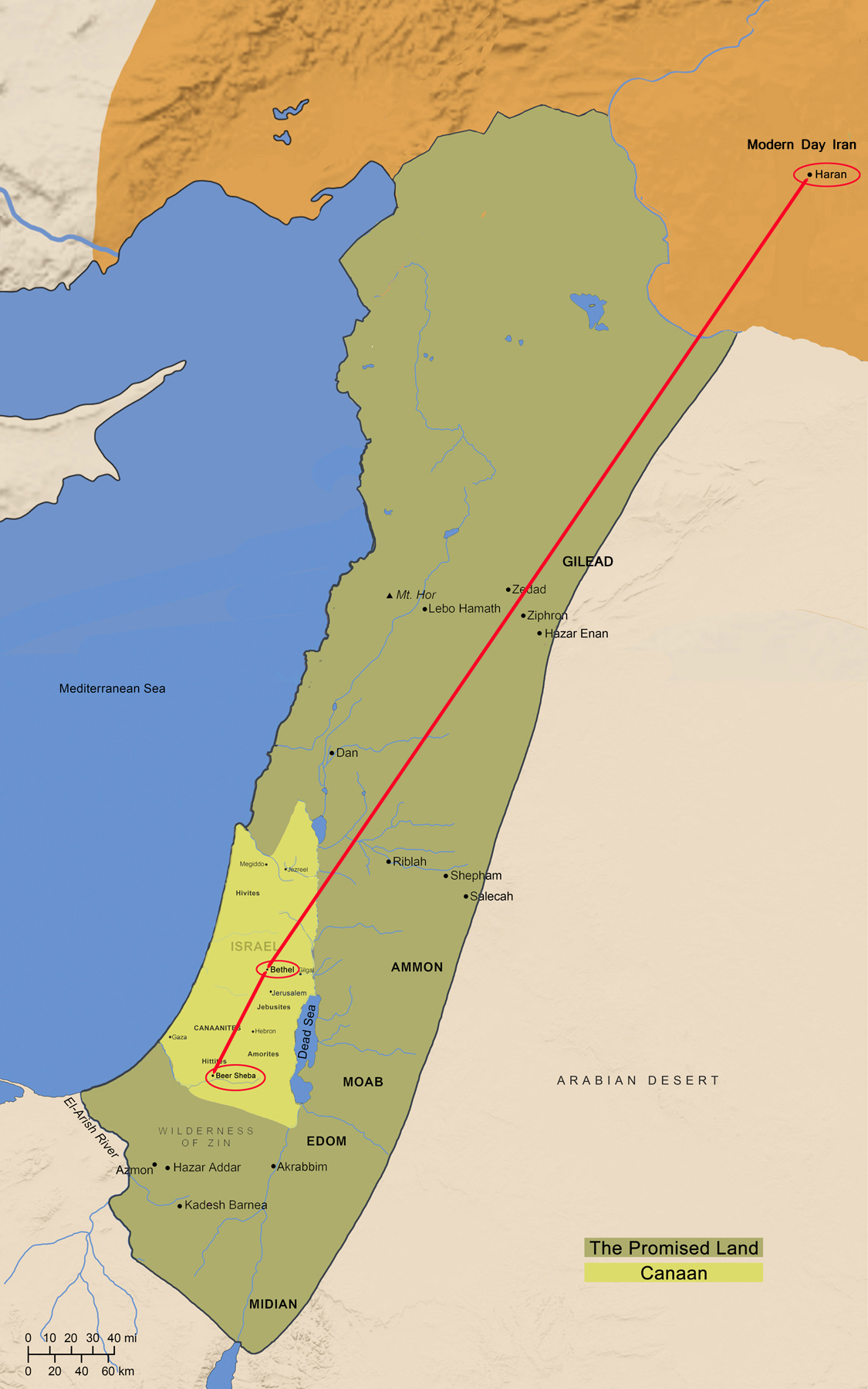
Genesis 31 – Jacob Leaves for Canaan
1908 BC
|
Joseph (6) Jacob's children
Resources |
Anti-semitism - Hostility or prejudice directed toward Jewish people and/or their property, or non-Jewish who are linked to Jews. Why are so many people antisemitic? Gentiles resent the way that Jews have prospered not only in this generation but from the time of Jacob and which is why so many people accused the Jews of becoming wealthy and taking advantage of others. Jesus was a Jew and was persecuted by other Jews as well as Gentiles. Today, Jews and Christians (non-Jewish people who are linked to Jews) are persecuted. So those who oppose Christians are anti-semitic and anti-God. After the fourteen years of service to Laban, Jacob stayed another six years to earn the flocks he was promised, but now it was time to leave. 1 Now Jacob heard the words of Laban's sons, saying, "Jacob has taken away all that was our father's, and from what was our father's he has acquired all this wealth." And Jacob saw the countenance of Laban, and indeed it was not favorable toward him as before. Then the Lord said to Jacob, "Return to the land of your fathers and to your family, and I will be with you." Jacob did not take anything that belonged to Laban. Laban's sons put into words what Laban was accusing Jacob of, which they accused Jacob of taking what really belonged to Laban. Laban's son could have done what Jacob did to increase the flocks but they were too busy being resentful. Jacob gained such wealth because the Divine blessing from God and because he was a hard worker1. When Jacob saw that Laban's attitude had changed, he prayed and THE LORD SPOKE to Jacob and told him to return to the his family and promises him his presence to protect him. 4 So Jacob sent and called Rachel and Leah to the field, to his flock, and said to them, "I see your father's countenance, that it is not favorable toward me as before; but the God of my father has been with me. And you know that with all my might I have served your father. Yet your father has deceived me and changed my wages ten times, but God did not allow him to hurt me. If he said thus: 'The speckled shall be your wages,' then all the flocks bore speckled. And if he said thus: 'The streaked shall be your wages,' then all the flocks bore streaked. So God has taken away the livestock of your father and given them to me. Jacob took Rachel and Leah to the field for privacy. Jacob had been faithful in keeping the cattle of Laban in spite of the fact that was persecuted by Laban, changing his wages many times. 10 "And it happened, at the time when the flocks conceived, that I lifted my eyes and saw in a dream, and behold, the rams which leaped upon the flocks were streaked, speckled, and gray-spotted. Then the Angel of God spoke to me in a dream, saying, 'Jacob.' And I said, 'Here I am.' And He said, 'Lift your eyes now and see, all the rams which leap on the flocks are streaked, speckled, and gray-spotted; for I have seen all that Laban is doing to you. I am the God of Bethel, where you anointed the pillar and where you made a vow to Me. Now arise, get out of this land, and return to the land of your family.' " Looking back to chapter 30, God gave Jacob the information needed to be able to breed the animals as he desired. The angel of the Lord, we observe, announces himself as the God of Bethel, and recalls to Jacob the pillar and the vow. The angel, thefore, is Jesus manifesting himself to human apprehension. 14 Then Rachel and Leah answered and said to him, "Is there still any portion or inheritance for us in our father's house? Are we not considered strangers by him? For he has sold us, and also completely consumed our money. For all these riches which God has taken from our father are really ours and our children's; now then, whatever God has said to you, do it." Women of that time period did not receive an inheritance from their family. Laban basically sold Leah and Rachel to Jacob so they were no longer considered Laban's family but strangers. And as strangers, they were not entitled to anything Laban owned. The Hebrew word "wasted", in this instance means to consume for yourself, and not to share. Laban did not give anything to his daughters or his grandchildren2. All the riches which God took from Laban, was earned by Jacob. It was used as Leah and Rachel's decision to leave with Jacob. 17 Then Jacob rose and set his sons and his wives on camels. And he carried away all his livestock and all his possessions which he had gained, his acquired livestock which he had gained in Padan Aram, to go to his father Isaac in the land of Canaan. Now Laban had gone to shear his sheep, and Rachel had stolen the household idols that were her father's. And Jacob stole away, unknown to Laban the Syrian, in that he did not tell him that he intended to flee. So he fled with all that he had. He arose and crossed the river, and headed toward the mountains of Gilead. Jacob took everything he owned and left just as God told him to do. He didn't tell Laban otherwise, he might have detained him by violence. Rachel stole her father's household idols, which were used as evidence of family leadership, to give Jacob the position of tribal leader. 22 And Laban was told on the third day that Jacob had fled. Then he took his brethren with him and pursued him for seven days' journey, and he overtook him in the mountains of Gilead. But God had come to Laban the Syrian in a dream by night, and said to him, "Be careful that you speak to Jacob neither good nor bad." Laban was in the fields (Three day's journey where he sent the sons with his flocks). When Laban got back, he chased after them. He was deadset on getting back everything that Jacob took in spite of the fact that Jacob only took what he earned. God told Laban not to speak from good or bad which is merely to refrain from language expressing and prefacing violence. 25 So Laban overtook Jacob. Now Jacob had pitched his tent in the mountains, and Laban with his brethren pitched in the mountains of Gilead. Jacob had traveled about 10 days when he arrived at Mount Gilead which was a mountain on the border of the land of Canaan, adjoining to Lebanon. At the foot there was a large and fruitful country. It was over three hundred miles away from Haran. It would require hard riding on the part of Laban and his brethren to enable them to overtake Jacob who had a young family and numerous flocks, therefore had to march slowly. 26 And Laban said to Jacob: "What have you done, that you have stolen away unknown to me, and carried away my daughters like captives taken with the sword? Why did you flee away secretly, and steal away from me, and not tell me; for I might have sent you away with joy and songs, with timbrel and harp? And you did not allow me to kiss my sons and my daughters. Now you have done foolishly in so doing. It is in my power to do you harm, but the God of your father spoke to me last night, saying, 'Be careful that you speak to Jacob neither good nor bad.' And now you have surely gone because you greatly long for your father's house, but why did you steal my gods?" Really! Jacob did not steal his daughters or anything else! Rachel and Leah willingly went with him. In the East it is customary, when any are setting out to a great distance, for their relatives and friends to accompany them a considerable way with music and valedictory songs. Kissing his sons and daughters refers to his grandclildren as well as his daughters. And if he would have let Jacob go when he first asked to leave, Laban could have had his fond farewell. But that was not the real reason he chased after them. Considering the past conduct of Laban, his complaint on this ground was hypocritical. He did not dare to touch Jacob, but there was a war of words. Being accompanied by a number of his people, he wanted to use violence had he had been divinely warned in a dream to give no interruption to his nephew's journey. 31 Then Jacob answered and said to Laban, "Because I was afraid, for I said, 'Perhaps you would take your daughters from me by force.' With whomever you find your gods, do not let him live. In the presence of our brethren, identify what I have of yours and take it with you." For Jacob did not know that Rachel had stolen them. Jacob did not expect fair treatment from Laban and feared he would kill him and keep his family and everything he earned. He challenged Laban to prove to the people who came with him that Jacob did not take anything away that didn't belong to him. Jacob knew nothing of the theft and told Laban to make the strictest search among all the things that he had with him. If he had found anything, the thief would be put to death. 33 And Laban went into Jacob's tent, into Leah's tent, and into the two maids' tents, but he did not find them. Then he went out of Leah's tent and entered Rachel's tent. Now Rachel had taken the household idols, put them in the camel's saddle, and sat on them. And Laban searched all about the tent but did not find them. And she said to her father, "Let it not displease my lord that I cannot rise before you, for the manner of women is with me." And he searched but did not find the household idols. The woman's riding saddle, which had a comfortable seat formed of carpets on the top of the packsaddle. Laban passed over Rachel's seat because she pretended to be on her monthly cycle.2 According to the customs, any one who touched the seat of such a woman was rendered unclean. Consequently Laban might refrain from making further examination, for fear of defilement. The idols symbolized that Laban was the leader of the clan. 36 Then Jacob was angry and rebuked Laban, and Jacob answered and said to Laban: "What is my trespass? What is my sin, that you have so hotly pursued me? Although you have searched all my things, what part of your household things have you found? Set it here before my brethren and your brethren, that they may judge between us both! These twenty years I have been with you; your ewes and your female goats have not miscarried their young, and I have not eaten the rams of your flock. That which was torn by beasts I did not bring to you; I bore the loss of it. You required it from my hand, whether stolen by day or stolen by night. There I was! In the day the drought consumed me, and the frost by night, and my sleep departed from my eyes. Jacob took care and diligence in watching and keeping the flock, and doing everything they needed. I have not eaten the rams of your flock—Eastern people seldom kill the females for food except they are barren. If any of the flock was killed by beasts or lost, he paid for them with his own flocks. Jacob had exceeded the standard of fairness which was required by custom. The temperature changes often in twenty-four hours from the greatest extremes of heat and cold, The hotter the day, the colder the night as a rule. 41 Thus I have been in your house twenty years; I served you fourteen years for your two daughters, and six years for your flock, and you have changed my wages ten times. Unless the God of my father, the God of Abraham and the Fear of Isaac, had been with me, surely now you would have sent me away empty-handed. God has seen my affliction and the labor of my hands, and rebuked you last night." Jacob demands that Laban prove to all those who were there as witnesses, including the relatives that came with him. But Laban could not produce anything that belonged to him. He also proved how unfairly he had treated Jacob. Remember Genesis 30:33 3 where Jacob covered himself in case of this?. He made his case in front of everyone there. He gave God the glory for his protection and wealth and reminded Laban of his dream not to cause harm to Jacob. So God must have told Jacob about the dream. 43 And Laban answered and said to Jacob, "These daughters are my daughters, and these children are my children, and this flock is my flock; all that you see is mine. But what can I do this day to these my daughters or to their children whom they have borne? Now therefore, come, let us make a covenant, you and I, and let it be a witness between you and me." Laban tipped his hand and revealed that he intended to take everything from Jacob. "These are MY daughters, MY flock, and ALL that you see is mine." To save face before everyone, he suggests making a promise of peace between them. This is more for show since he really embarrased himself in front of his kinsmen. Laban could neither justify himself nor condemn Jacob. He was not willing to confess that he was wrong. 45 So Jacob took a stone and set it up as a pillar. Then Jacob said to his brethren, "Gather stones." And they took stones and made a heap, and they ate there on the heap. Laban called it Jegar Sahadutha, but Jacob called it Galeed. And Laban said, "This heap is a witness between you and me this day." Therefore its name was called Galeed, also Mizpah, because he said, "May the Lord watch between you and me when we are absent one from another. If you afflict my daughters, or if you take other wives besides my daughters, although no man is with us—see, God is witness between you and me!" Jegar Sahadutha is Aramaic and Galeed is Hebrew, both means "witness pile". It was also called Mizpa which means "watchtower". A heap of stones were laid in a circular pile, to serve as seats, and in the center was a large one set up as an altar. They probably offered a sacrifice then had a feast. Heaps of stones are found abundantly in hte region still today. 51 Then Laban said to Jacob, "Here is this heap and here is this pillar, which I have placed between you and me. This heap is a witness, and this pillar is a witness, that I will not pass beyond this heap to you, and you will not pass beyond this heap and this pillar to me, for harm. The God of Abraham, the God of Nahor, and the God of their father judge between us." And Jacob swore by the Fear of his father Isaac. Then Jacob offered a sacrifice on the mountain, and called his brethren to eat bread. And they ate bread and stayed all night on the mountain. And early in the morning Laban arose, and kissed his sons and daughters and blessed them. Then Laban departed and returned to his place. It was Laban who led Jacob into polygamy but still makes him promise not to take any other wives, for the sake of his daughters, to whom he professes now much kindness and affection, though he had shown but little to them before. The heap represented the boundries of the two countries, they they should not cross over to harm one another. It is never good to quote a scripture without knowing the background or context of it. Mizpah is a Hebrew word for "watchtower" or "lookout" and is used to mark an agreement between two people, with God as their witness. Two pieces of jewery with Genesis 31:49 split in half is called a Mitzva coin. Each of two people wear or carry half because a person is only half a person when they're apart and when the coin is back together, they are one. However, Laban used it as a threat to Jacob that God will judge him if he did anything wrong against Laban when they are apart. So sharing a Mizpah coin is a threat to each other that God is watching them. Bible Study Questions 1.Jacob was persecuted by Laban and his sons. Why?
2. Why did Jacob send for Rachel and Leah to talk to them in the field?
3. To whom did Jacob give credit for his knowledge?
4. What dream did Jacob have?
5. When did Laban find out the Jacob had fled?
6. Whom did Laban bring with him when he pursued Jacob?
7. What did Laban accuse Jacob of doing?
8. Who stoled Laban's god?
9. How many years did Jacob serve Laban?
10. Why did Jacob set up a pillar?
|