Genesis 29 – Jacob Serves Laban
Timeline: 1928 - 1921 BC
|
Jacob - 77
Resources |
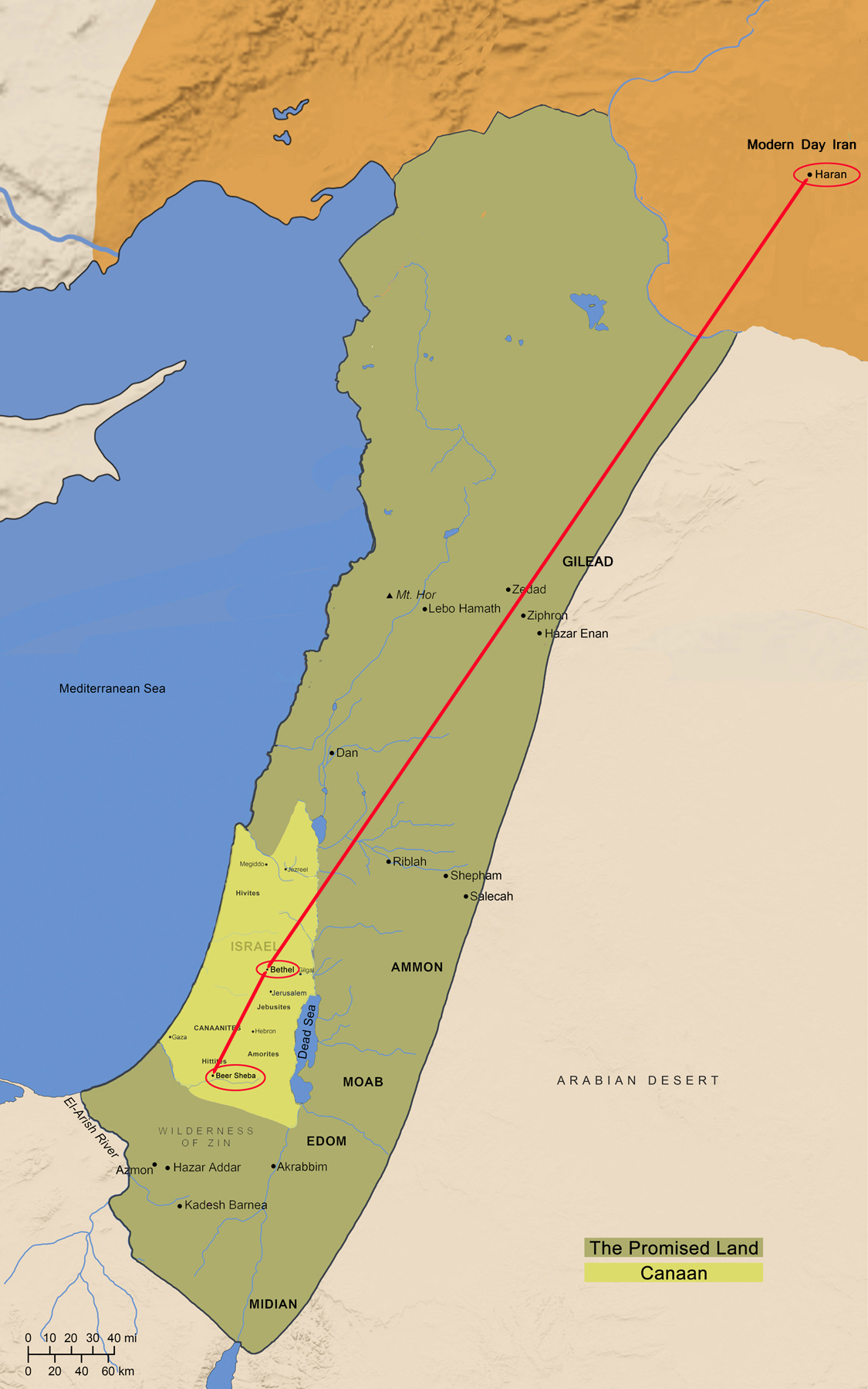
Jacob was passionate about faithfully following God’s plans and purposes. He spent the next 20 years in Haran. God chose Israel as His vessel to bring blessings from heaven into this world. 1 So Jacob went on his journey and came to the land of the people of the East. And he looked, and saw a well in the field; and behold, there were three flocks of sheep lying by it; for out of that well they watered the flocks. A large stone was on the well’s mouth. Now all the flocks would be gathered there; and they would roll the stone from the well’s mouth, water the sheep, and put the stone back in its place on the well’s mouth. So Jacob left Bethel and continued to the land of Mesopotamia or Syria, which lay east of Canaan. He went readily and cheerfully, being encouraged that God would be with him. He came to a well on the outskirts of Haran. Because they represent life and nourishment, wells are often used in Scripture to symbolize God's blessing. The large stone indicated that water was precious, and that the well, which was more likely a cistern, was the common property of the surrounding natives. The well was probably covered to keep other animals and debris out of it. Laban had too many sheep for his sons to take care of so they had to be divided up and his daughter had to take charge of a flock even though it was not customary for a woman to be a shepherd. Sheep were kept closer to home if they were herded by boys or women. The older sons would have taken their herds farther away. So they had to wait for others to arrive until there were enough of them were there to move the heavy stone together. 4 And Jacob said to them, "My brethren, where are you from?" Jacob must have been glad to learn he was so near to his destination. His question about Laban's welfare was to make sure he was still well. God's timing...as soon Jacob gets there, he sees Rachel. He asked them why they were idling when there were still several hours of daylight, instead of watering their flocks and sending them back to pasture. Perhaps he is trying to get them to move along so he can speak with Rachel alone. 9 Now while he was still speaking with them, Rachel came with her father’s sheep, for she was a shepherdess. And it came to pass, when Jacob saw Rachel the daughter of Laban his mother’s brother, and the sheep of Laban his mother’s brother, that Jacob went near and rolled the stone from the well’s mouth, and watered the flock of Laban his mother’s brother. Then Jacob kissed Rachel, and lifted up his voice and wept. And Jacob told Rachel that he was her father’s relative and that he was Rebekah’s son. So she ran and told her father. Jacob moved the stone and watered the flocks that Rachel had there. Rachel was at least 14 years old at this point. He was so carried away by the feelings of relationship that he kissed her and introduced himself with tears of joyous emotion as his cousin. This was a family connection kiss, not a passionate kiss. Rachel took off for home and left the sheep behind. Jacob stayed behind to take care of the sheep. 13 Then it came to pass, when Laban heard the report about Jacob his sister’s son, that he ran to meet him, and embraced him and kissed him, and brought him to his house. So he told Laban all these things. And Laban said to him, "Surely you are my bone and my flesh." And he stayed with him for a month. Daughters in those countries and times were objects of value, for which their family was accustomed to receive considerable gifts. No doubt, Laban ran to Jacob expecting presents, such as pieces of gold, pearls and jewels like Abraham's servant brought and gave him when he came for Rebekah. Jacob was planning on saying only for a few days, expecting his mother to send word that it was safe to come back home, but he was still there after a month. A month here means the period from new moon to new moon, and consists of twenty-nine or thirty days. 15 Then Laban said to Jacob, "Because you are my relative, should you therefore serve me for nothing? Tell me, what should your wages be?" Laban was no longer considering Jacob as a guest. However, Jacob was not just laying around. He was pitching in and working with the sheep since that is what he did back home. Jacob proved he was going to be a hard worker and that he was a man of integrity. Laban saw that Jacob's services would be very valuables so when he saw that Jacob was not leaving, he told him to name his price for staying. 16 Now Laban had two daughters: the name of the elder was Leah, and the name of the younger was Rachel. Leah’s eyes were delicate, but Rachel was beautiful of form and appearance. Now Jacob loved Rachel; so he said, "I will serve you seven years for Rachel your younger daughter." The word describing Leah’s eyes, “rakot,” can also be translated as tender, soft, or gentle. The rabbis teach that Leah’s eyes were tender because she wept constantly in prayer that she would not have to marry Esau. Others explain that she had a medical condition that made her eyes droop and described at least one nice thing about her, but nevertheless she was overshadowed by her gorgeous sister Rachel. Yet another states it is really an ancient idiom to express the idea of a gentle, loving and caring person. You can decide for yourself. Rachel is described as beautiful outwardly and inwardly. During the month he has been there, Jacob fell in love with Rachel. Since Jacob didn't have any money to give Laban for a dowry, as was customary in those times, he proposed servitude instead. 19 And Laban said, "It is better that I give her to you than that I should give her to another man. Stay with me." So Jacob served seven years for Rachel, and they seemed only a few days to him because of the love he had for her. It is still the custom among the Arabs to prefer a relative as the husband of a daughter in marriage. Seven years of wages would have been about 84 shekels. The average price for a dowry was about 25 shekels. So Laban was excited to accept Jacob's offer, accepted the proposal and invited Jacob to stay. If Jacob was such a trickster, why then did he offer to work for seven years rather than bargain with Laban? And he was an honest man. He fulfilled his obligation joyfully, probably spending much time together with Rachel tending the sheep. 21 Then Jacob said to Laban, "Give me my wife, for my days are fulfilled, that I may go in to her." And Laban gathered together all the men of the place and made a feast. Now it came to pass in the evening that he took Leah his daughter and brought her to Jacob; and he went in to her. And Laban gave his maid Zilpah to his daughter Leah as a maid. So it came to pass in the morning, that behold, it was Leah. And he said to Laban, "What is this you have done to me? Was it not for Rachel that I served you? Why then have you deceived me?" After 7 years passed, Jacob asks for his wife. At the time the contract was made, they were considered husband and wife even though they weren't allowed to have relations with each other until after the wedding feast. So Laban had the feast which usually lasted seven days and Laban sent in Leah, who was veiled, to Jacob to consummate the marriage. It was customary to give the bride a handmaid, who became her confidential servant. Now because Jacob slept with Leah, who was a virgin, it was the law that he could not divorce her. 26 And Laban said, "It must not be done so in our country, to give the younger before the firstborn. Fulfill her week, and we will give you this one also for the service which you will serve with me still another seven years." It is still the custom not to give the younger in marriage before the older, unless the latter be deformed or in some way defective. At this time, there was no express command against marrying more than one wife. It was the patriarchs' sin of ignorance. Jacob had proved himself as a man of honor so Laban took advantage of that fact. He knew he would stay for at least another seven years because he knew how much Jacob loved Rachel. 28 Then Jacob did so and fulfilled her week. So he gave him his daughter Rachel as wife also. And Laban gave his maid Bilhah to his daughter Rachel as a maid. Then Jacob also went in to Rachel, and he also loved Rachel more than Leah. And he served with Laban still another seven years. The marriage of Rachel is only a week after that of Leah. Rather than lose Rachel altogether, Jacob consents to comply with Laban's terms. Leah must have been a party to the fraud, and therefore Jacob's dislike of her was not altogether without reason. |
Timeline: 1767 BC Jacob - 84 years old Leah bears |
31 When the Lord saw that Leah was unloved, He opened her womb; but Rachel was barren. So Leah conceived and bore a son, and she called his name Reuben; for she said, "The Lord has surely looked on my affliction. Now therefore, my husband will love me." Then she conceived again and bore a son, and said, "Because the Lord has heard that I am unloved, He has therefore given me this son also." And she called his name Simeon. She conceived again and bore a son, and said, "Now this time my husband will become attached to me, because I have borne him three sons." Therefore his name was called Levi. And she conceived again and bore a son, and said, "Now I will praise the Lord." Therefore she called his name Judah. Then she stopped bearing. In those days, the value of a wife was based on the ability to produce children and especially sons. Because Jacob loved Rachel more then Leah, she felt that giving him sons made her more important to Jacob than Rachel.The names Leah gave her children, expressed her feelings, both to her husband and to God. This is the first four of the twelve tribes of Israel. Jesus will be descended from Jacob's fourth son Judah, whose name means Praise.
Bible Study Questions 1. What did Jacob first see when he got to the outskirts of Haran?
2. Why did Jacob rebuke the shepherds?
3. What was the excuse the shepherds used?
4. What did Jacob do when he saw Rachel?
5. How long did Jacob stay as a guest at Laban's home?
6. Why did Laban gather all the men of the place?
7. Why did Laban trick Jacob into marrying Leah first?
8. When did Jacob and Rachel marry?
9. When the Lord saw that Leah was unloved, what did he do?
10. How many children did Leah have before she stopped bearing?
|
| Joe, Cassie, Matt, Kelly | |