Genesis 28 – Jacob Flees to Laban
Timeline: 1760 BC
Rabbi Gottieb explains the dream.1
Jacob - Age 71
Resources |
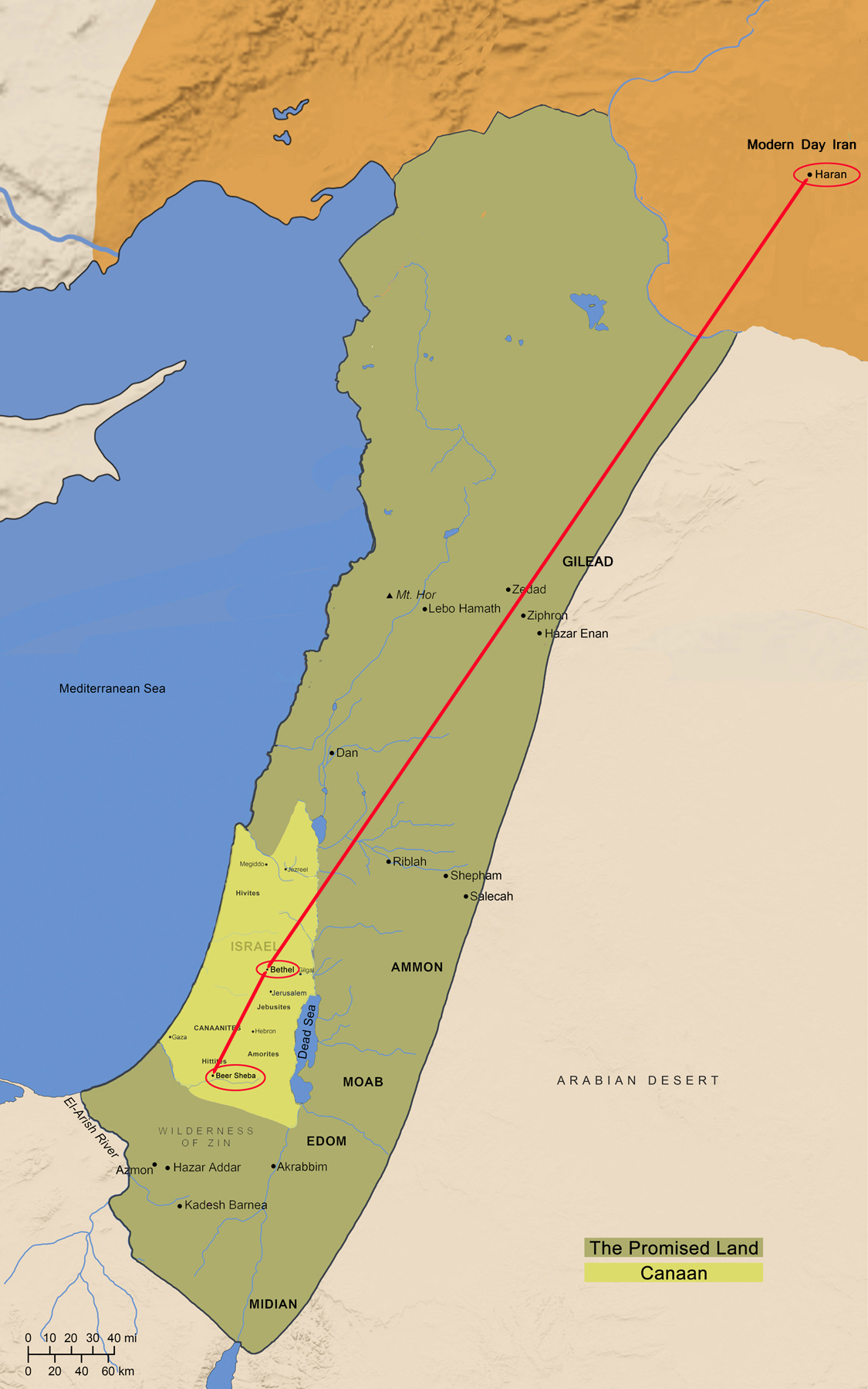
Pray for discernment when you study the Bible. To pursue faithful biblical interpretation, begin with the immediate context of the phrase or sentence, then move to the paragraph, then the chapter, and then the book. Finally, because Christ himself claims all of Scripture as a testimony to himself, allow the Old Testament to be interpreted in light of the New Testament, and vice versa. The Old Testament is the New Testament concealed, the New Testament is the Old Testament revealed. 1 Then Isaac called Jacob and blessed him, and charged him, and said to him: "You shall not take a wife from the daughters of Canaan. Arise, go to Padan Aram, to the house of Bethuel your mother's father; and take yourself a wife from there of the daughters of Laban your mother's brother. In the last chapter, Rebekah tells Isaac that she doesn't want Jacob to marry the daughters of Canaan. So Isaac is finally obeying God and publically blesses Jacob and orders him to go to Rebekah's father's house and take a wife from Laban's daughters in Padan Aram, which is Haran. 3 "May God Almighty bless you, and make you fruitful and multiply you, That you may be an assembly of peoples; and give you the blessing of Abraham, To you and your descendants with you, that you may inherit the land In which you are a stranger, which God gave to Abraham." "Assembly of peoples;" implies that the nations descended from Jacob would have a religious significance. Remember that blessings are in two parts? The first part explains why the son is worthy to receive the blessing. Here again, Isaac does not include that part. He truly wanted Esau to receive the blessing but he was not worthy. Esau despised the blessing that Isaac inherited from God though Abraham so he passed it to Jacob. 5 So Isaac sent Jacob away, and he went to Padan Aram, to Laban the son of Bethuel the Syrian, the brother of Rebekah, the mother of Jacob and Esau. Being obedient to his parents, Jacob left. Unfortunately, he was never going to see his mother again. Did you notice that Jacob is mentioned first? Names are usually given in the order of age, beginning with the oldest. Here Jacob is mentioned first which confirms that he now had the birthright that normally goes to the oldest. 6 Esau saw that Isaac had blessed Jacob and sent him away to Padan Aram to take himself a wife from there, and that as he blessed him he gave him a charge, saying, "You shall not take a wife from the daughters of Canaan," and that Jacob had obeyed his father and his mother and had gone to Padan Aram. Also Esau saw that the daughters of Canaan did not please his father Isaac. So Esau went to Ishmael and took Mahalath the daughter of Ishmael, Abraham's son, the sister of Nebajoth, to be his wife in addition to the wives he had. When Esau heard Isaac giving the blessing, is upset because Jacob is the obedient child and hates him for it. In rebellion, Esau married one of Ishmael‘s daughters. Ishmael was Isaac's half-brother who was born of Hagar, Sarah's maidservant. He was sent away when Isaac was born. He too was born first but he did not get the birthright because he was rejected by God. Ishmael has been dead for thirteen years. Esau had rejected the religious interests of his family, and demonstrated again that he was unfit to be the recipient of the blessing. In the book of Obadiah, the final war will ultimately be between Edom, the descendants of Esau and Israel, the descendants of Jacob. 10 Now Jacob went out from Beersheba and went toward Haran. So he came to a certain place and stayed there all night, because the sun had set. And he took one of the stones of that place and put it at his head, and he lay down in that place to sleep. Then he dreamed, and behold, a ladder was set up on the earth, and its top reached to heaven; and there the angels of God were ascending and descending on it. Jacob was in his 70's when he began the 500 mile journey toward Haran. After about 40 miles, he comes to Bethel, which means "House of God". Jewish commentators identify the place with Mount Moriah, and say that the stone which Jacob placed under his head was one of those which had formed the altar upon which Isaac had been bound for sacrifice. This is also the same place that Abraham had camped at when God first spoke to him. Bethel became Mount Moriah, or the Temple Mount where Solomon built the Temple. In the future, this is the same place where Jesus descends to Heaven after His resurrection and it will be the location where Christ will rule during the millennial kingdom. The ladder Jacob dreamed of was set on the earth (put in place from Heaven) and then reached to Heaven (indicating how big the ladder was). It was a stairway that bridged Heavens and earth. God initiates His plan and delivers it to the earth through the Angels which should be translated as "agents". These agents are ascending, bringing our prayers to God and then bringing messages from God.1 13 And behold, the Lord stood above it and said: "I am the Lord God of Abraham your father and the God of Isaac; the land on which you lie I will give to you and your descendants. Also your descendants shall be as the dust of the earth; you shall spread abroad to the west and the east, to the north and the south; and in you and in your seed all the families of the earth shall be blessed. Behold, I am with you and will keep you wherever you go, and will bring you back to this land; for I will not leave you until I have done what I have spoken to you." Each of the tree stages in the dream are empathized by the word "behold". The word 'Behold' is used 1,298 times in the King James Version of the Bible. It is used to tell us to see or observe an especially a remarkable or impressive verse(s). God referred to Himself as the God of Abraham and Isaac. The Hebrew language uses the word father refers to any number of generations that could mean any male ancestor. This is the first time God spoke to Jacob. The land on which you lie referred to the "land" that was described as "all the land of Canaan". The "dust of the earth" should be translated as "dirt". Dust blows in the wind. Dirt is a symbol of eternity. Although our physical bodies will deteriorate, we exist eternally. God will not leave Jacob until He has fulfilled his promises. When God finishes what he promised Jacob, then Jacob will be with God. 16 Then Jacob awoke from his sleep and said, "Surely the Lord is in this place, and I did not know it." And he was afraid and said, "How awesome is this place! This is none other than the house of God, and this is the gate of heaven!" Jacob wasn't aware that this is a sacred place. He wouldn't have slept there if he had known that. Jacob's vision contained three promises. God promised to give the land to Jacob and his descendants, in him and his descendants God will bless all the families of the earth and He will not leave Jacob until all the promises God made him will be done. His fear was with an awe of the greatness and glory of God, being conscious of his own unworthiness to receive such favors from Him. 18 Then Jacob rose early in the morning, and took the stone that he had put at his head, set it up as a pillar, and poured oil on top of it. And he called the name of that place Bethel; but the name of that city had been Luz previously. Then Jacob made a vow, saying, "If God will be with me, and keep me in this way that I am going, and give me bread to eat and clothing to put on, so that I come back to my father's house in peace, then the Lord shall be my God and this stone which I have set as a pillar shall be God's house, and of all that You give me I will surely give a tenth to You." Jacob anointed the stone which was probably the ceremony they used in dedicating their altars and then he named that "special place", Bethel. So Jacob made a vow to God. When he uses the "if", he might be saying "God willing". Jacob will fulfill his promise if this is what God wants him to do. He promises to faithfully tithe ten-percent of what God gives him. Now the Lord declared that He is the God of Jacob and ratified the promise He made to Abraham to Jacob.
Bible Study Questions 1. How should you interpret the Bible?
2. Why do you suppose Isaac and Rebekah did not want Jacob to marry a woman of the Canaanites?
3. To whom did Jacob go in Paddan Aram?
4. Who were the Angels who were ascending and descending?
5. Why did Esau marry the daughter of Ishmael?
6. What does the name Bethel mean?
7. What was the promise God made to Jacob?
8. What was the name of the city before Jacob named it?
9. What vow did Jacob make to the Lord?
10. What did Jacob do with the stone that he had put at his head?
|
| Joe, Cassie, Matt, Kelly | |