Genesis 26 – Isaac & Abimelech
Timeline: 1804 BC
|
Resources |
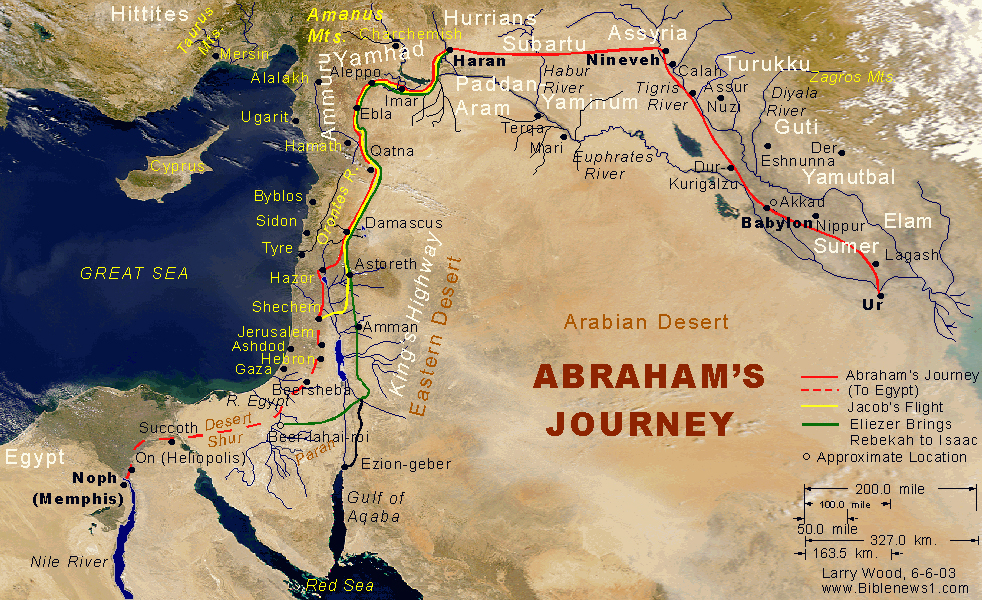
Talk about Déjà vu! Isaac learned a lot from his father, Abraham, including how to deceive a king. Almost 90 years have passed since Abraham's event. Famines were not uncommon in the land of Canaan which often forced migrations as people moved around to find more fertile territory and food 1 There was a famine in the land, besides the first famine that was in the days of Abraham. And Isaac went to Abimelech king of the Philistines, in Gerar. It's possible "Abimelech" may have been a title like "Pharaoh" or "Caesar". The other possibility is that these might be names passed from fathers to sons. Either way, this is not the same king that Abraham dealt with although it was the same place. 2 Then the Lord appeared to him and said: 'Do not go down to Egypt; live in the land of which I shall tell you. Dwell in this land, and I will be with you and bless you; for to you and your descendants I give all these lands, and I will perform the oath which I swore to Abraham your father. And I will make your descendants multiply as the stars of heaven; I will give to your descendants all these lands; and in your seed all the nations of the earth shall be blessed; because Abraham obeyed My voice and kept My charge, My commandments, My statutes, and My laws." God specifically instructed Isaac not to leave the Promised Land, repeating and ratifying the promises. Isaac was a very good man, but not cut out for hardship. He decided not to go to Egypt but went to Gerar instead, the country in which he was born. 6 So Isaac dwelt in Gerar. And the men of the place asked about his wife. And he said, 'She is my sister"; for he was afraid to say, 'She is my wife," because he thought, 'lest the men of the place kill me for Rebekah, because she is beautiful to behold." Now it came to pass, when he had been there a long time, that Abimelech king of the Philistines looked through a window, and saw, and there was Isaac, showing endearment to Rebekah his wife. Then Abimelech called Isaac and said, 'Quite obviously she is your wife; so how could you say, ‘She is my sister'?" Isaac said to him, 'Because I said, ‘Lest I die on account of her.' " Remember that when Abraham's servant found Rebekah, he stated how beautiful she was. Even good men have sometimes been guilty of very great faults and follies. At this point, Isaac still did not have enough trust in God since He told him he would be the father of many nations. However, God mercifully protects his chosen ones from the perils which they bring upon themselves. 10 And Abimelech said, 'What is this you have done to us? One of the people might soon have lain with your wife, and you would have brought guilt on us." So Abimelech charged all his people, saying, 'He who touches this man or his wife shall surely be put to death." Abimelech showed him how frivolous his excuse was and what might have been the bad consequences of it. Surely Abimelech had heard about the incident with the former king and knew quite well of the wrath God placed on his people. So he is protecting his people with this command. 12 Then Isaac sowed in that land, and reaped in the same year a hundredfold; and the Lord blessed him. The man began to prosper, and continued prospering until he became very prosperous; for he had possessions of flocks and possessions of herds and a great number of servants. So the Philistines envied him. Now the Philistines had stopped up all the wells which his father's servants had dug in the days of Abraham his father, and they had filled them with earth. And Abimelech said to Isaac, 'Go away from us, for you are much mightier than we." Moving from place to place is not as easy as picking up one's tent and pitching it in another place. Even before Isaac was blessed by God, he had flocks, herds and servants. But now that God blessed him a hundredfold, he was considered very wealthy. Jacob began to cultivate plots of ground in this fertile land. Digging a well conferred a sort of ownership on the digger, especially in a country where water was precious. Isaac was an alien and, in some sense, an intruder. The Philistines' envy induced hostility which resulted in their stopping of the wells. In that land, if the water is cut off, everything dies. 17 Then Isaac departed from there and pitched his tent in the Valley of Gerar, and dwelt there. And Isaac dug again the wells of water which they had dug in the days of Abraham his father, for the Philistines had stopped them up after the death of Abraham. He called them by the names which his father had called them. Isaac hoped that he was far enough from the city for the enmity to cease. He has a calm and peaceable disposition. He had the same spirit as when he was a lad, when he let his father bind him and lay him on the altar without a struggle or a word. So he went quietly, leaving his fields and pastures. The naming of wells by Abraham, indicated the hereditary right of his family to the property. 19 Also Isaac's servants dug in the valley, and found a well of running water there. But the herdsmen of Gerar quarreled with Isaac's herdsmen, saying, 'The water is ours." So he called the name of the well Esek, because they quarreled with him. Then they dug another well, and they quarreled over that one also. So he called its name Sitnah. And he moved from there and dug another well, and they did not quarrel over it. So he called its name Rehoboth, because he said, 'For now the Lord has made room for us, and we shall be fruitful in the land." Isaac renames the well 'Esek", which means quarrel. Sitnah means "hatred," or more accurately "accusation". Rehoboth means 'The Lord has given us room and we will flourish in the land". By now, the Philistines realized that Isaac had a quiet spirit and was strong in non-resistance but he was not going to give up trying so they left him alone. When a man's ways please the Lord, he makes even his enemies to be at peace with him. The last well they dug was about 20 miles south of Beersheba. 23 Then he went up from there to Beersheba. And the Lord appeared to him the same night and said, 'I am the God of your father Abraham; do not fear, for I am with you. I will bless you and multiply your descendants for My servant Abraham's sake." So he built an altar there and called on the name of the Lord, and he pitched his tent there; and there Isaac's servants dug a well. Isaac returned to the place where his father lived before, near the watershed between the Mediterranean and the Salt Sea. At Beersheba, the Well of the Oath, God appeared to him and renewed the promises already given. So Isaac built an altar and performed a solemn service. Again they build a well. 26 Then Abimelech came to him from Gerar with Ahuzzath, one of his friends, and Phichol the commander of his army. And Isaac said to them, 'Why have you come to me, since you hate me and have sent me away from you?" Remember when Abraham rescued Lot, the nearby kings came to make peace with him because they knew God was with him. Anyone who is against God's people will be cursed. Here is Isaac, growing in prosperity and notoriety and so the King of Gerar wants peace. 28 But they said, 'We have certainly seen that the Lord is with you. So we said, ‘Let there now be an oath between us, between you and us; and let us make a covenant with you, that you will do us no harm, since we have not touched you, and since we have done nothing to you but good and have sent you away in peace. You are now the blessed of the Lord.' " So he made them a feast, and they ate and drank. Then they arose early in the morning and swore an oath with one another; and Isaac sent them away, and they departed from him in peace. The king of Gerar discerns that Isaac's prosperity can only be explained by the special blessing of Jehovah his God. Isaac won the friendship of his opponents by his patience. This alliance was very similar to the one made between Abraham and the former King of Gerar. Isaac was hospitable to the royal party and after having sworn to the treaty, parts with them in peace. 32 It came to pass the same day that Isaac's servants came and told him about the well which they had dug, and said to him, 'We have found water." So he called it Shebah. Therefore the name of the city is Beersheba to this day. The same day when the agreement was made with Abimelech, Isaac's servants informed him of the well which they had dug; and Isaac gave it the name Shebah, which means oath, in commemoration of the treaty made on the oath. Two wells still exist at this place to attest the correctness of the record. 34 When Esau was forty years old, he took as wives Judith the daughter of Beeri the Hittite, and Basemath the daughter of Elon the Hittite. And they were a grief of mind to Isaac and Rebekah. When Esau was the same age of Isaac when he married Rebekah, he violated the great principle laid down by Abraham, to never marry idolaters. Such marriages were illegal and would have forfeited his birthright even if Jacob had not talked him out of it. Esau was foolish in marrying two wives together, and still more in marrying Hittites, the worst of the Canaanites, who were subject to the curse of Noah. The fathers of these two women were men of great power and authority. Esau also married a daughter of Ishmael, and sister of Nebajoth. This proved how thoroughly his heart was set upon earthly things. These wives never gained the affections of his Isaac and Rebekah. |