Genesis 25 – Birth of Jacob and Esau
Timeline: 1800 BC
|
Resources |
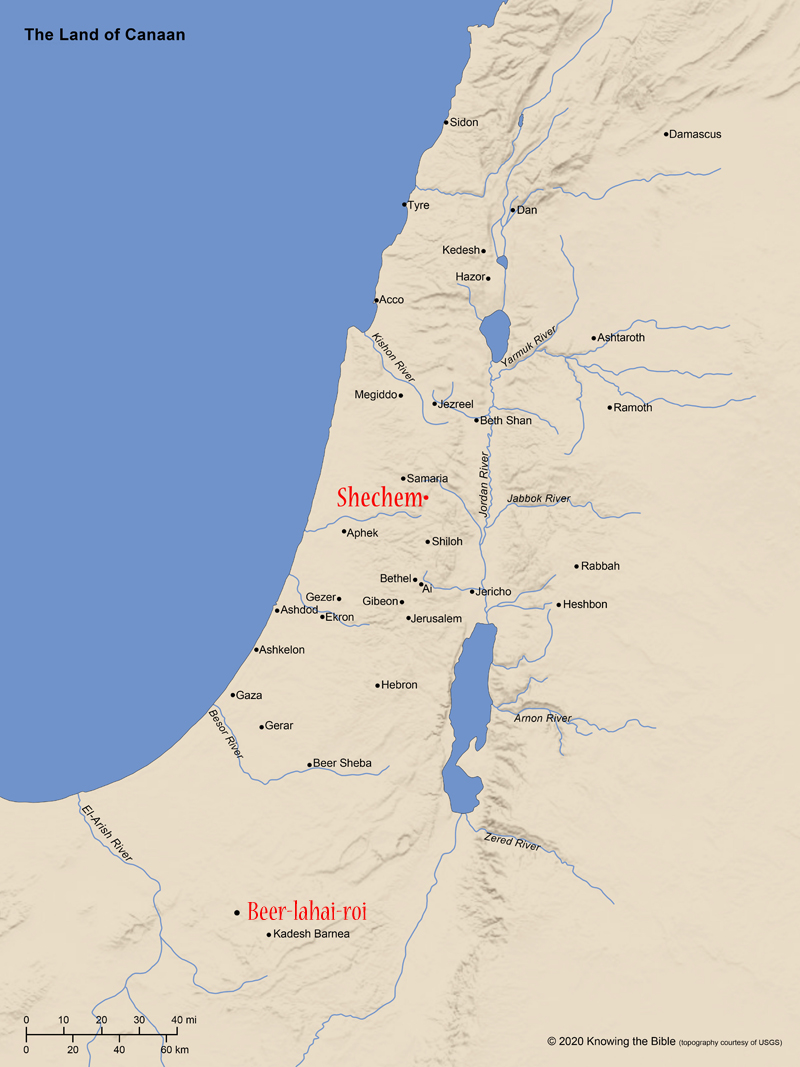
After the Sarah died and was buried in the last chapter. Abraham was now over 137 and will live another 38 years old. (FYI: Today there are just over 12,000 people in America that are over 100 years old.) Abraham marries again and has many children by Keturah. God in now fulfilling His promise that Abraham will be the father of many nations. 1 Abraham again took a wife, and her name was Keturah. And she bore him Zimran, Jokshan, Medan, Midian, Ishbak, and Shuah. Jokshan begot Sheba and Dedan. And the sons of Dedan were Asshurim, Letushim, and Leummim. And the sons of Midian were Ephah, Epher, Hanoch, Abidah, and Eldaah. All these were the children of Keturah. Abraham had eight sons: Isaac was born of Sarah, Ishmael through Hagar, and these six through Keturah. She bore him eight sons, seven grandsons and three great grandsons. It doesn’t mention female descendants but surely there are girls born among these. Keturah’s sons would themselves become the fathers of distinct peoples. For example, the Midianites came from Midian. Sheba was the monarch that visited Solomon. Keturah’s family lived in Arabia where Hagar was heading to when she got lost. 5 And Abraham gave all that he had to Isaac. But Abraham gave gifts to the sons of the concubines which Abraham had; and while he was still living he sent them eastward, away from Isaac his son, to the country of the east. Read carefully in Genesis chapter 24:36. Abraham gave Isaac all his wealth before he married Rebekah. While Abraham was alive, he could do whatever he wanted with his wealth but after his death, it would have been distributed between all the sons. This was God’s will that Isaac remain in the promised land of Canaan. The rest of his children were sent away to Arabia where Ishmael was supposed to go. He gave gifts to all the sons, including Ishmael, so that after death they could not dispute a settlement in the Land of Promise with Isaac. When Abraham was 160 years old, Jacob and Esau were born to Isaac. 7 This is the sum of the years of Abraham’s life which he lived: one hundred and seventy-five years. Then Abraham breathed his last and died in a good old age, an old man and full of years, and was gathered to his people. And his sons Isaac and Ishmael buried him in the cave of Machpelah, which is before Mamre, in the field of Ephron the son of Zohar the Hittite, the field which Abraham purchased from the sons of Heth. There Abraham was buried, and Sarah his wife. And it came to pass, after the death of Abraham, that God blessed his son Isaac. And Isaac dwelt at Beer Lahai Roi. Abraham lived a full, blessed life and died satisfied. He was gathered to his people, in other words, his soul went to be with people of faith who died before him. This place will be referred to by Jesus as Abraham’s bosom. Isaac and Ishmael had a good relationship with each other. They came together to bury Abraham in the cave he bought for Sarah. God’s covenant continues with Isaac. Beer Lahai Roi was the well which was named when Hagar had fled from Sarah. This area is where the blessings of God first begin to come upon Isaac apart from Abraham. 12 Now this is the genealogy of Ishmael, Abraham’s son, whom Hagar the Egyptian, Sarah’s maidservant, bore to Abraham. And these were the names of the sons of Ishmael, by their names, according to their generations: The firstborn of Ishmael, Nebajoth; then Kedar, Adbeel, Mibsam, Mishma, Dumah, Massa, Hadar, Tema, Jetur, Naphish, and Kedemah. These were the sons of Ishmael and these were their names, by their towns and their settlements, twelve princes according to their nations. These were the years of the life of Ishmael: one hundred and thirty-seven years; and he breathed his last and died, and was gathered to his people. (They dwelt from Havilah as far as Shur, which is east of Egypt as you go toward Assyria.) He died in the presence of all his brethren. The line of Ishmael is given here to show the fulfillment of the promise God made to Abraham, about Ishmael, in Genesis 17. Ishmael’s sons were wealthy as indicated by the towns and settlements which were named after them. These descendants moved east of Israel, they are in the face of Israel, and they are in the midst of Israel – exactly as was written in chapter 16. Note: Havilah was the name of one the rivers in Eden. It is the teritory of the Ishmaelites. Extra-biblical literature mentions Havilah as the source of precious jewels used by the Amorites. 19 This is the genealogy of Isaac, Abraham’s son. Abraham begot Isaac. Isaac was forty years old when he took Rebekah as wife, the daughter of Bethuel the Syrian of Padan Aram, the sister of Laban the Syrian. Now Isaac pleaded with the Lord for his wife, because she was barren; and the Lord granted his plea, and Rebekah his wife conceived. But the children struggled together within her; and she said, “If all is well, why am I like this?” So she went to inquire of the Lord. Isaac is the legitimate and chosen son of promise and the main branch leading to Jesus. Isaac married Rebekah when he was forty years old. After nineteen years, she still had no children. Isaac prayed fervently for her and God granted his request. The long period between marriage and birth demonstrated to Isaac and Rebekah that the conception wasn’t merely a natural occurrence, but a gift of grace. She did not know that she was carrying twins and she began to worry about losing her child. 23 And the Lord said to her: “Two nations are in your womb, Two peoples shall be separated from your body; One people shall be stronger than the other, And the older shall serve the younger.” God let her know that she was fine and that the twin boys were at war with each other from the time of their conception. (The two nations would become Israel and Edom – read Obadiah). God revealed that the two descendants will be separated and one will be stronger than the other. The natural order of family life is once again reversed, just as Ishmael was born first but Isaac received the firstborn’s birthright. The younger will be ahead of the older, indicating that Jacob would receive the birthright and the blessing that would normally go to the oldest son. Rebekah understood that the younger son would receive God’s covenant. 24 So when her days were fulfilled for her to give birth, indeed there were twins in her womb. And the first came out red. He was like a hairy garment all over; so they called his name Esau. Afterward his brother came out, and his hand took hold of Esau’s heel; so his name was called Jacob. Isaac was sixty years old when she bore them. Esau’s name in Hebrew translates to “hairy”. The Hebrew name Jacob means "to follow, be behind." Many people use the definition “someone who is morally reprehensible” which Jacob is certainly not. 27 So the boys grew. And Esau was a skillful hunter, a man of the field; but Jacob was a mild man, dwelling in tents. And Isaac loved Esau because he ate of his game, but Rebekah loved Jacob. Esau was born a man for this world. He was a cunning hunter who knew how to live by his wits. He spent all his time in the field. So Isaac loved Esau because he was more of a man’s man. Rebekah knew God’s will for Jacob which was important to her. Jacob was a plain man, dwelling in tents, an honest man that always meant well, and dealt fairly. And this was that son of Isaac on whom the covenant was entailed. 29 Now Jacob cooked a stew; and Esau came in from the field, and he was weary. And Esau said to Jacob, “Please feed me with that same red stew, for I am weary.” Therefore his name was called Edom. But Jacob said, “Sell me your birthright as of this day.” And Esau said, “Look, I am about to die; so what is this birthright to me?” Then Jacob said, “Swear to me as of this day.” So he swore to him, and sold his birthright to Jacob. And Jacob gave Esau bread and stew of lentils; then he ate and drank, arose, and went his way. Thus Esau despised his birthright. Esau’s name was called Edom whom God hates Malachi 1:2. Abraham was 175 when the twins were 15 so they obviously knew of the covenant made to their grandfather and father. Esau didn’t have much respect for his birthright. Hebrews 12:16 calls Esau a profane person for selling his birthright. Jacob, on the other hand, was following the will of God. |