Genesis 22 – The Offering of Isaac
Timeline: 2054 BC
|
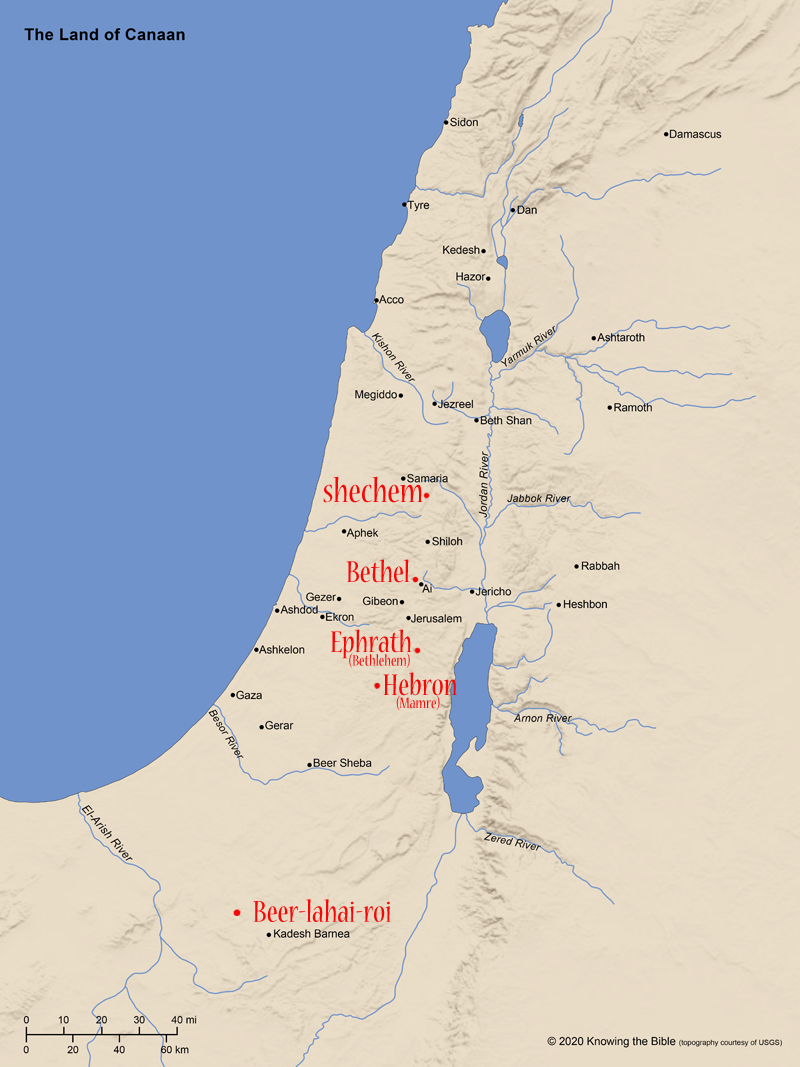
To tempt someone means you are trying to entice them to sin. A test is to experience or exercise designed to determine the level of a person's faith, knowledge, skill, etc. Satan tempts us to ruin us; God tests us to demonstrate his faithfulness and to develop our faith. ALL things work together for good to those who love God. When God tested Abraham, He waited until he was ready. These tests were not for God's sake, but for Abraham to he would trust that God could deliver on His promises. Genesis 22:1 Some time later God tested Abraham and said to him, "Abraham!" "Here I am," he answered. When Abraham said, "Here I am," it meant that he was ready to be taught, ready to obey, ready to surrender, and he was ready to be examined by God. Genesis 22:2 "Take your son," God said, "your only son Isaac, whom you love, and go to the land of Moriah. Offer him there as a burnt offering on one of the mountains, which I will show you." Notice that God specifies Isaac, "your only son". Although Abraham had two sons, God acknowledged Isaac as Abraham's only son. Ishmael had been sent away with his mother, although Abraham was the father. "…whom you love" - this is the very first time in the Bible the word love is mentioned. The first time a word is mentioned will be the simplest, most understandable reference from which the others build. The people of Canaan found nothing especially strange about human sacrifice. Canaanite religious rituals included child sacrifices to appease deities, but Abraham believed God was different. He expected that God would resurrect his son since He promised Isaac would be the father of many nations, and whom God had promised to make the heir of the covenant. God was specific about which mountain he was to go. The mountain was known later as Golgtha, the place of the skull, where Jesus died on the cross. Abraham believed God would resurrect Isaac because God promised to make great nations through Isaac. Hebrews 11:17-19 states, "By faith Abraham, when he was tested, offered up Isaac, and he who had received the promises offered up his only begotten son, of whom it was said, 'In Isaac your seed shall be called,' concluding that God was able to raise him up, even from the dead, from which he also received him in a figurative sense." Genesis 22:3-5 So Abraham got up early the next morning, saddled his donkey, and took along two of his servants and his son Isaac. He split the wood for a burnt offering and set out for the place God had designated. The similarities in this story of Abraham and Jesus' crucifixion are incredible (see here). The place God told Abraham to go to Mt. Moriah which is also as the site where Solomon built the first Temple and made sacrifices to the Lord. On the third day Abraham looked up and saw the place in the distance. "Stay here with the donkey," Abraham told his servants. "The boy and I will go over there to worship, and then we will return to you." The journey that took 3 days was about 50 miles from From Beersheba to Salem (known today as Jerusalem). Isaac was not a young boy at this time. Most scholars agree that he was in his late teens or early twenties. Abraham had instructed the servants to stay and stated that "WE will come back to you". Abraham believed Isaac would be resurrected. Genesis 22:6-8 Abraham took the wood for the burnt offering and placed it on his son Isaac. He himself carried the fire and the sacrificial knife, and the two of them walked on together. Then Isaac said to his father Abraham, "My father!" "Here I am, my son," he replied. "The fire and the wood are here," said Isaac, "but where is the lamb for the burnt offering?" The statement "Here I am" emphasizes Abraham's willingness to be available, listen, and respond to both God and his son. Lamb sacrifice was initially associated with the Passover ritual symbolizing the sparing of the Israelites' firstborn during the Exodus. After that, they were sacrificed as a way to temporarily atone for sins. Isaac was familiar with the ritual and expected his father to bring a lamb. He was probably not surprised by his father's answer since he grew up knowing how Abraham had trusted God. Abraham answered, "God Himself will provide the lamb for the burnt offering, my son." And the two walked on together. God will provide "FOR HIMSELF". Some translations say "God will provide Himself". We have a remarkable picture of the work of Jesus at the cross, thousands of years before it happened. The son of promise willingly went to be sacrificed in obedience to his father, carrying the wood of his sacrifice up the hill, all with full confidence in the promise of resurrection. Genesis 22:9-11 When they arrived at the place God had designated, Abraham built the altar there and arranged the wood. He bound his son Isaac and placed him on the altar, atop the wood. Then Abraham reached out his hand and took the knife to slaughter his son. Josephus, a renowned Jewish historian, describes Isaac as a 25-year-old who allowed Abraham to bind him and knew his father's intentions. Since Abraham was over 100 years old, it would not have been difficult for a son of that age could overtake his father to prevent the sacrifice. Although Abraham loved Isaac deepy, he was prepared to obey God, even though it meant sacrificing his only son. Just then the angel of the LORD called out to him from heaven, "Abraham, Abraham!" "The angel of the Lord" refers to a figure who is both an angel and a messenger of God, often identified as the pre-incarnate Jesus Christ. God repeated his name, drawing attention to the specific command that was being delivered, helping Abraham understand the importance of what He is about to say. "Here I am," he replied. Abraham paused, giving his full attention in response to the call, giving full attention, ready to obey God's command. This was a critical moment. Just as the fatal stroke was about to take Isaac's life, God intervened. Genesis 22:12"Do not lay a hand on the boy or do anything to him," said the angel, "for now I know that you fear God, since you have not withheld your only son from me." This is the third time God referred to Isaac as Abraham's only son. He was the only son of God's promise conceived by God's power. Jesus was also referred to as God's only son but God did not withhold His son from being sacrificed. Genesis 22:13-14 Then Abraham looked up and saw behind him a ram in a thicket, caught by its horns. So he went and took the ram and offered it as a burnt offering in place of his son. And Abraham called that place The LORD Will Provide. So to this day it is said, "On the mountain of the LORD it will be provided." God didn't call off the sacrifice. Instead, He provided a male sheep for a substitute. He who provided the ram for Abraham to sacrifice in the place of Isaac would provide His Son as a sacrifice for sinners. The mountain of the Lord refers to a place of divine encounter and revelation. Several significant events occurred in this place, Moses received the law, Solomon built the first Temple, Jacob had a dream, etc. Genesis 22:15-18 And the angel of the LORD called to Abraham from heaven a second time, saying, "By Myself I have sworn, declares the LORD, that because you have done this and have not withheld your only son, I will surely bless you, and I will multiply your descendants like the stars in the sky and the sand on the seashore. Your descendants will possess the gates of their enemies. And through your offspring all nations of the earth will be blessed, because you have obeyed My voice." The second message seems to be in the first person ("By Myself I have sworn"). Jesus the Messiah, God the Son, was uniquely present at this glorious event. He repeated and emphasized the promise after Abraham's remarkable obedience. Astronomers estimate that there are at least 10 to the 25th power (that is, a hundred-million-billion-billion stars), which reflects the same order of magnitude as the number of grains of sand on the earth. God had already declared Abraham righteous in His sight. He also made promises to Abraham: I will make you into a great nation. However, He gave Abraham conditions: Walk before me faithfully and be blameless. Then I will make my covenant between me and you and you will greatly increase you numbers. You and your descendants after you shall be circumcised as a sign of the covenant between me and you. Any uncircumcised male, who has not been circumcised in the flesh, will be cut off from his people. God also blessed Ishmael and promised to make him fruitful and greatly increase his numbers, to be the father of twelve rulers and make him into a great nation. However, God's covenant is established with Isaac.
|