Genesis 21 – Isaac Born
Timeline: 1892 BC
|
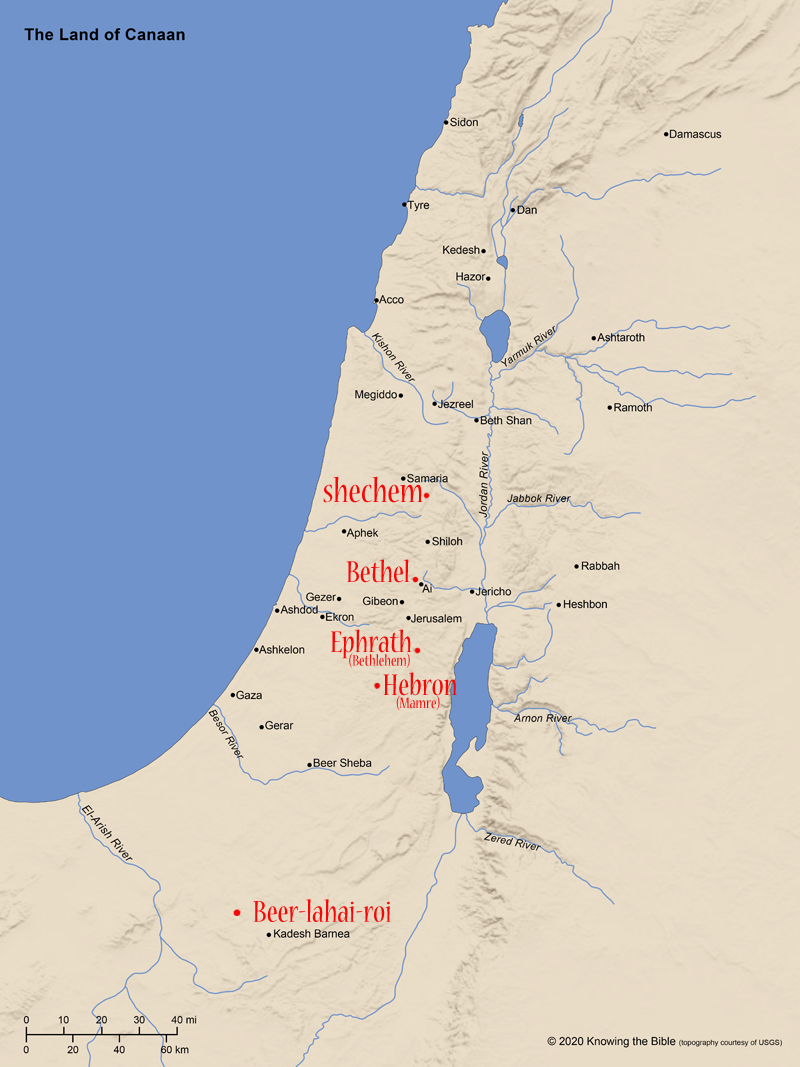
After the incident with Abimelech in Gerar, Abraham and Sarah returned to Beersheba. As prophesied 25 years ago, Sarah became pregnant and gave birth to a son when Abraham was 100 and Sarah was 90. Previously, Sarah gave her servant Hagar to Abram to bear a son, Ishmael, who is now 14 years old (Genesis 16:1-2). Genesis 21:1-2 Now the LORD attended to Sarah as He had said, and the LORD did for Sarah what He had promised. So Sarah conceived and bore a son to Abraham in his old age, at the very time God had promised. God had a specific plan for Abraham and Sarah. He made a promise and kept it. He waited until they were past childbearing age so that when the child was born, not by the power of common providence, but by the power of a special promise. Genesis 21:3-5 And Abraham gave the name Isaac to the son Sarah bore to him. When his son Isaac was eight days old, Abraham circumcised him, as God had commanded him. Abraham was a hundred years old when his son Isaac was born to him. Abraham obeyed God and named his son, Isaac, which means "laughter", because when Abraham received the promise of a child, he laughed in delight while Sarah laughed in disbelief. Isaac was circumcised on the eighth day, which began a custom of the Jews hereafter. Circumcision became a physical symbol of the covenant between God and the Israelites. Today, there is substantial evidence that circumcision offers many medical benefits. Circumcision on the eight day coincides with a natural surge in the baby's vitamin K levels which helps to reduce the risk of excessive bleeding during the procedure. Genesis 21:6-7 Then Sarah said, "God has made me laugh, and everyone who hears of this will laugh with me." She added, "Who would have told Abraham that Sarah would nurse children? Yet I have borne him a son in his old age." Sarah's laughter turned from unbelief to joy after the birth of her son. She gives God the glory and believes her laughter will be shared by everyone who hears her miraculous story. Breastfeeding was a necessity in Abraham's time. If the mother could not nurse, she would seek a "wet nurse" to provide nourishment. Sarah was delighted that she was fully restored to motherhood. Genesis 21:8 So the child grew and was weaned, and Abraham held a great feast on the day Isaac was weaned. Women typically breastfed their children until the age of three or four. Abraham held a celebration to mark his transition from infancy to a young child. It is still customary in the East to have a festive gathering when a child is weaned. Genesis 21:9-10 But Sarah saw that the son whom Hagar the Egyptian had borne to Abraham was mocking her son, and she said to Abraham, "Expel the slave woman and her son, for the slave woman's son will never share in the inheritance with my son Isaac. Casting out Ishmael was necessary to the establishment of Isaac in the rights and privileges of the covenant. The law of that time dictates that the son of a concubine has the right of inheritance as long as the father accepted him as a legitimate son when he was born. The only stipulation was that he wouldn't receive the right of the first born if the legal wife had produced a son. Abraham had to set Hagar free so that her son would not receive an inheritance. He loved both his sons so it was difficult but God made it clear that Isaac was to receive His promise. God promised Ishmael will become a nation for Abraham's sake. So he believed and obeyed God. There is a story written in clasic works of Jewish literature describing the story behind Ishael's expulsion. When he was fifteen, he played with idols and began to worhip them, imitating the pagans. When Sarah saw what Ishmael was doing, she reported it to Abraham. To prevent Ishmael from leading Isaac atray, Abraham sent him away with his mother. Genesis 21:11-13 Now this matter distressed Abraham greatly because it concerned his son Ishmael. But God said to Abraham, "Do not be distressed about the boy and your maidservant. Listen to everything that Sarah tells you, for through Isaac your offspring will be reckoned. But I will also make a nation of the slave woman's son, because he is your offspring." God did not refer to Ishmael as Abraham's son, instead he refers to him as "the lad" and the "son of the bondwoman". Isaac fulfilled the messianic promise. The strife between Ishmael and Isaac continues even today. Ishmael is regarded as a prophet and messenger and the ancestor to the Ishmaelites in Islam. Israel, who descended from Isaac, has faced opposition from Islamists and many other nations, many being subjected to harassment, threats and violence for thousands of years. Genesis 21:14-16 Early in the morning, Abraham got up, took bread and a skin of water, put them on Hagar's shoulders, and sent her away with the boy. She left and wandered in the Wilderness of Beersheba. When the water in the skin was gone, she left the boy under one of the bushes. Then she went off and sat down nearby, about a bowshot away, for she said, "I cannot bear to watch the boy die!" And as she sat nearby, she lifted up her voice and wept. Ishmael was a teenager when Hagar was set free. Abraham gave them a skin of water that held about 3 gallons of water and Egypt was about 80 to 100 miles away. They should have had enough to get them to Egypt except Hagar apparently got lost. Genesis 21:17-19 Then God heard the voice of the boy, and the angel of God called to Hagar from heaven, "What is wrong, Hagar? Do not be afraid, for God has heard the voice of the boy where he lies. Get up, lift up the boy, and take him by the hand, for I will make him into a great nation." Then God opened her eyes, and she saw a well of water. So she went and filled the skin with water and gave the boy a drink. Ishmael was weak from dehydration. He must have either cried out in distress and misery, or he prayed to God to save him. Either way, God heard him and told Hagar of His promised to Abraham, that Ishmael would become a great nation. If they would have made it to Egypt, he may have been integrated into the Egyptian culture and would not have fulfilled God's plan. Genesis 21:20-21 And God was with the boy, and he grew up and settled in the wilderness and became a great archer. And while he was dwelling in the Wilderness of Paran, his mother got a wife for him from the land of Egypt. Ishmael settled in the wilderness of Paran, a wild place fit for a wild man. He became proficient with a bow and arrow and passed his talent to his descendants. His sons and their children were extraordinary marksmen for bows and arrows. Hagar was Egyptian and according to Jewish writers, Ishmael had two wives. The first one, Aisha was from the daughters of Moab. It is said that after he divorced Aisha, Hagar sought a wife for her son from Egypt. He then married Fatima who was from Hagar's father's house. Genesis 21:22-24 At that time Abimelech and Phicol the commander of his army said to Abraham, "God is with you in all that you do. Now, therefore, swear to me here before God that you will not deal falsely with me or my children or descendants. Show to me and to the country in which you reside the same kindness that I have shown to you." And Abraham replied, "I swear it." Abimelech had suffered God's curse because of Abraham's previous deception. Clearly, Abimelech had been extraordinarily generous to Abraham in order to appease his God. So he asked him to swear he would not deceive him or any of his descendants in return for the favor Abimelech did for him. Abraham agreed. Genesis 21:25-26 But when Abraham complained to Abimelech about a well that Abimelech's servants had seized, Abimelech replied, "I do not know who has done this. You did not tell me, so I have not heard about it until today." Having an adequate supply of potable water was a constant struggle in Canaan which had no significant rivers and therefore was susceptible to droughts and famines. Thus the inhabitants of Canaan developed several ways of supplementing the amount of water available to them, One of the most significant ways was by digging wells, which was not an easy task. It took great skill to cut through the clay and limestone. Then they had to be maintained or they would dry up. Abraham had spent many years digging wells around Canaan. Apparently, Abimelech's servants had forcefully seized one in particular which was in Gerar. In unoccupied lands, the possession of wells gave a claim on the land itself. To capture a well was a form of aggression or a violation of property rights. Genesis 21:27-29 So Abraham brought sheep and cattle and gave them to Abimelech, and the two men made a covenant. Abraham separated seven ewe lambs from the flock, and Abimelech asked him, "Why have you set apart these seven ewe lambs?" Giving gifts, in that culture, was a means of opening negotiations and diplomacy. Abimelech gave Abraham sheep and cattle as a formal agreement ensuring peace and mutual respect between them. Now Abraham returned the favor in order to show that he would keep his oath that he would not deceive him or his family to the third generation. Genesis 21:30-32 He replied, "You are to accept the seven ewe lambs from my hand as my witness that I dug this well." So that place was called Beersheba, because it was there that the two of them swore an oath. After they had made the covenant at Beersheba, Abimelech and Phicol the commander of his army got up and returned to the land of the Philistines. Giving Abimelech the lambs was Abraham's way of procuring the well and the surrounding land, thus avoiding any more conflict. The name Beersheba combines the Hebrew words "be'er" (באר), meaning "well," and "sheva" (שבע), which can mean either "seven" or "oath". In this case, it appears that the meaning is the latter. Genesis 21:33-34 And Abraham planted a tamarisk tree in Beersheba, and there he called upon the name of the LORD, the Eternal God. And Abraham resided in the land of the Philistines for a long time. The tamarisk tree represents a covenant between God's relationship with his people. Abraham planted the tree to declare his reliance on God and as a way to leave a legacy for his descendants. Beersheba was on the border of Philistine land. Evidently, they achieved peace with the philistines and stayed for a while. |