Genesis 20 – Abraham, Sarah and Abimelech
Timeline: 1898 BC
|
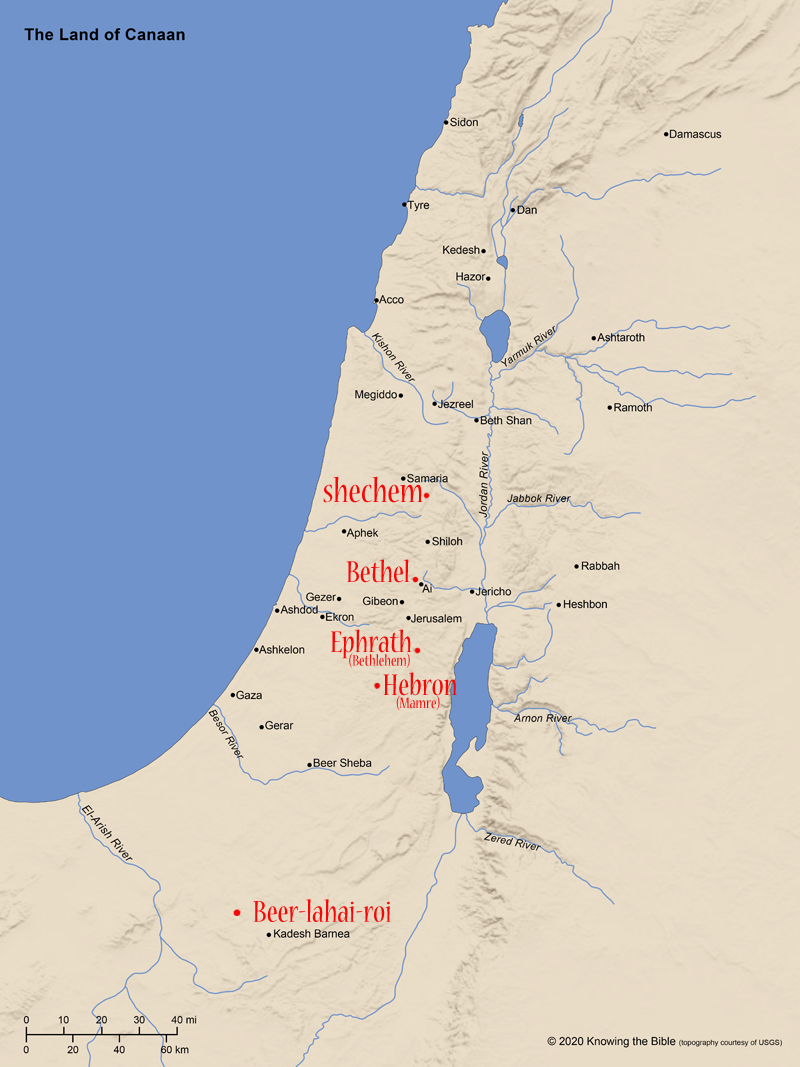
Abraham was living near the great trees of Mamre at Hebron for nearly twenty years when the destruction of Sodom and Gomorrah occurred. The text does not explain why, but he made the decision to move about 50 miles south where he camped in Gerar, future land of the Philistines. The scripture does not explicitly say how long they were there, but God told him Sarah was going to have a son in a year just before they moved. Genesis 20:1-2 Now Abraham journeyed from there to the region of the Negev and settled between Kadesh and Shur. While he was staying in Gerar, Abraham said of his wife Sarah, "She is my sister." So Abimelech king of Gerar had Sarah brought to him. Among the Philistines, Abimelech it was used as a title for kings in the land of Canaan just as Pharaoh was a title for a king in Egypt. It was considered to be the duty of the beautiful women to be one of the women in the king's harem. Sarah lived to 127 years old so at 90, she would have been middle aged and still beautiful. The relationship between Abraham and Sarah as half-siblings was not uncommon or immoral in their culture. They shared the same father. However when Abraham didn't fully disclose his relationship with Sarah, he committed a sin of omission. In his fear, he misrepresented his real relationship with her. Abraham used the same tactic in Genesis 12:10-20 to avoid problems with Pharaoh in Egypt. Pharaoh took Sarah into his harem when she was about 65 on account of her great beauty. Once again, concerned about his own personal safety, Abraham told Sarah to say she was his sister out of fear that because of Sarah's beauty she would be taken as a wife by violence. Abraham was wealthy and powerful. It is possible that Abimelech, who was led to believe Sarah was his sister, may also have wanted to form an alliance with him. Genesis 20:3 One night, however, God came to Abimelech in a dream and told him, "You are as good as dead because of the woman you have taken, for she is a married woman." Taking Sarah into his harem was done in ignorance: his conscience was clear. Sarah was about to conceive Isaac, the promised son. Abraham had to be the father in order to fulfill God's promise. Therefore God warned Abimelech not to touch Sarah in order to protect that promise. Genesis 20:4-5 Now Abimelech had not gone near her, so he replied, "Lord, would You destroy a nation even though it is innocent? Didn't Abraham tell me, 'She is my sister'? And she herself said, 'He is my brother.' I have done this in the integrity of my heart and the innocence of my hands." Abimelech feared that God would destroy the nation because of his unintentional iniquity but more likely God's threat was directed at himself and those associated with him. Apparently Abimelech, his wife and his maidservants were all stricken with an illness which prevented them from conceiving and would have killed them. Not only did Abraham tell Abimelech that Sarah was his sister, she herself confirmed the fact. In that culture, having multiple wives was not considered a sin. He did not use force or have malicious intent. He believed he acted in good faith. Genesis 20:6-7 Then God said to Abimelech in the dream, "Yes, I know that you did this with a clear conscience, and so I have kept you from sinning against Me. That is why I did not let you touch her. Now return the man's wife, for he is a prophet; he will pray for you and you will live. But if you do not restore her, be aware that you will surely die—you and all who belong to you." God knew that Abimelech was telling the truth. He afflicted Abimelech in order to prevent him from sinning against God by taking Sarah. God gave Abimelech the choice, return Sarah to Abraham or suffer the consequences. A prophet was a spokesman for God; he spoke in God's name and by His authority. God declared Abraham to be a prophet who would intercede on Abimelech's behalf. Genesis 20:8 Early the next morning Abimelech got up and summoned all his servants; and when he described to them all that had happened, the men were terrified. In ancient times, dreams experienced by kings often influenced their decisions and actions. They were taken very seriously. Kings would seek interpreters of their dreams who were usually part of the staff. Abimelech's dream frightened the servants. They immediately brought Abraham into his presence in order to confront him. Genesis 20:9-10 Then Abimelech called Abraham and asked, "What have you done to us? How have I sinned against you, that you have brought such tremendous guilt upon me and my kingdom? You have done things to me that should not be done." Abimelech also asked Abraham, "What prompted you to do such a thing?" Abimelech expressed shock as to Abraham's conduct expressing his moral indignation. In that culture, having multiple wives was not considered a sin. However, even the pagans were aware of the moral sin of adultery. He held Abraham personally responsible for his sin. The questions implied that Abraham must have had some motive for deceiving Abimelech. Genesis 20:11-13 Abraham replied, "I thought to myself, 'Surely there is no fear of God in this place. They will kill me on account of my wife.' Besides, she really is my sister, the daughter of my father—though not the daughter of my mother—and she became my wife. So when God had me journey from my father's house, I said to Sarah, 'This is how you can show your loyalty to me: Wherever we go, say of me, "He is my brother."'" Abraham began to defend himself by admitting that he had assumed the worse. Indeed, in that culture, there were instances where men were killed so that a ruler or another powerful figure could take their wife (2 Samuel 12). However, Abraham's fear led him to lose his in trust God once again using the same excuse as before (Genesis 12:17-20). Justifying his deception, he told the truth about Sarah being his sister (Genesis 11:27-29). Genesis 20:14-16 So Abimelech brought sheep and cattle, menservants and maidservants, and he gave them to Abraham and restored his wife Sarah to him. And Abimelech said, "Look, my land is before you. Settle wherever you please." And he said to Sarah, "See, I am giving your brother a thousand pieces of silver. It is your vindication before all who are with you; you are completely cleared." In the ancient Near East, livestock was a primary measure of wealth and a common form of currency. Abimelech had suffered God's curse because of Abraham so he gave such a gift to Abraham in order to appease his God. Abimelech was afraid of further angering God so he also gave him permission to live anywhere in his kingdom. Calling Abraham Sarah's "brother" was probably for the purpose of sarcasim. To guarantee that no adultery had taken place between Sarah and the king, he gave Abraham a substancial amount of money. Genesis 20:17 Then Abraham prayed to God, and God healed Abimelech and his wife and his maidservants, so that they could again bear children—for on account of Abraham's wife Sarah, the LORD had completely closed all the wombs in Abimelech's household. Apparently, God protected Abimelech from having relations with Sarah when God inflicted him and his household with a deadly illness. At the same time as they were healed, the women of Abimelech's household were once again able to bear children and Sarah's womb was also opened. |