Genesis 19 – The Destruction of Sodom
Timeline:1898 BC
|
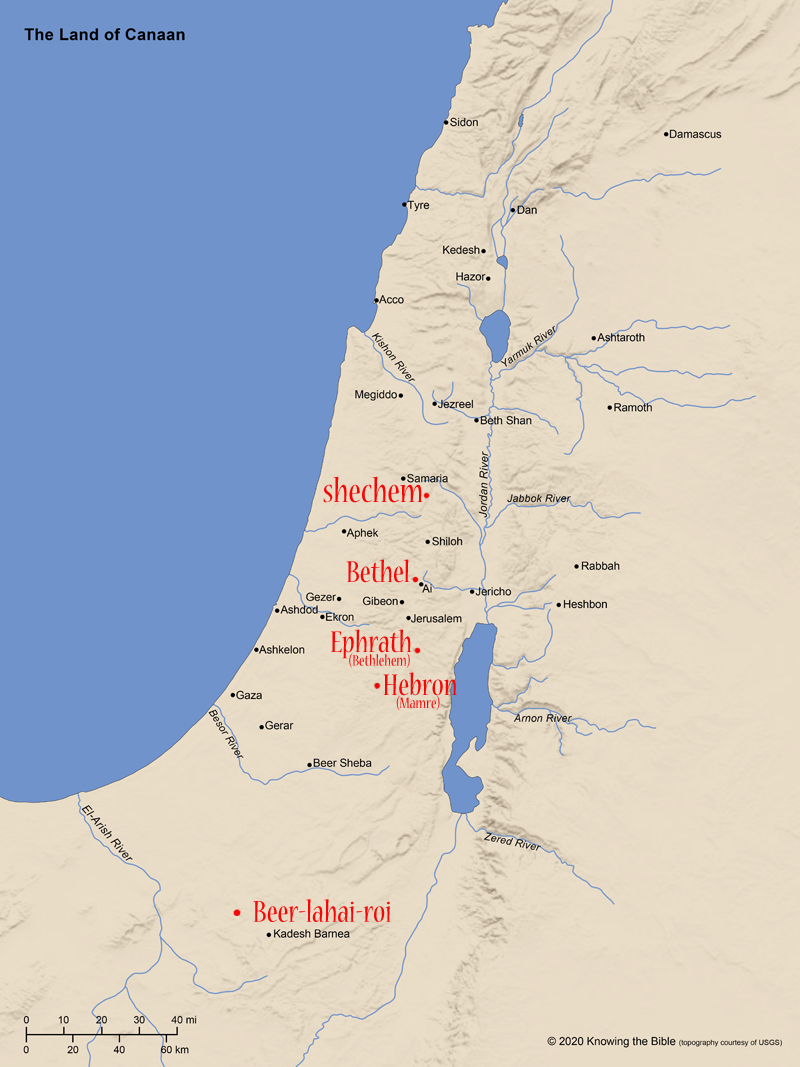
God visited Abraham with his two angels and told him he was going to judge Sodom and Gomorrah. Abraham pleaded with God to save the cities if he could find ten righteous people. The angels left Hebron and traveled to Sodom. When the angels arrived, Abraham's nephew Lot met them at the gate. Genesis 19:1-2 Now the two angels arrived at Sodom in the evening, and Lot was sitting in the gateway of the city. When Lot saw them, he got up to meet them, bowed face down, and said, "My lords, please turn aside into the house of your servant; wash your feet and spend the night. Then you can rise early and go on your way." The Hebrew word malʾak is translated as the word "angels" in this verse. The word means a messenger. The journey from Hebron to Sodom normally took two to three days. If this trip happened the same day after their visit with Abraham, it was supernatural. The gate area of an ancient city was sort of a town-hall where judges settled disputes, conferred with one another, and supervised those who entered and left the city. Lot had always preferred living in the city and had secured a position of authority. Genesis 19:3 But Lot insisted so strongly that they followed him into his house. He prepared a feast for them and baked unleavened bread, and they ate. Lot had been living in Sodom for over 20 years so knew what would happen to the men if they went into the town. The angels probably agreed to stay with Lot to protect him and to give him a chance to save his family from the impending destruction of Sodom and Gomorrah. Genesis 19:4-5 Before they had gone to bed, all the men of the city of Sodom, both young and old, surrounded the house. They called out to Lot, saying, "Where are the men who came to you tonight? Send them out to us so we can have relations with them!" The term "sodomy", derived from the Canaanite city of Sodom, is understood in history, literature, and law to refer to homosexual practices between men and was considered a criminal offense. It immediately became evident Sodom was completely and totally corrupt and there were not one righteous person in those cities. People of every age and class, from one end of the city to the other, engaged in this riot. Genesis 19:6-8 Lot went outside to meet them, shutting the door behind him. "Please, my brothers," he pleaded, "don't do such a wicked thing! Look, I have two daughters who have never slept with a man. Let me bring them to you, and you can do to them as you please. But do not do anything to these men, for they have come under the protection of my roof." Wickedness can refer to moral depravity, immorality, idolatry, drunkenness, or rebellion. Lot was well aware of their intentions. He tried to use his standing in the community to plead with them to refrain from their evil intentions and even offered his virgin daughters instead. In that culture, a guest was under obligation to protect a guest over family, especially over the females. Women were degraded and viewed as something to own. Genesis 19:9 "Get out of the way!" they replied. And they declared, "This one came here as a foreigner, and he is already acting like a judge! Now we will treat you worse than them." And they pressed in on Lot and moved in to break down the door. Previously Sodom was saved from the invasion of the four kings because of Lot. Now they were so depraved that they were out of control. They began to ridicule and threaten Lot who was once a prominent figure in the community now was a barrier to fulfilling their wicked desires. Genesis 19:10-11 But the men inside reached out, pulled Lot into the house with them, and shut the door. And they struck the men at the entrance, young and old, with blindness, so that they wearied themselves trying to find the door. When Lot failed to control the crowd; the angels intervened swiftly and decisively. Unable to see, they were incapacitated which gave the angels an opportunity to save Lot and his family. Even blinded, the morally corrupted men attempted to fulfill their lust until they were too frustrated and exhausted to continue.. Genesis 19:12-13 Then the two men said to Lot, "Do you have anyone else here—a son-in-law, your sons or daughters, or anyone else in the city who belongs to you? Get them out of here, because we are about to destroy this place. For the outcry to the LORD against its people is so great that He has sent us to destroy it." There is much debate whether Lot had sons, daughters that were married and not living at home or if the "son-in-law" referred to the ones who were betrothed to his daughters. What matters is that the angels asked about Lot's family members to ensure that everyone who was willing to leave would be saved for Lot's sake. Genesis 19:14 So Lot went out and spoke to the sons-in-law who were pledged in marriage to his daughters. "Get up," he said. "Get out of this place, for the LORD is about to destroy the city!" But his sons-in-law thought he was joking. Like the people whom Noah warned about the Flood, the people were going about their business and When he went to warn them about the imminent danger, they scoffed at him and refused to heed his warning. They considered Lot's message ridiculous, unbelievable and too fantastic to be taken seriously. Their response illustrates how morally insensitive they had become. The fact that they were unbelievers proved that Lot did not bring his daughters in the way of the Lord because a believer was to marry an unbeliever. Lot had spent the night trying to warn his sons-in-law and then preparing to evacuate the city. Genesis 19:15-16 At daybreak the angels hurried Lot along, saying, "Get up! Take your wife and your two daughters who are here, or you will be swept away in the punishment of the city." But when Lot hesitated, the men grabbed his hand and the hands of his wife and his two daughters. And they led them safely out of the city, because of the LORD's compassion for them. Lot was a wealthy man (See Genesis 13). Lot had established a life in Sodom. He was in a position of authority. Now he was told to leave everything behind. Lot clearly seemed to believe the warning since he tried to warn his future sons-in-law. Despite the urgent warnings, he must have struggled to let it all go. Undoubtedly, Lot's wife also struggled to leave behind her old life. The angels knew that the destruction was eminent so they literally took matters into their own hands and led Lot and his family out of the city. Despite Lot's hesitation, God cared about them and protected them from the pending annihilation of Sodom and the surrounding cities. Genesis 19:17 As soon as the men had brought them out, one of them said, "Run for your lives! Do not look back, and do not stop anywhere on the plane! Flee to the mountains, or you will be swept away!" The angels took Lot and his family outside the city and gave them orders to run quickly to the mountains on the Moabite Plateau east of the Dead Sea. Today they stand between 2,500 and 3,000 feet above the Dead Sea. They would have provided better protection from the destructive forces that were about to reign on the cities. For the second time, they had rescued Lot but now it was up to him to save his life and the lives of his family. Rather than listening and obeying the men, Lot negotiated. The angel ordered Lot and his family to escape quickly to the mountains. To the east were mountains were called Moab (after the disaster) and to the west was Hebron, also a mountain where Abraham lived. . For the second time, the angels had rescued Lot but now it was up to him to save his life and the lives of his family. Lot could have chosen to flee towards his uncle but instead chose to bargain with the angels. The phrase "don't look back" meant more than just turning around to see what was happening, it was intended for them to let go of their past and put their faith in God for their deliverance. Genesis 19:18-20 But Lot replied, "No, my lords, please! Your servant has indeed found favor in your sight, and you have shown me great kindness by sparing my life. But I cannot run to the mountains; the disaster will overtake me, and I will die. Look, there is a town nearby where I can flee, and it is a small place. Please let me flee there—is it not a small place? Then my life will be saved." At first Lot hesitated leaving the city, now he doubts his ability to make it to the mountains. In spite of the miracle from the night before, he still lacked faith. He begged that he might be allowed to take refuge in the one of the five Amorite cities, Bela, which was renamed to Zoar which means "small" or "insignificance" in Hebrew. Perhaps it was because he felt he couldn't make it all the way to the mountains or that the thought of living as cave dwellers, homeless, friendless, stripped of everything was more than he could bear. Another possibility was that he thought he might re-establish himself in Bela. Genesis 19:21-22 "Very well," he answered, "I will grant this request as well, and will not demolish the town you indicate. Hurry! Run there quickly, for I cannot do anything until you reach it." That is why the town was called Zoar. "Bela" is derived from the Hebrew root word "balah," which means "to devour" or "to swallow". Jewish tradition says that it was called Bela from having been repeatedly engulfed by earthquakes. Renaming places in the Bible often marks a divine encounter, covenant, or a pivotal event in the narrative of God's people. So when Lot retreated to Bela, it was renamed to Zoar because God saved the city on account of Lot. God's original plan was to destroy the entire Vale of Siddim, which is essentially the area surrounding the Dead Sea, including Zoar. He agreed to spare the city which gave Lot enough time to enter Zoar before the devastation began. The distance from Sodom to Zoar is estimated to be around 27-30 miles. Genesis 19:23 And by the time the sun had risen over the land, Lot had reached Zoar. Zoar was approximately 30 miles from Sodom so the journey would have taken about 10 to 12 hours. "The sun had risen over the land" would be better translated to "when the sun had passed over the earth" or in other words, "the sun was setting" rather than just risen. Genesis 19:24-25 Then the LORD rained down sulfur and fire on Sodom and Gomorrah—from the LORD out of the heavens. Thus He destroyed these cities and the entire plain, including all the inhabitants of the cities and everything that grew on the ground. Lot first chose to live in Sodom because it resemblance to "the gardens of the Lord". It was a well-watered fertile valley flourishing with vegetation and wildlife. The rich pasture was ideal for his livestock. The total destruction included all the inhabitants as well all the surrounding vegetation. Still today, the area is desolate and unable to sustain life. Archaeological discoveries at Tall el-Hammam and the surrounding location matched the Bible's description of what happened to Sodom and Gomorrah. Evidence thata "giant wave" of boiling hot salt had actually swept over the land and instantaneously incinerated the entire valley. In this video, Joel Kramer shows archaeological evidence of how the Bible's account certainly did happen. Genesis 19:26 But Lot's wife looked back, and she became a pillar of salt. Most bible stories tell the tale of Lot and his family running away from Sodom and his wife turning to look at the destruction. However, the scripture clearly states that Lot was in Zoar before the destruction began. "Look back" is defined in the Merriam Webster dictionary as "to think about something in the past". The implication of the passage is that in looking back, referred either to her lagging behind or turning to go back to Sodom. She was not willing to give up her former lifestyle and it cost her life. The International Standard Version translates this verse "But Lot's wife looked back as she lingered behind him, and she became a pillar of salt" indicating that she may not have gone into the city of shelter with Lot and their daughters but rather got caught in the wave of boiling hot salt. Genesis 19:27-29 Early the next morning, Abraham got up and returned to the place where he had stood before the LORD. He looked down toward Sodom and Gomorrah and all the land of the plain, and he saw the smoke rising from the land like smoke from a furnace. The morning after the disaster, Abraham once again stood where he could see the devestated cities. All that was left was smoldering ashes. It is assumed that he somehow knew that Lot had survived. His intercession had not been in vain. Genesis 19:27-29 So when God destroyed the cities of the plain, He remembered Abraham, and He brought Lot out of the catastrophe that destroyed the cities where he had lived. To say that "God remembered Abraham" means that He did exactly what He had promised. He knew that Abraham's request to save ten righteous people referred to his nephew Lot. Genesis 19:30-33 Lot and his two daughters left Zoar and settled in the mountains—for he was afraid to stay in Zoar—where they lived in a cave. Lot's fear may have resulted for many reasons. Zoar was considered as wicked as Sodom so perhaps he was afraid the same judgment would come to that town as well. It is possible that all the people of the town also fled in fear. Perhaps Lot considered the angels' warnings to go to the mountains and finally conceded. Abraham lived in mountains east of Zoar, however, Lot had gone west. For whatever reason, he did not consider going to Abraham to ask for help which surely he would have given. One day the older daughter said to the younger, "Our father is old, and there is no man in the land to sleep with us, as is the custom over all the earth. Come, let us get our father drunk with wine so we can sleep with him and preserve his line." If Lot's escape from Zoar was from fear of its destruction, his daughters probably assumed the human race was extinct with the exception of themselves. They had lost their mother and their husbands-to-be. They may also have had brothers who were annihilated. In ancient times, lineage and ancestry played a crucial role in defining people's identity, with individuals often identified by their family connections and descendants. With no one to carry on their father's name, they felt it necessary to do whatever it took to produce an heir. So that night they got their father drunk with wine, and the firstborn went in and slept with her father; he was not aware when she lay down or when she got up. Apparently they had brought provisions with them which included wine, a standard drink in ancient times. Lot was described as righteous so it stands to reason that if had he been aware of his daughter's intentions, would not have approved. Genesis 19:34-35 The next day the older daughter said to the younger, "Look, I slept with my father last night. Let us get him drunk with wine again tonight so you can go in and sleep with him and we can preserve our father's line." Lot had allowed himself to be corrupted by the society in which he lived. He obviously did not raise his daughters to trust in God. He was willing to compromise his virgin daughters when he offered them to the Sodomites in order to save his guests. No wonder they lacked morals, they were raised in a society of wickedness. So again that night they got their father drunk with wine, and the younger daughter went in and slept with him; he was not aware when she lay down or when she got up. To their credit, Lot's daughters had remained virgins up to this time. However, they rationalized their sinful behavior by claiming they were "preserving their family" through their father. The moral corruption had effected Lot's family. Genesis 19:36-38 Thus both of Lot's daughters became pregnant by their father. The older daughter gave birth to a son and named him Moab. He is the father of the Moabites of today. The younger daughter also gave birth to a son, and she named him Ben-ammi. He is the father of the Ammonites of today. Both sons were characters of God's displeasure. They became founders of nations that worshiped idolatrous gods and were notorious for continual envy and enmity against the people of God. They lived on the border of the Promised Land but were never allowed to enter it. God commanded the Israelites not to marry these pagans, because intermarriage would lead the Israelites to worship false gods. They both ultimately merged into the more general class of the Arabs. The name Moab means "from my father." Scripture calls him "the abomination of Moab". Moab afterward occupied the area northeast of the Dead Sea. Moab women were known to seduce some Israelites. Despite their wickedness, God can take the evil actions of nations and use them to accomplish His greater purposes. Hundreds of years later, Ruth who was "of the women of Moab" became the wife of Boaz and the grandmother of king David in the genealogy of Jesus Christ. "Ben-Ammi" means "son of my kinsmen." The Ammonites, descendants of Ben-Ammi, were a nomadic people who lived to the northeast of Moab in the territory of modern-day Jordan. The name of the capital city, Amman, reflects the name of those ancient inhabitants. The Ammonites were part of the inhabitants of Canaan when Israel conquered the land.Lot spent his life struggling between living a virtuous life and compromising his morals. Despite his flaws and failures, Lot was spared from destruction in Sodom, and God still considered him righteous. |