Genesis 16 – Hagar and Ishmael
Timeline: 1913 BC
|
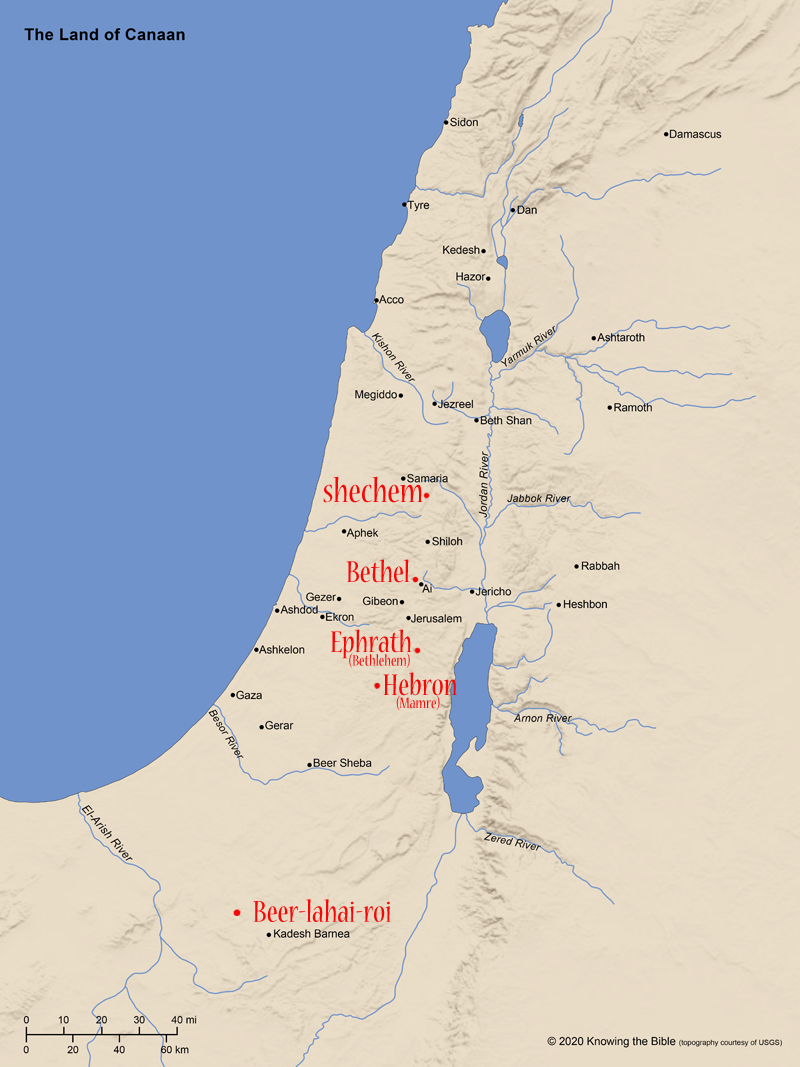
Genesis 16:1-3 Now Abram's wife Sarai had borne him no children, but she had an Egyptian maidservant named Hagar. So Sarai said to Abram, "Look now, the LORD has prevented me from bearing children. Please go to my maidservant; perhaps I can build a family by her." And Abram listened to the voice of Sarai. So after he had lived in Canaan for ten years, his wife Sarai took her Egyptian maidservant Hagar and gave her to Abram to be his wife. Abram and Sarai have been waiting years for God to fulfill His promise. Sarai decided to take it upon herself to fulfill God's promise. She was now over 75 years old and past child bearing age. Sarai offered Hagar, her servant, who was probably part of the rewards he received from the pharaoh back in Genesis 12 as a concubine. So Hagar will become a surrogate mother and Sarai would consider her children as her own. Genesis 16:4-5 And he slept with Hagar, and she conceived. But when Hagar realized that she was pregnant, she began to despise her mistress. Then Sarai said to Abram, "May the wrong done to me be upon you! I delivered my servant into your arms, and ever since she saw that she was pregnant, she has treated me with contempt. May the LORD judge between you and me." "Yes," they replied, "you may do as you have said." Concubine: In Abram's day, it was written in the marriage contract that if the wife did not produce a child within 3 years, he had the right to divorce her, marry again and could take her dowry. The other solution was to produce children through a servant or concubine. The wife would give her servant to her husband to be a surrogate. She would not be considered as an equal to the legal wife, and her children but the concubine's children could be regarded as legitimate. This was a pagan custom so Abram should have trust in God. Doesn't this sound like Adam and Eve??? Genesis 16:6 "Here," said Abram, "your servant is in your hands. Do whatever you want with her." Then Sarai treated Hagar so harshly that she fled from her. Sarai realized that the reason she never got pregnant was not Abram but her. Obviously, he was not the problem since he got Hagar pregnant. Being barren was considered a curse in those days. When Hagar conceived, she flaunted her proud condition before the barren Sarai. Then Sarai blamed Abram. So Abram, "She's your servant, deal with it!" Infuriated, Abram's wife became abusive to her slave and drove her out of the camp. Genesis 16:7-12 7Now the angelb of the LORD found Hagar by a spring of water in the desert—the spring along the road to Shur. 8"Hagar, servant of Sarai," he said, "where have you come from, and where are you going?" "I am running away from my mistress Sarai," she replied. So the angel of the LORD told her, "Return to your mistress and submit to her authority." Then the angel added, "I will greatly multiply your offspring so that they will be too numerous to count." The angel of the LORD proceeded: "Behold, you have conceived and will bear a son. And you shall name him Ishmael, for the LORD has heard your cry of affliction. He will be a wild donkey of a man, and his hand will be against everyone, and everyone's hand against him; he will live in hostility toward all his brothers." The Angel of the Lord: In the Old Testament, God appeared in a visible form, often referred to as a Theophany (a visible or tangible manifestation of God) or as a Christophany (a pre-incarnate of Jesus). Hagar was at the spring on the road to Shur heading toward Egypt when The Angel of the Lord, stopped her. He told her to name her son "Ishmael" (which means "God hears") because God heard her cry of affliction. He made a promise to Hagar to multiply her descendants exceedingly. Like Isaac, Ishmael had 12 sons, but God prophesied that his descendants would live in hostility toward everyone and everyone will be against them. Genesis 16:13-14 So Hagar gave this name to the LORD who had spoken to her: "You are the God who sees me," for she said, "Here I have seen the One who sees me!" Therefore the well was called Beer-lahai-roi. It is located between Kadesh and Bered. Hagar referred to the Lord as "El Roi," meaning "the God who sees me," realizing that God took personal interest in her. She called the spring "Beer-lahai-roi" which means "well of the Living One who sees me". It was common in ancient times to name places emphasizing the importance of location. Some scholars believe ithat the well still exist between Kadesh and Bered in the Negev desert, near the modern site of `Ain Moilaihhi. Genesis 16:15-16 And Hagar bore Abram a son, and Abram gave the name Ishmael to the son she had borne. Abram was eighty-six years old when Hagar bore Ishmael to him. Abram was 86 years old when Hagar gave birth to Ishmael. Ishmael was born by natural means; however, Issac was conceived as a miraculous response to God's promise. Arabs are descended from Ishmael. Their religion is Muslim. They consider the Quran to be the word of the God of Abraham (Allah). Mohammed wrote the Qur'an between AD 609 to 632, after the birth and resurrection of Jesus, altering the scriptures to present Ishmael as the promised child. The people in the Islamic faith believe Palestine belongs to them because Ishmael was the first born and should have the legal right to Israel. They believe Abraham was going to offer Ishmael instead of Isaac. Galatians 4:21-31 21 Tell me, you who want to be under the law, do you not understand what the law says? For it is written that Abraham had two sons, one by the slave woman and the other by the free woman. His son by the slave woman was born according to the flesh, but his son by the free woman was born through the promise. These things serve as illustrations, for the women represent two covenants. One covenant is from Mount Sinai and bears children into slavery: This is Hagar. Now Hagar stands for Mount Sinai in Arabia and corresponds to the present-day Jerusalem, because she is in slavery with her children. But the Jerusalem above is free, and she is our mother. For it is written: "Rejoice, O barren woman, who bears no children; break forth and cry aloud, you who have never travailed; because more are the children of the desolate woman than of her who has a husband." Now you, brothers, like Isaac, are children of promise. At that time, however, the son born by the flesh persecuted the son born by the Spirit. It is the same now. But what does the Scripture say? "Expel the slave woman and her son, for the slave woman's son will never share in the inheritance with the free woman's son." Therefore, brothers, we are not children of the slave woman, but of the free woman. Old Testament figures like Adam, Noah, Abraham and Moses are considered prophets in Islam. They believe Mohammed was the last prophet of God. According to the Qur'an, the archangel Gabriel revealed the word of God to Mohammed. Jesus is also a revered as a prophet by Muslims. They believe in the virgin birth of Jesus but that a disciple took His place on the cross. They do admit that He did ascend to Heaven. They also believe in the second coming of Jesus who will defeat the Antichrist. Islam is the Arabic word for submission and obedience to God; it comes from a word meaning peace. Islam is divided into two main branches: the Shia and the Sunni. The differences are political and spiritual. The Sunnis believed a devout member of Muhammad's original Quraysh (kor'esh) tribe should become the next leader; the Shias believe Muhammad's successor should be directly related to Muhammad by blood. The Quran explicitly states that men and women are equal in the eyes of God. It instructs Muslims to educate daughters as well as sons, insists that women have the right to refuse a prospective husband, and gives women the right to divorce in certain cases, etc. It also forbids female infanticide (killing a child within a year of its birth to prevent resources being spent on weak or disabled offspring). Extremists who sincerely view themselves as Muslims have committed horrible acts in the name of Islam. These are a minority within Islam. The vast majorities of Muslims reject their violence and consider their interpretation a distortion of the Muslim faith. Terrorists use radical interpretations of Islam, which take a small number of texts that were meant to regulate warfare in the early days of Islam then apply these interpretations to contemporary times. People often do the same with the Bible. |