Genesis 13 – Abram and Lot Separate
Timeline: 1918 BC
|
|
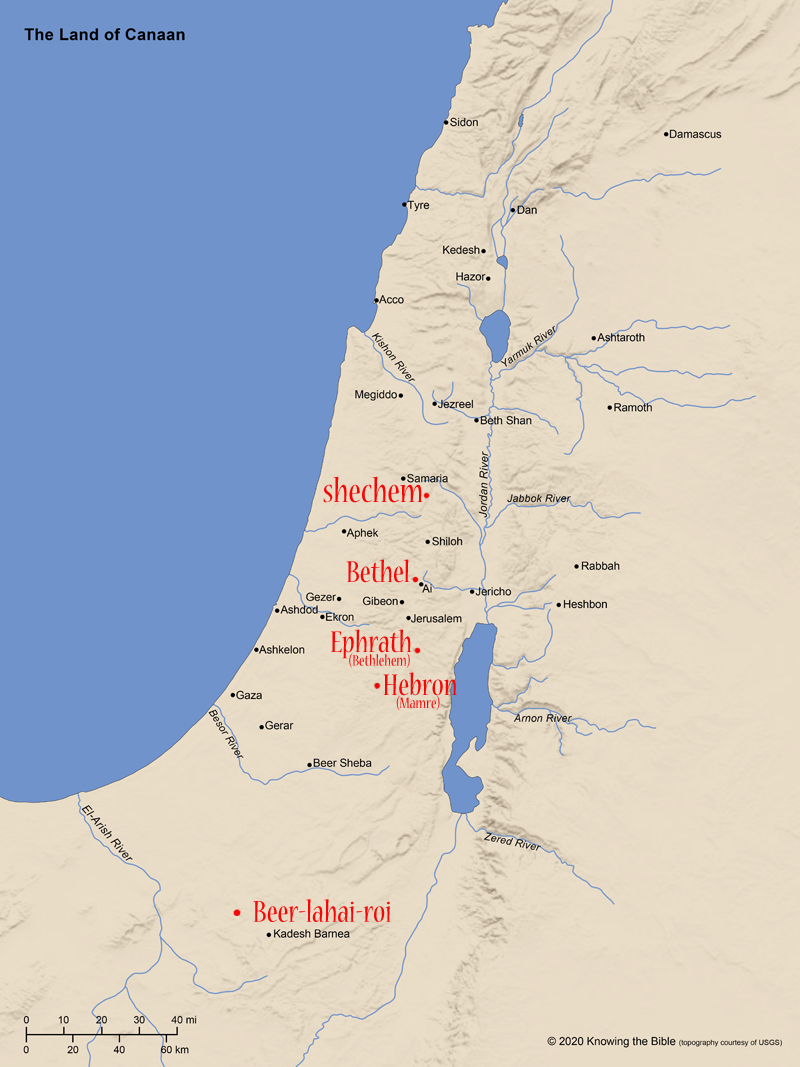
Abram had been living in the Promised Land but left for Egypt because of famine. Instead of trusting in God, he took it upon himself to remedy his situation but only found himself in trouble. In spite of that, God protected His promise to Abram through His grace and mercy. Then Abram went up from Egypt, he and his wife and all that he had, and Lot with him, to the South. Abram was very rich in livestock, in silver, and in gold. And he went on his journey from the South as far as Bethel, to the place where his tent had been at the beginning, between Bethel and Ai, to the place of the altar which he had made there at first. And there Abram called on the name of the Lord. Abram put the sin of Egypt behind him and went back to the Negev, which is the southern desert of Canaan, where he had received his promise from God. Now he renewed his allegiance to God and offered the typical sacrifices once again. Abram had already owned many cattle, sheep, and goats, as well as precious metals, but now he was even more wealthy. However, everything Abraham received in Egypt later caused trouble. 5 Lot also, who went with Abram, had flocks and herds and tents. Now the land was not able to support them, that they might dwell together, for their possessions were so great that they could not dwell together. And there was strife between the herdsmen of Abram's livestock and the herdsmen of Lot's livestock. The Canaanites and the Perizzites then dwelt in the land. Abram's nephew shared in his prosperity. The land probably had not yet recovered from the drought and therefore was not sufficient enough for the amount of livestock owned by Abram and Lot, much less the Canaanites and other former inhabitants of the country. The herdsmen of Abram, Lot, the Canaanite and the Perizzites began to quarrel over who should have the rights to the space for the numerous herds to graze. 8 So Abram said to Lot, "Please let there be no strife between you and me, and between my herdsmen and your herdsmen; for we are brethren. Is not the whole land before you? Please separate from me. If you take the left, then I will go to the right; or, if you go to the right, then I will go to the left." Evidently, Lot had begun to side with his herdsmen. But Abram knew how to turn away wrath by a soft answer. He relinquished his own rights as the elder for the sake of peace. He offered an equal or better share to Lot as he put his trust in God that whatever he ended up with would be sufficient. 10 And Lot lifted his eyes and saw all the plain of Jordan, that it was well watered everywhere (before the Lord destroyed Sodom and Gomorrah} like the garden of the Lord, like the land of Egypt as you go toward Zoar. Then Lot chose for himself all the plain of Jordan, and Lot journeyed east. And they separated from each other. Abram dwelt in the land of Canaan, and Lot dwelt in the cities of the plain and pitched his tent even as far as Sodom. But the men of Sodom were exceedingly wicked and sinful against the Lord. Instead of lifting up his eyes to heaven, Lot lifted up his eyes to the plain of Jordan. Now Sodom and Gomorrah was in the immediate vicinity of the Dead Sea where God later pronounced judgment and transformed it into a filthy lake or dead sea. The cities were previously a fertile agricultural region, still flourishing at the time of Lot's arrival. Without considering the state of the people living there and without consulting God, he chose beauty over character. The people who dwelt there went above and beyond the call of normal sin and took their heinous acts of sin to a new level of depravity. Abram chose to remain in the land where God had sent him. 14 And the Lord said to Abram, after Lot had separated from him: "Lift your eyes now and look from the place where you are—northward, southward, eastward, and westward; for all the land which you see I give to you and your descendants forever. And I will make your descendants as the dust of the earth; so that if a man could number the dust of the earth, then your descendants also could be numbered. Arise, walk in the land through its length and its width, for I give it to you." In ancient times, lineage and ancestry played a crucial role in defining people's identity, with individuals often identified by their family connections and descendants. God promised not only to give Abram the land which will be called Israel but also that he would bless him with many generations. Can all of God's chosen people from Abram to today and into tomorrow be counted? Galatians 3:28-29 There is neither Jew nor Greek, there is neither slave nor free, there is neither male nor female; for you are all one in Christ Jesus. And if you are Christ's, then you are Abraham's seed, and heirs according to the promise. 18 Then Abram moved his tent, and went and dwelt by the terebinth trees of Mamre, which are in Hebron, and built an altar there to the Lord. The tree under which he had pitched his tent. situated about halfway between Mamre and Hebron, is known as the oak or terebinth of Mamre. According to the scholar Josephus, the "Oaks of Mamre" are as old as the world itself. One particular tree was still alive until 1996 when it appeared to be dead. A long-standing tradition is that the Oak of Abraham will die before the appearance of the Anti-Christ. However, in 1997, new shoots grew from the tree's roots. The appearance of new life gave believers hope that the world was again being pardoned. This is the third time the Bible records Abram building an altar expressing gratitude and to enjoy the peace and presence of God. |