Genesis 12 – God's Promise to Abram
Timeline: 2091 BC
|
|
God appeared in a glorious manner to Abraham, either in a vision, or by an angel, or in some glorious form. In Acts 7:2-3, Stephen states "The God of glory appeared to our father Abraham when he was in Mesopotamia, before he dwelt in Haran, and said to him, 'Get out of your country and from your relatives, and come to a land that I will show you.'" But when they came to Haran, they settled there in a house. It was the border of their country, the last center of worship of their moon god and the end of their familiar way of life. Beyond this was desert and they would have to live in tents so they stayed there until Terah died at age 205. Then God spoke to Abram again and told him to leave Haran. Genesis 12:1 The Lord had said to Abram, "Go from your country, your people and your father's household to the land I will show you. Abram left in faith, not knowing where he was going, or even why he was going, except that God had commanded him. However, the command came with a blessing. Genesis 12:2 "I will make you into a great nation, and I will bless you; I will make your name great, and you will be a blessing. I will bless those who bless you, and whoever curses you I will curse; and all peoples on earth will be blessed through you." Abraham is the common Hebrew patriarch of the Abrahamic religions, including Judaism, Christianity, and Islam. In Judaism, he is the founding father of the special relationship between the Jews and God; in Christianity, he is the spiritual ancestor of all believers and in Islam, he is a link in the chain of Islamic prophets that begins with Adam and leads up to Muhammad. History has shown that those who have blessed the Jews have been blessed and those who have cursed them have been cursed. Genesis 12:4 So Abram went, as the Lord had told him; and Lot went with him. Abram was seventy-five years old when he set out from Harran. He took his wife Sarai, his nephew Lot, all the possessions they had accumulated and the people they had acquired in Harran, and they set out for the land of Canaan, and they arrived there. Abram grew prosperous during the time he lived in Haran. He owned many cattle, sheep, and goats, and had a lot of silver and gold. In addition, he had many servants, herdsmen, shepherds, etc. They married, and bore their own children, thus steadily increasing the size of his house.
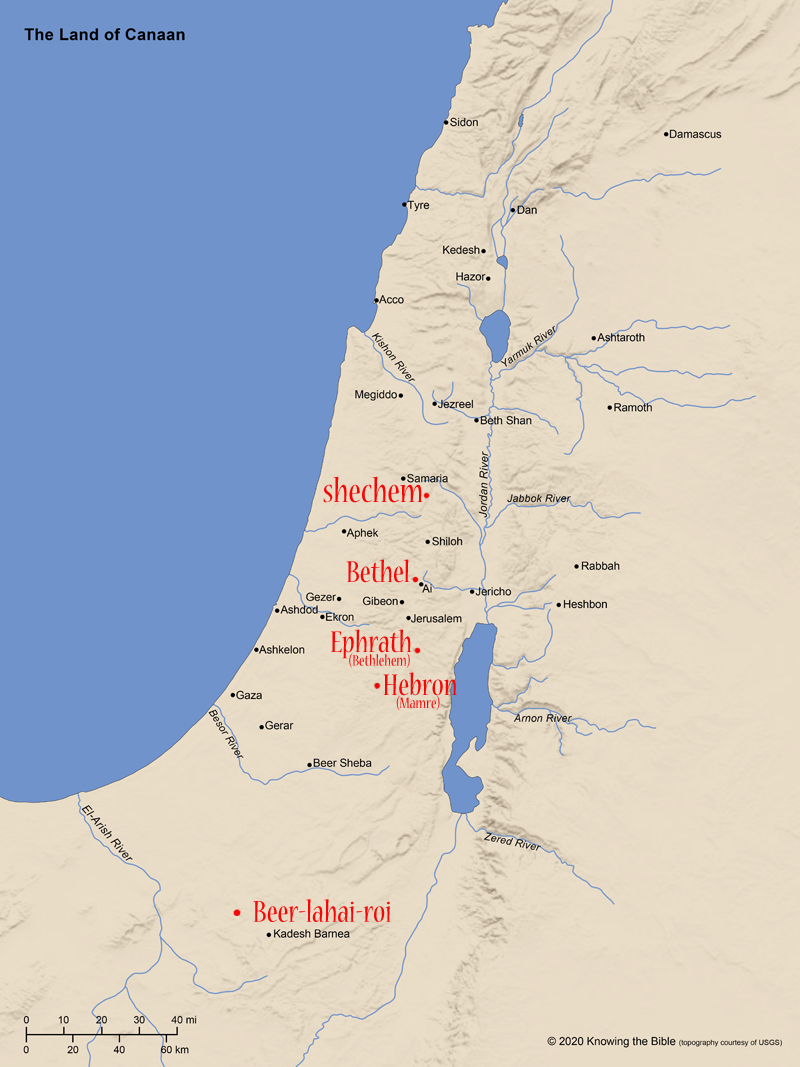
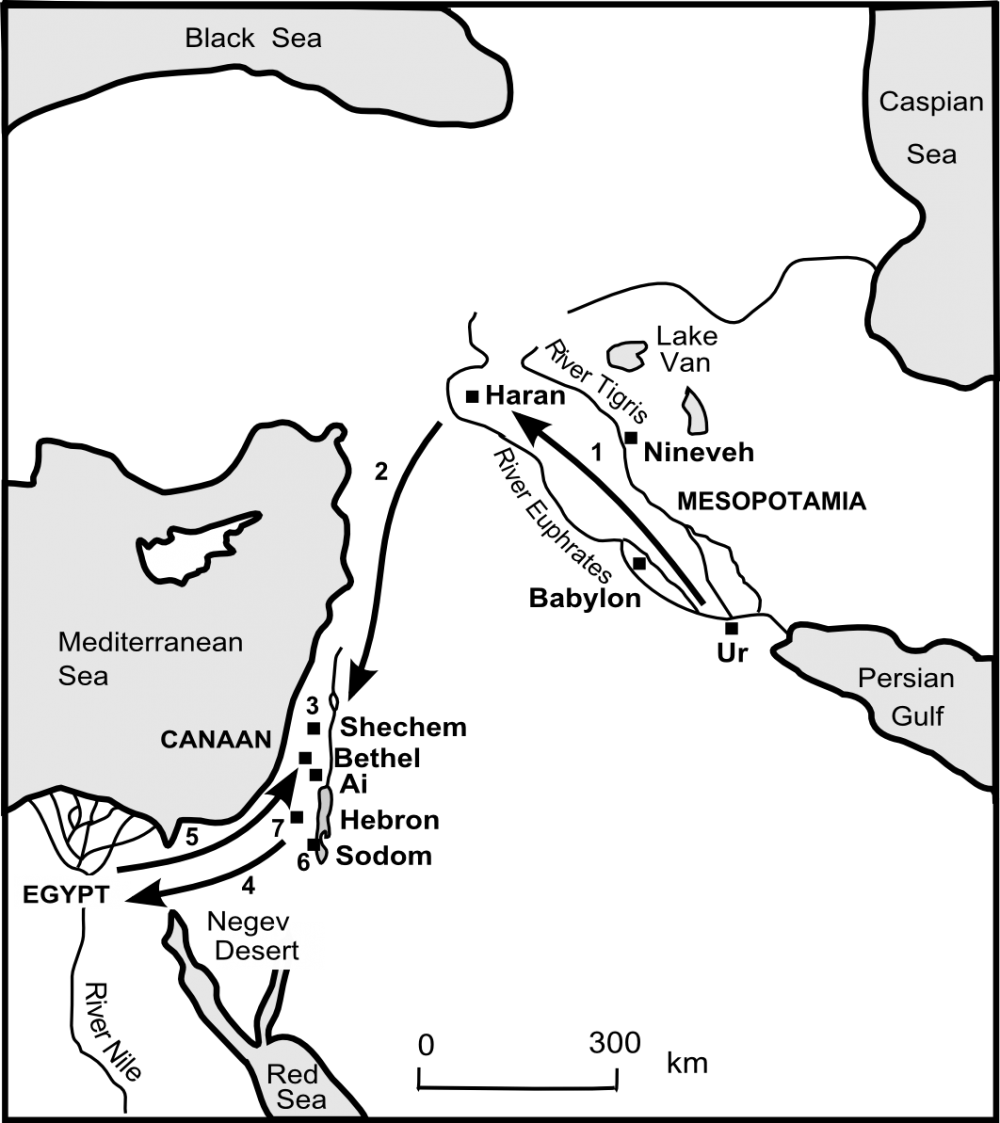
Genesis 12:6 Abram traveled through the land as far as the site of the great tree of Moreh at Shechem. At that time the Canaanites were in the land. The Lord appeared to Abram and said, "To your offspring I will give this land." So he built an altar there to the Lord, who had appeared to him. Once Abram arrived at site of the great oak tree of Moreh at Shechem, God appeared to Abram and promised that Abram's descendants would outnumber the stars in the sky. Abraham's descendants were destined to become God's chosen people. Evidently in Abram's time the two most powerful races of Canaan, the Amorites and Hittites occupied Shechem. After he built an alter to the Lord and worshipped with his household, he continued toward the Negev. (See the map of Abraham's Journey from Ur to Haran to Egypt.) Genesis 12:8 From there he went on toward the hills east of Bethel and pitched his tent, with Bethel on the west and Ai on the east. There he built an altar to the Lord and called on the name of the Lord. Bethel (house of God) was 20 miles south of Shechem and 10 miles north of Jerusalem. It was one of the highest places in Canaan. Presumably, Abram pitched his tent wherever he went, therefore the mention of it here suggests that he settled near Bethel for some time. Wherever Abram went, he worshipped God, and offered sacrifice unto Him. Bethel means 'house of God.' it was the symbol of fellowship with God. In contrast, Ai means 'heap of ruins.' It was the symbol of the world. So Abram was between between a holy place and a Canaanite city. Genesis 12:9 Then Abram set out and continued toward the Negev. The Negev marks the southern border of Canaan lying between the hills of Judah and Kadesh-Barnea. So Abram established a little tent village with his family and servants on one of the hills. Genesis 12:10 Now there was a famine in the land, and Abram went down to Egypt to live there for a while because the famine was severe. As he was about to enter Egypt, he said to his wife Sarai, "I know what a beautiful woman you are. When the Egyptians see you, they will say, 'This is his wife.' Then they will kill me but will let you live. Say you are my sister, so that I will be treated well for your sake and my life will be spared because of you." Rain falls only at two seasons of the year in Palestine. If either of these failed or were scanty he Negeb would be wasted by drought and consequent famine. On the other hand, Egypt's is watered by the annual flooding of the Nile and not just by the seasonal rains. Every summer, between May and September, the river gradually swelled until it overflowed its banks and flooded the surrounding plains. When the waters receded, they left behind layers of fertile deposits that were essential for growing crops to feed the realm. Genesis 12:14 When Abram came to Egypt, the Egyptians saw that Sarai was a very beautiful woman. And when Pharaoh's officials saw her, they praised her to Pharaoh, and she was taken into his palace. He treated Abram well for her sake, and Abram acquired sheep and cattle, male and female donkeys, male and female servants, and camels. Abram had a choice to make. He could either depend upon the Lord and trust in Him for deliverance or else he could depend upon a plan of his own contrivance. Abram trusted in his own plans instead of trusting in the Lord. The resulting actions would take the form of a tragedy were it not for the actions of the Lord. Genesis 12:17 But the Lord inflicted serious diseases on Pharaoh and his household because of Abram's wife Sarai. So Pharaoh summoned Abram. "What have you done to me?" he said. "Why didn't you tell me she was your wife? Why did you say, 'She is my sister,' so that I took her to be my wife? Now then, here is your wife. Take her and go!" Then Pharaoh gave orders about Abram to his men, and they sent him on his way, with his wife and everything he had. Abram's lie contained half-truth. Both Sarai and Abram had the same father, however Sarai was Terah's daughter by another wife. Marrying close relatives wasn't uncommon in those times. God didn't outlaw this practice until 600 years later.Most likely, Abraham's father arranged their marriage. God blessed Abram even when he didn't do what he should. Pharaoh gave gifts to Abram, probably as a dowry, before he found out he was being deceived. Pharaoh wanted to compensate for his own error. He allowed Abram to keep the gifts probably to compensate for his own error. Oddly enough, the Israelites too were given riches as they were thrown out of Egypt during the Exodus. |