Exodus 5 – Moses Encounters Pharoah
Timeline: 1450 BC
|
|
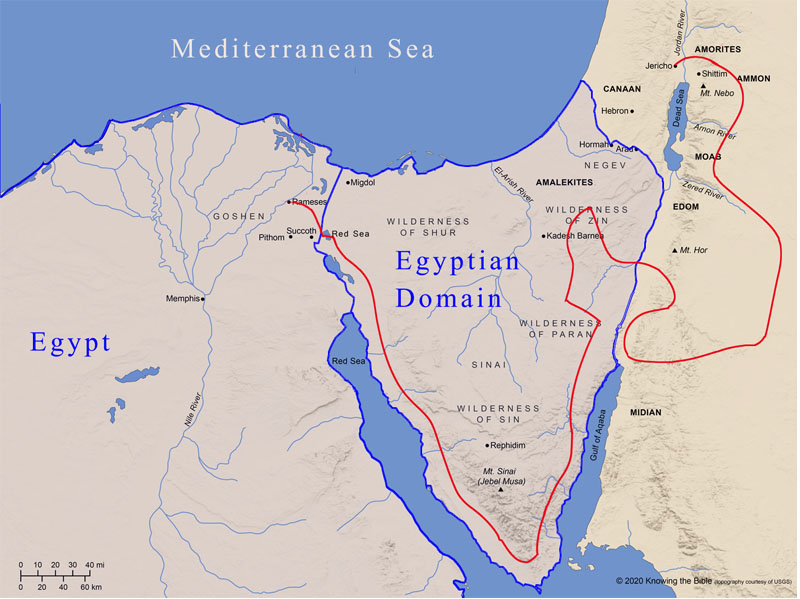
After Moses met Aaron and told him what had happened with him and the burning bush, they went on their journey to see the Pharaoh to deliver the message from God. 1 Afterward Moses and Aaron went in and told Pharaoh, "Thus says the Lord God of Israel: 'Let My people go, that they may hold a feast to Me in the wilderness.' " Moses and Aaron were representatives of the Hebrews, therefore, they were entitled to seek an audience with Pharoah. Moses would have known the custom since he was raised by Egyptians. The initial request is for the Israelites to go to the wilderness for a three day feast as was a custom of the Hebrews. The Hebrews hold a feast to the Lord and then would offer animal sacrifices as a way for His people to temporarily atone for their sins and draw nearer to Him. Even the polytheistic Egyptians held ceremonies to honor their gods so this should not have been such a reasonable request. However, because they sacrificed animals what were regarded as sacred to the Egyptians, their could not freely excercise their religion without violating their laws. 2 And Pharaoh said, "Who is the Lord, that I should obey His voice to let Israel go? I do not know the Lord, nor will I let Israel go." Considering that Pharaoh considered himself a god, he refused to acknowledge that there was any other God that would be mightier than himself. The Egyptians celebrated many gods and the Hebrew God wasn't one of them. He immediately hardened his heart against God and Israel. 3 So they said, "The God of the Hebrews has met with us. Please, let us go three days' journey into the desert and sacrifice to the Lord our God, lest He fall upon us with pestilence or with the sword." They ask for permission, giving Pharaoh a chance to grant their request. The land of Goshen where the Hebrews lived, bordered Canaan where Hittite incursions were especially feared. Aaron communicated that their God could punish His people by sending a plague or employ the Hittites as the punishment if they neglected their worship. 4 Then the king of Egypt said to them, "Moses and Aaron, why do you take the people from their work? Get back to your labor." And Pharaoh said, "Look, the people of the land are many now, and you make them rest from their labor!" The bottom line is that Pharoah was afraid of the Hebrew either rebelling or uniting with the Hittites and invade Egypt. Pharoah knew of the attempts to control the population earlier, when the previous Pharoah had all the male Hebrew babies killed. Yet he refused to give in to their requests. The Egyptians became accustomed to having the Hebrews do the manual labor. Losing them would be devistating to their economy. 6 So the same day Pharaoh commanded the taskmasters of the people and their officers, saying, "You shall no longer give the people straw to make brick as before. Let them go and gather straw for themselves. And you shall lay on them the quota of bricks which they made before. You shall not reduce it. For they are idle; therefore they cry out, saying, 'Let us go and sacrifice to our God.' Let more work be laid on the men, that they may labor in it, and let them not regard false words." Taskmasters were Egyptians who were in charge of seeing that the slaves produced the required amount of bricks the Pharoah had mandated. The officers were Hebrews placed over their brethren, under the taskmasters. They were accountable each man's work that was under their supervision. A picture representing the Hebrews on a brick field, exactly as described in this chapter, was found in an Egyptian tomb. Ancient bricks are nearly all stamped with the name of a king. They were made of clay mixed with chopped straw and dried or hardened in the sun. Pharaoh ordered to them to gather their own straw implies that they were given straw prior to this and now they had extra work piled upon them. 10 And the taskmasters of the people and their officers went out and spoke to the people, saying, "Thus says Pharaoh: 'I will not give you straw. Go, get yourselves straw where you can find it; yet none of your work will be reduced.' " So the people were scattered abroad throughout all the land of Egypt to gather stubble instead of straw. And the taskmasters forced them to hurry, saying, "Fulfill your work, your daily quota, as when there was straw." Also the officers of the children of Israel, whom Pharaoh's taskmasters had set over them, were beaten and were asked, "Why have you not fulfilled your task in making brick both yesterday and today, as before?" Stubble is the stalks left behind where grain was threshed. Without being provided with straw, the Hebrews were expected to spend time traveling on foot looking for the stubble. Not only did they have to make bricks, but they had to chop it to the right size for brick-making. Then they were expected to meet the quota set previously. 15 Then the officers of the children of Israel came and cried out to Pharaoh, saying, "Why are you dealing thus with your servants? There is no straw given to your servants, and they say to us, 'Make brick!' And indeed your servants are beaten, but the fault is in your own people." The Hebrew officers were being accused of negligence. They appealed to Pharoah as to why such unfair standards have been levied upon them. Since they are responsible for their crew, they would receive the punishment when they could not meet the quota. Their beatings are unjustified. 17 But he said, "You are idle! Idle! Therefore you say, 'Let us go and sacrifice to the Lord.' Therefore go now and work; for no straw shall be given you, yet you shall deliver the quota of bricks." And the officers of the children of Israel saw that they were in trouble after it was said, "You shall not reduce any bricks from your daily quota." Then, as they came out from Pharaoh, they met Moses and Aaron who stood there to meet them. And they said to them, "Let the Lord look on you and judge, because you have made us abhorrent in the sight of Pharaoh and in the sight of his servants, to put a sword in their hand to kill us." Idleness was considered one of the worst sins in Egyptian society. Pharoah repeated Idle twice to show his utter disdain for both the Hebrews and the God whom they desired to serve. The officers soon realized that nothing they said to Pharoah would help them.They were afraid that they would now be executed for their disobedience. So they turned to Moses and Aaron and blamed them for the injustice that was put upon them rather than humbling themselves before God. 22 So Moses returned to the Lord and said, "Lord, why have You brought trouble on this people? Why is it You have sent me? For since I came to Pharaoh to speak in Your name, he has done evil to this people; neither have You delivered Your people at all." In spite of God's warnings that there would be several unsuccessful attempts before they would be set free, Moses did not expect the evil treatment that was inflicted on his people as a result of his actions. God often allows things to get worse before they get better. This pattern is seen throughout the scriptures. In the end times, the world will be in utter caos before peace rules. When everything is said and done, God wants us to know Him, and to know that He carrying us through the tough times. Bible Study Questions 1. What was the first request Moses made to Pharoah?
2. What was Pharoah's reaction to Moses request?
3. Who were the taskmasters?
4. What did Pharoah deny the people?
5. Where did the Israelites get stubble? 6. What happened to the officers when they pleaded with Pharoah?
7. What did Pharoah say to the Officers?
8. What did the officers say to Moses and Aaron?
9. What did Moses say to the Lord?
10. Since Moses spoke in God's name to Pharoah...
|
| Cassie, Matt, Sue, Kelly | |