Exodus 4 – Signs for Moses
Timeline: 1450 BC
|
|
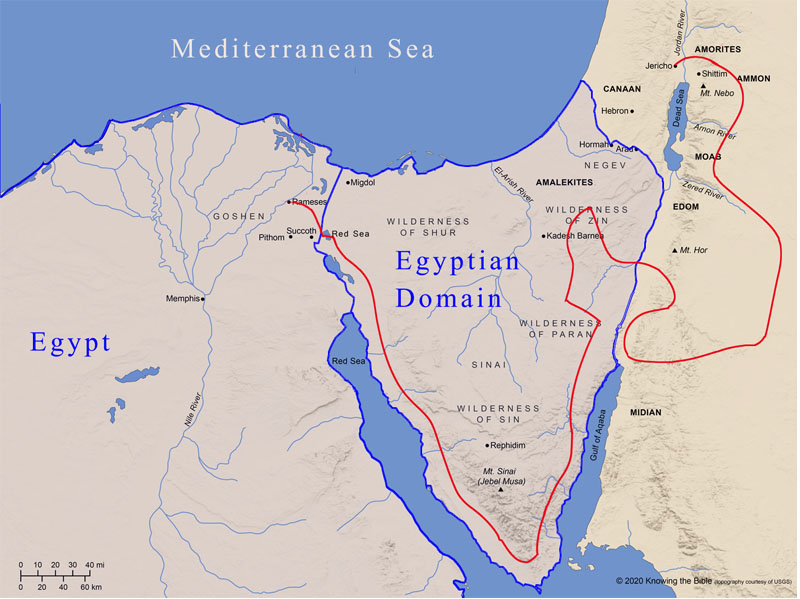
In the last chapter, Moses gave his first excuse for not wanting to go to deliver his people from captivity. "Who am I that I should go to Pharoah...?" Moses grew up in Egypt. He was being groomed to become a Pharoah himself before he left Egypt. So why wouldn't he be perfect for the job? Exodus 4:1 Then Moses answered and said, "But suppose they will not believe me or listen to my voice; suppose they say, 'The Lord has not appeared to you.' " Excuse number two: They rejected him before, why should they believe him now? Besides, God had not appeared to any one for four hundred years. Imagine if someone today says, "The Lord spoke to me from a burning bush." Who would believe him? Exodus 4:2 So the Lord said to him, "What is that in your hand?" He said, "A rod." The rod seems to be a shepherds hook or a walking-stick. The Lord knew exactly was in Moses' hand but He wanted to draw his attention to the miracle He was about to perform. Exodus 4:3 And He said, "Cast it on the ground." So he cast it on the ground, and it became a serpent; and Moses fled from it. Then the Lord said to Moses, "Reach out your hand and take it by the tail" (and he reached out his hand and caught it, and it became a rod in his hand), "that they may believe that the Lord God of their fathers, the God of Abraham, the God of Isaac, and the God of Jacob, has appeared to you." The serpent was probably a Cobra, which was the symbol of royal and divine power on the diadem (crown) of every Pharaoh. Exodus 4:6 Furthermore the Lord said to him, "Now put your hand in your bosom." And he put his hand in his bosom, and when he took it out, behold, his hand was leprous, like snow. And He said, "Put your hand in your bosom again." So he put his hand in his bosom again, and drew it out of his bosom, and behold, it was restored like his other flesh. "Then it will be, if they do not believe you, nor heed the message of the first sign, that they may believe the message of the latter sign. Each of the first two signs had to do with transformation. God turned an inanimate object (a stick) into a snake and caused a healthy hand to be leprous. Both were restored to their original state. Exodus 4:9 And it shall be, if they do not believe even these two signs, or listen to your voice, that you shall take water from the river and pour it on the dry land. The water which you take from the river will become blood on the dry land." If the miracles of transformation did not turn the hearts of the people, then perhaps the sign of judgment would. Exodus 4:10 Then Moses said to the Lord, "O my Lord, I am not eloquent, neither before nor since You have spoken to Your servant; but I am slow of speech and slow of tongue."
During his 40 years in Egypt, Moses would have spoken Late Egyptian. This was an Afro-Asiatic language used in everyday life. A phenomenon exists called "native language attrition." It is a gradual decline in the proficiency of ones' native language when they are removed from their native environment. After spending so much time in Midian, where Hebrew would have been the spoken language, Moses probably struggled with "tip-of-the-tongue" moments, pause more frequently or unknowingly adopt the grammatical structures of their new foreign language. Thus he lost his confidence in being able to appear before the Pharaoh. He felt his Hebrew was no longer fluent enough to address the Pharaoh and the Israelites. Exodus 4:11 So the Lord said to him, "Who has made man's mouth? Or who makes the mute, the deaf, the seeing, or the blind? Have not I, the Lord? Now therefore, go, and I will be with your mouth and teach you what you shall say." Jewish tradition had understood the dumbness, deafness, and muteness to refer to the hardened heart of man, and not to non-functioning physiological parts of the body (ears, eyes, voice).The deafness, muteness, and blindness created by the Lord are not physical, but moral and spiritual handicaps. Psalms 115:5-6a They have mouths, but they do not speak; Eyes they have, but they do not see; They have ears, but they do not hear; Exodus 4:13 But he said, "O my Lord, please send by the hand of whomever else You may send." Moses is very reluctant toward what God has asked him to do. Perhaps it was his fear of facing those who would remember what he did before he left Egypt. Whatever his reason, he made one last excuse in an attempt to dodge God's mission for him. Exodus 4:14 So the anger of the Lord was kindled against Moses, and He said: "Is not Aaron the Levite your brother? I know that he can speak well. And look, he is also coming out to meet you. When he sees you, he will be glad in his heart. Aaron was born three years before Moses. His destiny was to become the first of the tribe of Levi that was employed in the priestly office. Evidently, Aaron had both the ability and willingness to speak. So God made arrangements for Aaron to come to meet with Moses (v 27). Exodus 4:15 Now you shall speak to him and put the words in his mouth. And I will be with your mouth and with his mouth, and I will teach you what you shall do. So he shall be your spokesman to the people. And he himself shall be as a mouth for you, and you shall be to him as God. Moses would give God's words to Aaron and Aaron would deliver them to the people. Exodus 4:17 And you shall take this rod in your hand, with which you shall do the signs." Not any rod, but the particular one which had already once become a serpent. This rod is now endowed with the power to do wondrous things, meaning the ten plagues inflicted on Egypt. Resigned to the fact that he was going to complete his task, Moses returned to Midian to ask Jethro's permission to leave as an expression of respect and also to get his family. Exodus 4:18 So Moses went and returned to Jethro his father-in-law, and said to him, "Please let me go and return to my brethren who are in Egypt, and see whether they are still alive." And Jethro said to Moses, "Go in peace." Now the Lord said to Moses in Midian, "Go, return to Egypt; for all the men who sought your life are dead." Then Moses took his wife and his sons and set them on a donkey, and he returned to the land of Egypt. And Moses took the rod of God in his hand. After God had appeared in the bush, he often spoke to Moses. Earlier we learned Now it happened in the process of time that the king of Egypt died. (Exodus 2:23) Pharoah is not one single king in Exodus. It is a title given to the one in charge. In addition, anyone who was involved in the search for Moses had died as well so Moses was free of that fear. Exodus 4:21 And the Lord said to Moses, "When you go back to Egypt, see that you do all those wonders before Pharaoh which I have put in your hand. But I will harden his heart, so that he will not let the people go. This particular Pharaoh places his own reputation and pride above the well-being of his own people. Pharaoh' heart was hardened to begin with. The cause of a hard, calloused, angry heart is a depraved heart that rebels against God especially after God has made Himself known. This is a prediction that after God reveals himself, Pharoah will still refuse and there is nothing that will change his mind. Exodus 4:22 Then you shall say to Pharaoh, 'Thus says the Lord: "Israel is My son, My firstborn. So I say to you, let My son go that he may serve Me. But if you refuse to let him go, indeed I will kill your son, your firstborn."' Pharoahs were referred to as the son of their imagined sun god, Ra and the mediator between the gods and humankind. The reason Moses was to give this message was so that the Pharoah could understand vividly the consequences of his refusal. These next passages are considered to be some of the most obscure passages in Scripture. Some biblical stories were told in a shorthand manner because they were once well known and it was therefore unnecessary for the narrator to fill in the details. However, that leaves us guessing. Richard Cohen, a Jewish Rabbi, has a possible explanation here. Notice that up to this point, only one son has been mentioned – Gershom. His other son, Eliezer, is not mentioned until later. Exodus 4:24 And it came to pass on the way, at the encampment, that the Lord met him and sought to kill him. Then Zipporah took a sharp stone and cut off the foreskin of her son and cast it at Moses' feet, and said, "Surely you are a husband of blood to me!" So He let him go. Then she said, "You are a husband of blood!"—because of the circumcision. We are told that God met him and sought to kill him, but we are not told to whom this refers. A sharp stone was used since it was regarded as purer and more sacred material than metal. Once Zipporah completed the circumcision, she cast the foreskin "at Moses' feet". God "let him go", assuming that He was referring to Eliezer. The phrase "You are a husband of blood!" has sometimes been explained as "You should have been the circumciser, not me!" Whatever the explanation of these verses, one thing is clear. Just as Rebekah, obeyed God when Isaac was supposed to get the blessing over Esau, she took it upon herself to order Jacob to deceive her husband into fulfilling God's plan, so Zipporah corrected the situation by stepping in and obeying God's law of circumcision. Moses sent Zipporah and her children back to Jethro before he went to Egypt. (See Exodus 18:1-6) Exodus 4:27 And the Lord said to Aaron, "Go into the wilderness to meet Moses." So he went and met him on the mountain of God, and kissed him. So Moses told Aaron all the words of the Lord who had sent him, and all the signs which He had commanded him. Then Moses and Aaron went and gathered together all the elders of the children of Israel. And Aaron spoke all the words which the Lord had spoken to Moses. Then he did the signs in the sight of the people. So the people believed; and when they heard that the Lord had visited the children of Israel and that He had looked on their affliction, then they bowed their heads and worshiped. While God was giving Moses his instructions, He was also speaking to Aaron. Moses began his journey to Egypt when he met Aaron on 'The mountain of God' which is the name used for Mt. Sinai. Together they continued to speak to the the elders and used the rod to perform the miracles God had given him. So they believed and worshipped God. Bible Study Questions 1. How many miracles did God give to Moses?
2. What was in Moses' hand?
3. What happened when Moses put his hand into his bosom?
4. What happened to the water when Moses poured it on dry land? 5. What did Moses say when he replied "I am not eloquent"?
6. What did God say Aaron would do for Moses?
7. What did Moses say to Jethro about why he wanted to go to Egypt?
8. What did Zipporah do to her son?
9. What did the Lord say to Aaron?
10. What made the Elders believe Moses was actually visited by God?
|
| Cassie, Matt, Sue | |