Exodus 36-39
Timeline: 1450 BC
|
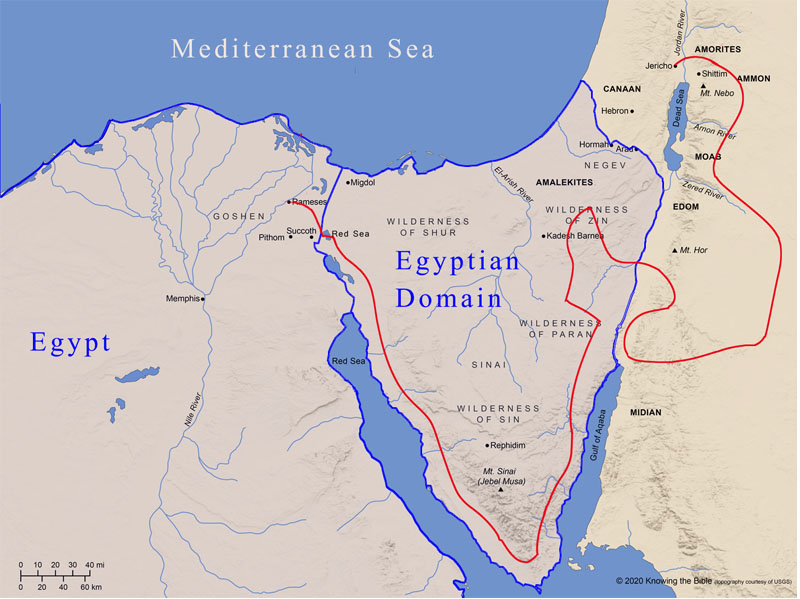
Israelite Journeys Rameses
|
Chapter 36 In Exodus 19-24 God spoke to Moses about the covenant that was made between Himself and the people of Israel. These verses were written from the perspective of God dictating the divine design to Moses. Precise details are given for each element of the tabernacle. God clearly stated his intent to dwell with his people in Ex 25:8 and 29:45-46. When Moses didn't return immediately from up on the mountain, the people broke the covenant by making a golden calf and offering sacrifices before it. Moses attempted to make atonement for them and God granted Moses's request and repaired the covenant. God told Moses he would not go with them but would send His Angel. In Chapters 35-39, the perspective shifts from instruction to construction. God renewed the covenant and because of Moses' faith, agreed to go with them again. The grateful community of Israelites actively gathered materials and started the building process. The construction began exactly where the instructions left off: The Sabbath.
Exodus36:1 "And Bezalel and Aholiab, and every gifted artisan in whom the Lord has put wisdom and understanding, to know how to do all manner of work for the service of the sanctuary, shall do according to all that the Lord has commanded." The Lord gave wisdom and understanding to Bezalel and Aholiab to be the design directors of the project that took six months to build. They also had the gift of administration to directed the children of Israel during the construction. Then Moses called Bezalel and Aholiab, and every gifted artisan in whose heart the Lord had put wisdom, everyone whose heart was stirred, to come and do the work. And they received from Moses all the offering which the children of Israel had brought for the work of the service of making the sanctuary. So they continued bringing to him freewill offerings every morning. Then all the craftsmen who were doing all the work of the sanctuary came, each from the work he was doing, and they spoke to Moses, saying, "The people bring much more than enough for the service of the work which the Lord commanded us to do." Moses gave all the materials to the workers and instructed them to begin. The craftsmen worked with readiness and zeal. Moses gave them the materials he had collected which were arriving on a daily basis. (See Exodus Chapter 25) Exodus36:6 So Moses gave a commandment, and they caused it to be proclaimed throughout the camp, saying, "Let neither man nor woman do any more work for the offering of the sanctuary." And the people were restrained from bringing, for the material they had was sufficient for all the work to be done—indeed too much. The fact that the work had commenced did not stop the inflow of gifts. Every morning the people brought an abundance of materials. The craftsmen went to Moses and told him they had more than enough. The generosity of the people was overwhelming. At last it became clear that the supply had exceeded the demand so Moses commanded that the offerings should cease. Throughout the following verses, "he" is mentioned referring to the individuals who did that particular work. Curtains for the Tabernacle Exodus36:8 Then all the gifted artisans among them who worked on the tabernacle made ten curtains woven of fine linen, and of blue, purple, and scarlet thread; with artistic designs of cherubim they made them. The length of each curtain was twenty-eight cubits, and the width of each curtain four cubits; the curtains were all the same size. And he coupled five curtains to one another, and the other five curtains he coupled to one another. He made loops of blue yarn on the edge of the curtain on the selvedge of one set; likewise he did on the outer edge of the other curtain of the second set. Fifty loops he made on one curtain, and fifty loops he made on the edge of the curtain on the end of the second set; the loops held one curtain to another. And he made fifty clasps of gold, and coupled the curtains to one another with the clasps, that it might be one tabernacle. Exodus36:14 He made curtains of goats' hair for the tent over the tabernacle; he made eleven curtains. The length of each curtain was thirty cubits, and the width of each curtain four cubits; the eleven curtains were the same size. He coupled five curtains by themselves and six curtains by themselves. And he made fifty loops on the edge of the curtain that is outermost in one set, and fifty loops he made on the edge of the curtain of the second set. He also made fifty bronze clasps to couple the tent together, that it might be one. Then he made a covering for the tent of ram skins dyed red, and a covering of badger skins above that. (See Exodus Chapter 26) The Frames and Bases Exodus36:20 For the tabernacle he made boards of acacia wood, standing upright. The length of each board was ten cubits, and the width of each board a cubit and a half. Each board had two tenons for binding one to another. Thus he made for all the boards of the tabernacle. And he made boards for the tabernacle, twenty boards for the south side. Forty sockets of silver he made to go under the twenty boards: two sockets under each of the boards for its two tenons. And for the other side of the tabernacle, the north side, he made twenty boards and their forty sockets of silver: two sockets under each of the boards. For the west side of the tabernacle he made six boards. He also made two boards for the two back corners of the tabernacle. And they were coupled at the bottom and coupled together at the top by one ring. Thus he made both of them for the two corners. So there were eight boards and their sockets—sixteen sockets of silver—two sockets under each of the boards. (See Exodus Chapter 26) Exodus36:31 And he made bars of acacia wood: five for the boards on one side of the tabernacle, five bars for the boards on the other side of the tabernacle, and five bars for the boards of the tabernacle on the far side westward. And he made the middle bar to pass through the boards from one end to the other. He overlaid the boards with gold, made their rings of gold to be holders for the bars, and overlaid the bars with gold. (See Exodus Chapter 26) The Veil Exodus36:35 And he made a veil of blue, purple, and scarlet thread, and fine woven linen; it was worked with an artistic design of cherubim. He made for it four pillars of acacia wood, and overlaid them with gold, with their hooks of gold; and he cast four sockets of silver for them. (See Exodus Chapter 26) The Curtain for the Entrance Exodus36:37 He also made a screen for the tabernacle door, of blue, purple, and scarlet thread, and fine woven linen, made by a weaver, and its five pillars with their hooks. And he overlaid their capitals and their rings with gold, but their five sockets were bronze. (See Exodus Chapter 26) Chapter 37 Ark of the Testimony Exodus37:1 Then Bezalel made the ark of acacia wood; two and a half cubits was its length, a cubit and a half its width, and a cubit and a half its height. He overlaid it with pure gold inside and outside, and made a molding of gold all around it. And he cast for it four rings of gold to be set in its four corners: two rings on one side, and two rings on the other side of it. He made poles of acacia wood, and overlaid them with gold. And he put the poles into the rings at the sides of the ark, to bear the ark. He also made the mercy seat of pure gold; two and a half cubits was its length and a cubit and a half its width. He made two cherubim of beaten gold; he made them of one piece at the two ends of the mercy seat: one cherub at one end on this side, and the other cherub at the other end on that side. He made the cherubim at the two ends of one piece with the mercy seat. The cherubim spread out their wings above, and covered the mercy seat with their wings. They faced one another; the faces of the cherubim were toward the mercy seat. (See Exodus Chapter 25, Genesis 3) The Table for the Showbread Exodus37:10 He made the table of acacia wood; two cubits was its length, a cubit its width, and a cubit and a half its height. And he overlaid it with pure gold, and made a molding of gold all around it. Also he made a frame of a handbreadth all around it, and made a molding of gold for the frame all around it. And he cast for it four rings of gold, and put the rings on the four corners that were at its four legs. The rings were close to the frame, as holders for the poles to bear the table. And he made the poles of acacia wood to bear the table, and overlaid them with gold. He made of pure gold the utensils which were on the table: its dishes, its cups, its bowls, and its pitchers for pouring. (See Exodus Chapter 25) The Gold Lampstand Exodus37:17 He also made the lampstand of pure gold; of hammered work he made the lampstand. Its shaft, its branches, its bowls, its ornamental knobs, and its flowers were of the same piece. And six branches came out of its sides: three branches of the lampstand out of one side, and three branches of the lampstand out of the other side. There were three bowls made like almond blossoms on one branch, with an ornamental knob and a flower, and three bowls made like almond blossoms on the other branch, with an ornamental knob and a flower—and so for the six branches coming out of the lampstand. And on the lampstand itself were four bowls made like almond blossoms, each with its ornamental knob and flower. There was a knob under the first two branches of the same, a knob under the second two branches of the same, and a knob under the third two branches of the same, according to the six branches extending from it. Their knobs and their branches were of one piece; all of it was one hammered piece of pure gold. And he made its seven lamps, its wick-trimmers, and its trays of pure gold. Of a talent of pure gold he made it, with all its utensils. (See Exodus Chapter 25) The Altar of Incense Exodus37:25 He made the incense altar of acacia wood. Its length was a cubit and its width a cubit—it was square—and two cubits was its height. Its horns were of one piece with it. And he overlaid it with pure gold: its top, its sides all around, and its horns. He also made for it a molding of gold all around it. He made two rings of gold for it under its molding, by its two corners on both sides, as holders for the poles with which to bear it. And he made the poles of acacia wood, and overlaid them with gold. Exodus37:29 He also made the holy anointing oil and the pure incense of sweet spices, according to the work of the perfumer. (See Exodus Chapter 30) Chapter 38 The Bronze Altar of Burnt Offering Exodus38:1 He made the altar of burnt offering of acacia wood; five cubits was its length and five cubits its width—it was square—and its height was three cubits. He made its horns on its four corners; the horns were of one piece with it. And he overlaid it with bronze. He made all the utensils for the altar: the pans, the shovels, the basins, the forks, and the firepans; all its utensils he made of bronze. And he made a grate of bronze network for the altar, under its rim, midway from the bottom. He cast four rings for the four corners of the bronze grating, as holders for the poles. And he made the poles of acacia wood, and overlaid them with bronze. Then he put the poles into the rings on the sides of the altar, with which to bear it. He made the altar hollow with boards. (See Exodus Chapter 27) The Bronze Laver Exodus38:8 He made the laver of bronze and its base of bronze, from the bronze mirrors of the serving women who assembled at the door of the tabernacle of meeting. (See Exodus Chapter 30) The Court of the Tabernacle Exodus38:9 Then he made the court on the south side; the hangings of the court were of fine woven linen, one hundred cubits long. There were twenty pillars for them, with twenty bronze sockets. The hooks of the pillars and their bands were silver. On the north side the hangings were one hundred cubits long, with twenty pillars and their twenty bronze sockets. The hooks of the pillars and their bands were silver. And on the west side there were hangings of fifty cubits, with ten pillars and their ten sockets. The hooks of the pillars and their bands were silver. For the east side the hangings were fifty cubits. The hangings of one side of the gate were fifteen cubits long, with their three pillars and their three sockets, and the same for the other side of the court gate; on this side and that were hangings of fifteen cubits, with their three pillars and their three sockets. All the hangings of the court all around were of fine woven linen. The sockets for the pillars were bronze, the hooks of the pillars and their bands were silver, and the overlay of their capitals was silver; and all the pillars of the court had bands of silver. The screen for the gate of the court was woven of blue, purple, and scarlet thread, and of fine woven linen. The length was twenty cubits, and the height along its width was five cubits, corresponding to the hangings of the court. And there were four pillars with their four sockets of bronze; their hooks were silver, and the overlay of their capitals and their bands was silver. All the pegs of the tabernacle, and of the court all around, were bronze. (See Exodus Chapter 27) Exodus38:21 This is the inventory of the tabernacle, the tabernacle of the Testimony, which was counted according to the commandment of Moses, for the service of the Levites, by the hand of Ithamar, son of Aaron the priest. The term 'Testimony' refers to the covenant relationship between God and Israel. The core purpose of the tabernacle was to provide a place for the Israelites to meet with God. The Levites were responsible for the care and protection of the tabernacle. Aaron's youngest son, Ithamar was in charge not only of counting and entering the inventory but also to ascertain their weight and to estimate their worth. Exodus38:22 Bezalel the son of Uri, the son of Hur, of the tribe of Judah, made all that the Lord had commanded Moses. And with him was Aholiab the son of Ahisamach, of the tribe of Dan, an engraver and designer, a weaver of blue, purple, and scarlet thread, and of fine linen. Bezalel was from the tribe of Judah, Oholiab was from the tribe of Dan. In the order of march of Israel, Judah lead the procession, he was beginning and Dan was at the end. They represented all of Israel. God inspired Bezalel and Oholiab to teach the other craftsmen who had been given special skill by God to work with the raw materials and to form the artistic designs. Together, they were able to complete the tabernacle according to God's specifications Exodus38:24 All the gold that was used in all the work of the holy place, that is, the gold of the offering, was twenty-nine talents and seven hundred and thirty shekels, according to the shekel of the sanctuary. And the silver from those who were numbered of the congregation was one hundred talents and one thousand seven hundred and seventy-five shekels, according to the shekel of the sanctuary: a bekah for each man (that is, half a shekel, according to the shekel of the sanctuary), for everyone included in the numbering from twenty years old and above, for six hundred and three thousand, five hundred and fifty men. And from the hundred talents of silver were cast the sockets of the sanctuary and the bases of the veil: one hundred sockets from the hundred talents, one talent for each socket. Then from the one thousand seven hundred and seventy-five shekels he made hooks for the pillars, overlaid their capitals, and made bands for them. It literally took a ton of gold to make the tabernacle: Gold weighed about 2,193 Pounds. – Today's price – $58,225,728.96 Exodus38:29 The offering of bronze was seventy talents and two thousand four hundred shekels. And with it he made the sockets for the door of the tabernacle of meeting, the bronze altar, the bronze grating for it, and all the utensils for the altar, the sockets for the court all around, the bases for the court gate, all the pegs for the tabernacle, and all the pegs for the court all around. They offered about 5254 pounds. Bronze was only worth about $2 per pound in today's market. Total Price of the Tabernacle and all in it in today's dollars: $62,155,646.16 ($62.126 MILLION dollars). Chapter 39 Exodus39:1 Of the blue, purple, and scarlet thread they made garments of ministry, for ministering in the holy place, and made the holy garments for Aaron, as the Lord had commanded Moses. Making the Ephod Exodus39:2 He made the ephod of gold, blue, purple, and scarlet thread, and of fine woven linen. And they beat the gold into thin sheets and cut it into threads, to work it in with the blue, purple, and scarlet thread, and the fine linen, into artistic designs. They made shoulder straps for it to couple it together; it was coupled together at its two edges. And the intricately woven band of his ephod that was on it was of the same workmanship, woven of gold, blue, purple, and scarlet thread, and of fine woven linen, as the Lord had commanded Moses. Exodus39:6 And they set onyx stones, enclosed in settings of gold; they were engraved, as signets are engraved, with the names of the sons of Israel. He put them on the shoulders of the ephod as memorial stones for the sons of Israel, as the Lord had commanded Moses. (See Exodus Chapter 28) Making the Breastplate Exodus39:8 And he made the breastplate, artistically woven like the workmanship of the ephod, of gold, blue, purple, and scarlet thread, and of fine woven linen. They made the breastplate square by doubling it; a span was its length and a span its width when doubled. And they set in it four rows of stones: a row with a sardius, a topaz, and an emerald was the first row; the second row, a turquoise, a sapphire, and a diamond; the third row, a jacinth, an agate, and an amethyst; the fourth row, a beryl, an onyx, and a jasper. They were enclosed in settings of gold in their mountings. There were twelve stones according to the names of the sons of Israel: according to their names, engraved like a signet, each one with its own name according to the twelve tribes. And they made chains for the breastplate at the ends, like braided cords of pure gold. They also made two settings of gold and two gold rings, and put the two rings on the two ends of the breastplate. And they put the two braided chains of gold in the two rings on the ends of the breastplate. The two ends of the two braided chains they fastened in the two settings, and put them on the shoulder straps of the ephod in the front. And they made two rings of gold and put them on the two ends of the breastplate, on the edge of it, which was on the inward side of the ephod. They made two other gold rings and put them on the two shoulder straps, underneath the ephod toward its front, right at the seam above the intricately woven band of the ephod. And they bound the breastplate by means of its rings to the rings of the ephod with a blue cord, so that it would be above the intricately woven band of the ephod, and that the breastplate would not come loose from the ephod, as the Lord had commanded Moses. (See Exodus Chapter 28) Other Priestly Garments Exodus39:22 He made the robe of the ephod of woven work, all of blue. And there was an opening in the middle of the robe, like the opening in a coat of mail, with a woven binding all around the opening, so that it would not tear. They made on the hem of the robe pomegranates of blue, purple, and scarlet, and of fine woven linen. And they made bells of pure gold, and put the bells between the pomegranates on the hem of the robe all around between the pomegranates: a bell and a pomegranate, a bell and a pomegranate, all around the hem of the robe to minister in, as the Lord had commanded Moses. Exodus39:27 They made tunics, artistically woven of fine linen, for Aaron and his sons, a turban of fine linen, exquisite hats of fine linen, short trousers of fine woven linen, and a sash of fine woven linen with blue, purple, and scarlet thread, made by a weaver, as the Lord had commanded Moses. Exodus39:30 Then they made the plate of the holy crown of pure gold, and wrote on it an inscription like the engraving of a signet: HOLINESS TO THE LORD. Exodus39:31 And they tied to it a blue cord, to fasten it above on the turban, as the Lord had commanded Moses. (See Exodus Chapter 28) The Work Completed Seven months after the Israelites left Egypt the tent and its furnishings were complete. They brought all the parts before it was put together so Moses could carefully inspect the whole. Moses determined that everything was done in accordance to the instructions given by God. Being satisfied, he expressed his own and God's approval by blessing the people for their liberal contribution, and the workmen for their great care and industry. Exodus39:32 Thus all the work of the tabernacle of the tent of meeting was finished. And the children of Israel did according to all that the Lord had commanded Moses; so they did. And they brought the tabernacle to Moses, the tent and all its furnishings: its clasps, its boards, its bars, its pillars, and its sockets; the covering of ram skins dyed red, the covering of badger skins, and the veil of the covering; the ark of the Testimony with its poles, and the mercy seat; the table, all its utensils, and the showbread; the pure gold lampstand with its lamps (the lamps set in order), all its utensils, and the oil for light; the gold altar, the anointing oil, and the sweet incense; the screen for the tabernacle door; the bronze altar, its grate of bronze, its poles, and all its utensils; the laver with its base; the hangings of the court, its pillars and its sockets, the screen for the court gate, its cords, and its pegs; all the utensils for the service of the tabernacle, for the tent of meeting; and the garments of ministry, to minister in the holy place: the holy garments for Aaron the priest, and his sons' garments, to minister as priests. Exodus39:42 According to all that the Lord had commanded Moses, so the children of Israel did all the work. Then Moses looked over all the work, and indeed they had done it; as the Lord had commanded, just so they had done it. And Moses blessed them. Three men were working hard, breaking large stones into smaller ones. A passerby got curious and stopped to ask them what they were doing. The first workman looked up briefly and said curtly, "I'm working" and went back to his work. Not satisfied with the answer, the onlooker asked the second laborer the same question. "Can't you see, I'm breaking stones" he replied. This still did not quench the bystander's curiosity so he asked the third worker the purpose of their work. "I'm building a castle" replied this workman smilingly. The Israelites went from slaves who were building cities and storage depots for Pharaoh in Egypt to creating a dwelling place for God. This story illustrates that purpose has the power to transform not only our attitude about the work that we do, but the quality of our work as well.
Bible Study Questions 1. How did every gifted artisan know how to do all manner of work for the service of the sanctuary? 1. They learned from Bezalel and Aholiab. 2. How often did the people bring Moses freewill offerings? 1. Every morning. 3.Why were the men and women told to stop bringing offerings? 1. They ran out of materials. 4. What was made first? 1. The curtains. 5. Who took inventory of the tabernacle? 1. Aholiab, son of Moses. 6. What was counted in the inventory? 1. Gold, silver and bronze. 7. What did the Garments of the High Priest include? 1. A breastplate, an ephod, a robe and a tunic. 8. What was engraved on the plate of the holy crown? 1. HOLINESS TO THE LORD 9. What did the children of Israel do with the tent and all its furnishings when they were done? 1. They celebrated with a feast to the Lord. 10. Once all the work had been completed, what did Moses do? 1. He dismissed the children of Israel. |
| Cassie, Matt, Joe | |